Rethinking the Group Job Interview – Consensus? Abdication? Or Focus Group?
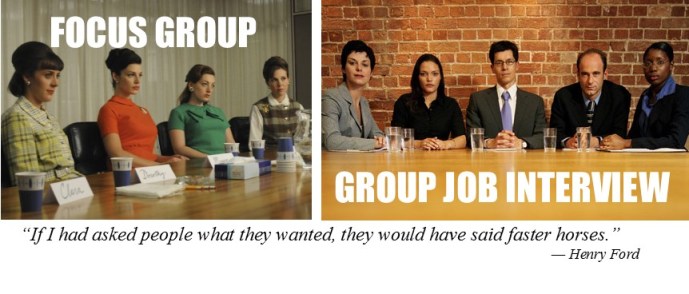
I’ve tortured people in the group interview process. I thought I was offering consensus. Buy-in. Group drive.
I was wrong.
Wrong. Wrong. Wrong.
Oh, so wrong.
To everyone I’ve ever put through that, on either side of the table, I apologize. I’ll never do it again. Promise.
There are four decisions: autocratic (I say), consultative (I say with your input), democratic (we vote, losers weep), consensus (we vote and everyone backs the decision).
As practiced, the group interview might have evolved into a method for managers to abdicate responsibility in the name of consensus. While consensus is ideal, the group-think process can too often be dominated by a crank in the corner with issues, motives, and insecurities. And, possibly, an unknown agenda.
Group-think promises consensus but can preclude innovation.
And why would you ever choose to preclude innovation?
Disinterested Advocacy: When Issues Become Global, the Pool for Support Grows Exponentially

Women’s issues are not about women. Race issues are not about people of color.
And when Mars attacks Oklahoma, the issues will not be about Oklahoma.
I visited a domestic abuse nonprofit. They do great work, but are ghettoized by donors as a “women’s issue” charity. The executive director wondered how they might be able to globalize the cause (and increase revenues).
“Domestic abuse is a societal problem,” she complained. “And I worry that without some men providing disinterested advocacy, we’ll only attract women donors.”
But every time she interviewed qualified men for marketing or development positions (and they’d graduate to a final 10-on-1 group interview), the staff and board balked. “Just not a good fit,” they’d euphemize. And they’d recommend another qualified woman.
Is your charity’s issue exclusively yours? If not, how are you communicating that?
Hiring 103: Do Unto Others, for Pete’s Sake!

Oh, those shoddy, “industry standard” hiring practices. They’re still here.
To follow up on this, this, this, this and this,
1) Communicate quickly, at least twice.
- We got your resume.
- Thanks for your interest, but you are not being considered (within a week of close).
2) When you’ve interviewed someone, call them (no email) within a week.
- Thanks for your interest, but you are no longer being considered.
- We’re still interviewing people. I’ll call you on [date range].
3) When you’ve interviewed someone more than once and have hired someone else, call them (no email) immediately.
- Thanks for your interest, but we’ve chosen someone else.
4) Never…
- …send communications stating who you’ve hired (salt, meet wound)
- …let them know they were in the final cut (see above)
- …say you’ll be in touch and then disappear.
- …be rude.
- …assume job-seekers are psychics.
I died this morning.

I was an energetic, charismatic, visionary leader.
I worked at least 60 hours a week.
The office is by turns chaotic and paralyzed.
Some are crying.
Some are ecstatic.
Outside the charity, most don’t care.
Not their problem.
Trustees are panicking. Staff members are traumatized.
Some are taking charge, Alexander Haig-style.
Others are forming committees to decide what to decide.
Still others are composing resignations.
Reporter on line 1.
I knew every board and staff member.
And their families.
I knew every major donor.
I knew local foundation leaders.
Benefactors on line 2.
Beneficiaries on line 3.
I knew financials.
I knew history.
I had passwords.
Vendors on line 4.
I knew where everything was.
I shared that information.
But that was 5 years ago.
To employees who are no longer here.
Too bad there wasn’t a written succession policy.
Not my problem.
Hiring 102: Breaking the Code on Ageism (We’re on to You.)

You don’t have to be Alan Turing to break the HR “can’t-ask-how-old-you-are” code:
“How is your energy level?” = “Are you a geezer?”
…Correct response: “I run 26 marathons daily.”
“What were you doing before 2001?” = “What were you doing before I turned 10?”
…Correct response: “I’m 35 years old with 30 years’ experience.”
“When did you graduate college?” = “I’m checking my arithmetic to determine your age.”
…Correct response: “When I was 22.”
“How flexible are you?” = “Is your mind as ossified as a petrified fossil?”
…Correct response: “I’m currently holding the phone with my pinkie toe while simultaneously writing Iraq’s new constitution.”
Seriously, though, hiring managers: according to the US Bureau of Labor Statistics, workers 45–64 stayed twice as long as those 25–34 — so those under 40 are a much higher risk of leaving you high and dry.
So stop it.
Sustainability is Neither Reaching for Relevance nor Selling Out. It’s More Important than That.

The art of sustainability in arts charities is akin to performing a balance beam routine on a Ginsu knife. You can sacrifice mission for dollars or dollars for mission, but even if you maintain a perfect balance, there will still be substantial blood on both sides.
We talk way too much about relevance in the arts. The tag in the back of the shirt is relevant for a description of content and washing instructions, but the design of the shirt can reveal personal characteristics of the wearer. Let’s aim higher. How about “integral”?
Integral arts charities are those that are so entwined with other charities that they become essential to the health of the community. “Integral” obviates this useless discussion of relevance and moves us to the more useful question:
How do the arts make communities thrive?
Jack and Jill: Why Smart Nonprofits Search for Interim Leadership

Executive Director Jack resigns.
Jack leads the committee to replace himself. The committee selects Jill.
Jill is not Jack.
Jill discovers too late that she been enlisted to follow Jack’s path rather than set her own.
After a year, not only is Jill unhappy, but trustees and employees resign.
After a second year, Jill resigns. Or is fired.
The reeling company hires Fred – who is neither Jack nor Jill.
Uneasy lies the head that breaks a crown.
Succession planning needn’t require permanence. It might be best to hire an interim leader from outside the organization (not a board member) while the permanent search is carefully executed.
Every organizational leader’s legacy ends the day the leader leaves. Which means it is never a good idea to have the outgoing director have a say on a permanent successor.
40 years in the Desert – Advice for Leaders Taking the Helm and Those Whose Helm is being Taken

Happy Passover. Story goes: Jews escaped slavery and spent 40 years finding “the Promised Land.”
A popular idea on why it took so long: the generation that escaped were slaves. The generation after that was prepared to lead the new world. People found leadership abilities only after shedding the slave mentality.
When a change in staff or board leadership occurs, it is incumbent upon the incumbent organizational leaders to adapt, not the other way around. You didn’t hire (or elect) a “new” former leader. You hired an exemplary individual with different (but complementary) values, aspirations, and ideas. Shed the mentality of an organization run by the previous leader. That culture vanished when that person left.
If you’re the new leader, remember that you were hired to lead on your terms. Your feet won’t fit in someone else’s footprints.
Seen on a sweatshirt while walking around Green Lake: “Change is good. You go first.”

Innovation is annoying. Instigation is even worse. I ought to know. I’ve been accused of both.
But when companies are stagnant (or failing), staying put is not an option.
Innovators and instigators can be difficult. Steve Jobs, Thomas Edison, and Henry Ford are/were not particularly “easy” people. Nor were César Chávez or Copernicus. Nor were many women who broke through glass ceilings.
Too often when things aren’t working, managers paralyze themselves by thinking without forensic analysis. For them, all they believe they need to do is to keep doing what they’re doing.
“We tried change,” they’ll tell you. “It didn’t work. All we have to do is work harder.”
Forensic analysis matters. The great leaders know that and use it to their competitive advantage. They may also consider change agency to be annoying – but also rewarding.
You’re faking it. You know you are. So why would you hire someone who knows less than you do?

Deep in your soul, you understand that you have no idea what you’re doing. You’ve been faking it for years.
You have years of experience and an important-sounding title. But you know the truth.
Now that it’s time to hire someone to report to you, who do you want?
“Someone young I can mold,” said an ED acquaintance recently. What he meant was, “Someone who won’t outshine me in front of my board.” Idiot.
“Someone who has fought the fight,” said a board member I know. “Someone who can offer great perspective and can innovate intelligently.” Wise.
We are imperfect. We have weaknesses. So when you accept that you don’t know everything, the best thing you can do is hire to those weaknesses.
When you do, you’ll be a leader. Until then, you really are a fake.
Nonprofit hiring… Consensus…check. Fairness…check. Zombie interviewers…GRAXAGHZ.

Employees are your biggest asset as an organization. Nonprofit employees hold greater importance. Relationship-building through positive, passionate human interaction are better portents to success than technological advances.
And yet, too often the hiring process – especially in communities seeking “consensus” or “fairness” – has devolved into “Interviews in Zombieland.”
“Consensus” is not unanimity. “Fairness” is irrelevant when you’re seeking great people.
The group interview is quickly disintegrating. Every person takes turns reading pre-designed, pre-printed questions in the dullest drones imaginable. Your staff turns into a cast of Zombies in a badly-written, badly-acted play, and everyone uses the same dull inflection to every candidate.
And then, invariably, zombie staff members complain about the candidates’ dullness.
Nonprofit leaders: is your hiring process as undead as your results? And are zombie interviews the best way to show off your organization?
How to Hire Great People (or, Don’t Buy a Dog and then Bark, Too)

A school of thought says you should hire people who are not as talented as you, want to be in the same job five years hence, and are cheap and green.
Nonsense. Don’t be an idiot.
Know your limitations. Hire to your weaknesses.
Hire smart, talented, overqualified people. Yes, overqualified. Pick those who can do your job. Or your boss’s job. They likely want the job because the essential tasks make them happy. If paid fairly and treated well, they will stay forever (lowering your HR costs) and constantly exceed your expectations.
After the hire, assist them in their work, not the other way around.
Empower them to make big honking mistakes. Mistakes aren’t fatal; covering them up is.
Embrace their joys. Embrace yours.
Convince them to go home. The planet spins, no matter what. Always has.
When HR was H

If you’ve applied for a job in the last eight years or so, you’ve sent your resume to a bot. The bot sends you a disingenuous message thanking you for your interest, scans your resume for certain keywords, and decides in a blink of an eye whether to advance your candidacy.
Then, silence.
Often, you’ll never hear from that potential employer. Or you’ll hear something months later, after the job has been awarded (even if you were never in the running). As a final insult, you may even receive a happy letter exclaiming the virtues of the person that the company hired.
HR used to be “Personnel” and was only part of large corporations. Then it became an industry. Now, people are overwhelmed with responses. Hence the bot.
It’s not that hard to be human.
Is it?
 137 Words