Nonprofit Management Counter-Intuition: Every Now and Then, You Have to Fire Yourself
 Every now and then, fire yourself. Then interview yourself for your job. Would you get it? What attributes would best suit you for it? (Do you even want it?)
Don’t schedule a meeting for one entire week each quarter. Stop being “too busy.” Find your value as a resource (rather than as a boss).
Take down all the cubicle and office doors. Then, every morning, say hello to each human you see before you walk into your door-free office.
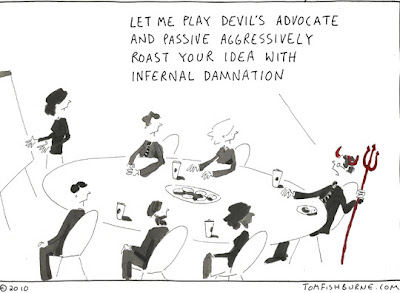
Eliminate devil’s advocacy (unless you’re the Pope). Disagreement without responsibility hinders your organization’s progress.
Teach your staff your job. Let them do it when you’re on vacation.
Take all your vacation days. No contact. Don’t ruin it by doubling your workload upon returning.
Make sure your full-time salary is less than 6x the full-time salary of anyone else.
Jack and Jill: Why Smart Nonprofits Search for Interim Leadership

Executive Director Jack resigns.
Jack leads the committee to replace himself. The committee selects Jill.
Jill is not Jack.
Jill discovers too late that she been enlisted to follow Jack’s path rather than set her own.
After a year, not only is Jill unhappy, but trustees and employees resign.
After a second year, Jill resigns. Or is fired.
The reeling company hires Fred – who is neither Jack nor Jill.
Uneasy lies the head that breaks a crown.
Succession planning needn’t require permanence. It might be best to hire an interim leader from outside the organization (not a board member) while the permanent search is carefully executed.
Every organizational leader’s legacy ends the day the leader leaves. Which means it is never a good idea to have the outgoing director have a say on a permanent successor.
Personality, Talent, Intellect, Experience, Spirit, Passion, and the Ability to Inspire. Good Qualities for You but Intimidating as Hell to Insecure Leaders

I have a friend (not me) who is a sensational grant writer. She’s brilliant (Ivy League educated), inspirational (magnetic personality), talented (great references), and people genuinely like her.
She’s also ethical, sensible, positive, quite attractive, and a snappy dresser.
And without a job.
Lately, when she meets with prospective employers, they are impressed by her prowess, references, and samples. Sadly, they don’t hire her. It’s plausible that insecure bosses-to-be fear she is more impressive than they are and look elsewhere.
Look, if you’re in greater Seattle and need a hell of a grant writer for a full-time gig, contact me and I’ll forward your info to her. But if you’re unstable enough just to want someone inferior to you (even if your grants are being denied) because “anyone can write a grant,” then you deserve your results.
40 years in the Desert – Advice for Leaders Taking the Helm and Those Whose Helm is being Taken

Happy Passover. Story goes: Jews escaped slavery and spent 40 years finding “the Promised Land.”
A popular idea on why it took so long: the generation that escaped were slaves. The generation after that was prepared to lead the new world. People found leadership abilities only after shedding the slave mentality.
When a change in staff or board leadership occurs, it is incumbent upon the incumbent organizational leaders to adapt, not the other way around. You didn’t hire (or elect) a “new” former leader. You hired an exemplary individual with different (but complementary) values, aspirations, and ideas. Shed the mentality of an organization run by the previous leader. That culture vanished when that person left.
If you’re the new leader, remember that you were hired to lead on your terms. Your feet won’t fit in someone else’s footprints.
You’re faking it. You know you are. So why would you hire someone who knows less than you do?

Deep in your soul, you understand that you have no idea what you’re doing. You’ve been faking it for years.
You have years of experience and an important-sounding title. But you know the truth.
Now that it’s time to hire someone to report to you, who do you want?
“Someone young I can mold,” said an ED acquaintance recently. What he meant was, “Someone who won’t outshine me in front of my board.” Idiot.
“Someone who has fought the fight,” said a board member I know. “Someone who can offer great perspective and can innovate intelligently.” Wise.
We are imperfect. We have weaknesses. So when you accept that you don’t know everything, the best thing you can do is hire to those weaknesses.
When you do, you’ll be a leader. Until then, you really are a fake.
Nonprofit hiring… Consensus…check. Fairness…check. Zombie interviewers…GRAXAGHZ.

Employees are your biggest asset as an organization. Nonprofit employees hold greater importance. Relationship-building through positive, passionate human interaction are better portents to success than technological advances.
And yet, too often the hiring process – especially in communities seeking “consensus” or “fairness” – has devolved into “Interviews in Zombieland.”
“Consensus” is not unanimity. “Fairness” is irrelevant when you’re seeking great people.
The group interview is quickly disintegrating. Every person takes turns reading pre-designed, pre-printed questions in the dullest drones imaginable. Your staff turns into a cast of Zombies in a badly-written, badly-acted play, and everyone uses the same dull inflection to every candidate.
And then, invariably, zombie staff members complain about the candidates’ dullness.
Nonprofit leaders: is your hiring process as undead as your results? And are zombie interviews the best way to show off your organization?
How to Hire Great People (or, Don’t Buy a Dog and then Bark, Too)

A school of thought says you should hire people who are not as talented as you, want to be in the same job five years hence, and are cheap and green.
Nonsense. Don’t be an idiot.
Know your limitations. Hire to your weaknesses.
Hire smart, talented, overqualified people. Yes, overqualified. Pick those who can do your job. Or your boss’s job. They likely want the job because the essential tasks make them happy. If paid fairly and treated well, they will stay forever (lowering your HR costs) and constantly exceed your expectations.
After the hire, assist them in their work, not the other way around.
Empower them to make big honking mistakes. Mistakes aren’t fatal; covering them up is.
Embrace their joys. Embrace yours.
Convince them to go home. The planet spins, no matter what. Always has.
Just putting it out there…

I’ve been working with nonprofit arts organizations (mostly theaters) for most of the last twenty-six years. Executive/Managing Director for ten. Marketing and Development Director, too. Consultant for nineteen, the last two full-time.
Raised several million dollars (not by myself, of course!). Increased attendance by hundreds of thousands, mostly by engaging young people.
I’m now looking to regroup. Enhance one brilliant mission. Make life better.
I’m currently based in Seattle, so the I-5 corridor from greater Portland-BC would be optimal. Additionally, I’m very interested in relocating – but to the right place: Chicago, San Diego, Eastern Michigan, NY/NJ/PA, or DC would be fantastic (personal networks in those regions).
I don’t come cheap. But I’ve proven that I’m worth it.
All I need is a company looking for greatness; more than the sum of its programming.
Interested? Click here.
When HR was H

If you’ve applied for a job in the last eight years or so, you’ve sent your resume to a bot. The bot sends you a disingenuous message thanking you for your interest, scans your resume for certain keywords, and decides in a blink of an eye whether to advance your candidacy.
Then, silence.
Often, you’ll never hear from that potential employer. Or you’ll hear something months later, after the job has been awarded (even if you were never in the running). As a final insult, you may even receive a happy letter exclaiming the virtues of the person that the company hired.
HR used to be “Personnel” and was only part of large corporations. Then it became an industry. Now, people are overwhelmed with responses. Hence the bot.
It’s not that hard to be human.
Is it?
 137 Words