Careers in the Arts: It’s Pretty Ugly Out There

Paul Begala said, “Politics is show business for ugly people.”
The converse, that show business is politics for pretty people, is equally true.
Pretty (young) people enter nonprofit arts leadership believing that they should land a high-paying managing director’s job within 3 years. Ginormous student debt is predicated on that prospect.
Ugly (old) people, therefore, had better vamoose, and decrease the surplus population, to paraphrase C-Dick.
Pretty people panic at red ink. They leave. No experience or belief in failure.
Ugly people see an opportunity. They know when to duck and when to charge.
Consider for your next important hire:
- When hiring for “fit,” by definition, you’re hiring to appease. Don’t expect much change.
- When hiring for “innovation,” you’re hiring to anticipate obstacles. And only someone who has experienced obstacles (and carried on) knows how to do that.
Your Next Charity Leader: “Cool, Aloof, Efficient” or “Passionate, Assertive, Innovative?”

I suppose it’s not a binary choice. But ultimately, they seem to fall in exclusive constellations of attributes.
Few leaders are in both camps. And, depending on the organization’s life-stage, you may need more from one camp than the other.
Pope Benedict vs. Steve Jobs. Neither is perfect, but each offers different personality sets at the helm of your charity.
I prefer to work with those who are in the latter camp. They are invariably afraid of little, impolitic, guileless, insistent, and noisy. But they most often find solutions, tell the truth, and can make things happen.
Not that I don’t like the former group, but I’ve found they hold their cards tight, condescend, rarely make a definitive statement, defer, passively-aggressively ignore, and require others to make things happen.
But they rarely threaten change. So there’s that.
Have You Heard? I’m a “Bomb-Throwing Provocateur!” Who’d Have Thought an Artist Could be One of Those?
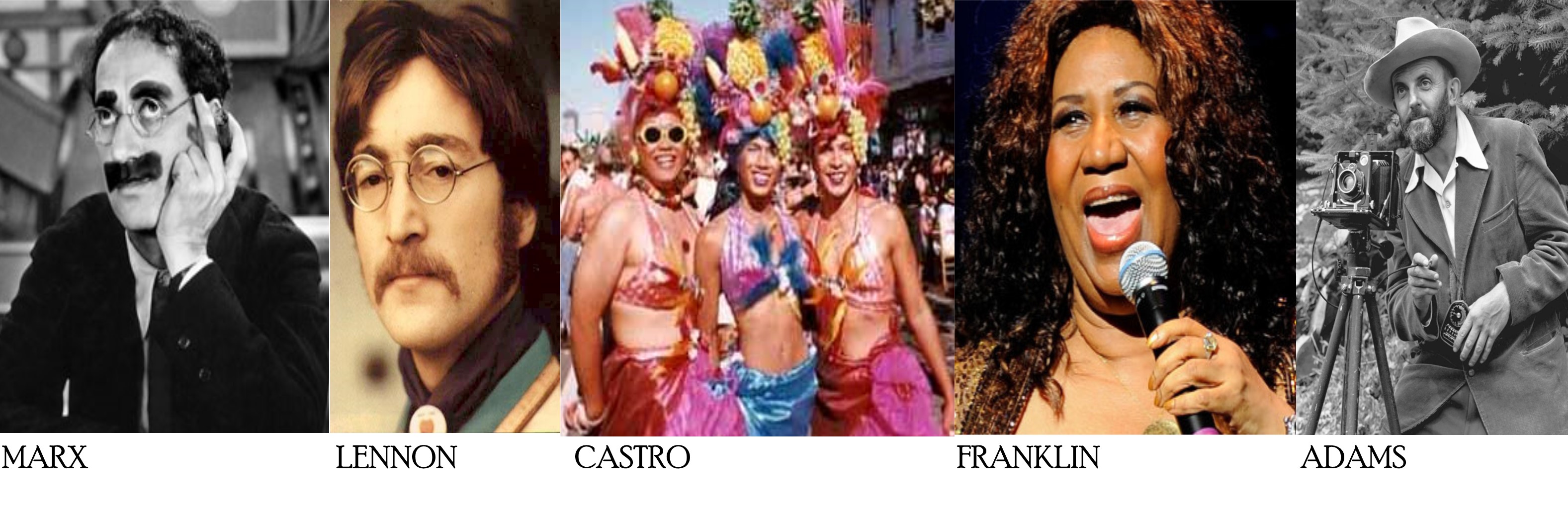
A few posts ago, we talked about the enmity brewing between the arts charities and the rest of the charity sector. That many US arts charities concentrate on the quality of their art while the rest of the sector concentrates on outcomes. That arts charities are pretty much the only part of the charity sector in which the donor also uses the charity, exacerbating the arts’ reputation as being elitist.
Responses were 50-50. Those that agreed tended to come from arts marketers and fundraisers while the rest came from artistic directors and producers. Break it up…nothing to infer here.
Funniest comment was from a 36-year arts veteran decrying elitism; it’s part of the title here. She could have said, “You’re an asshole.” Or “jerk.” Or just plain “wrong.”
I might be all those things. After all, I’m an artist.
Rethinking the Group Job Interview – Consensus? Abdication? Or Focus Group?
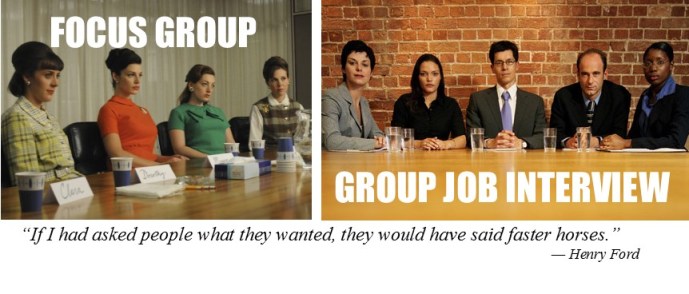
I’ve tortured people in the group interview process. I thought I was offering consensus. Buy-in. Group drive.
I was wrong.
Wrong. Wrong. Wrong.
Oh, so wrong.
To everyone I’ve ever put through that, on either side of the table, I apologize. I’ll never do it again. Promise.
There are four decisions: autocratic (I say), consultative (I say with your input), democratic (we vote, losers weep), consensus (we vote and everyone backs the decision).
As practiced, the group interview might have evolved into a method for managers to abdicate responsibility in the name of consensus. While consensus is ideal, the group-think process can too often be dominated by a crank in the corner with issues, motives, and insecurities. And, possibly, an unknown agenda.
Group-think promises consensus but can preclude innovation.
And why would you ever choose to preclude innovation?
Disinterested Advocacy: When Issues Become Global, the Pool for Support Grows Exponentially

Women’s issues are not about women. Race issues are not about people of color.
And when Mars attacks Oklahoma, the issues will not be about Oklahoma.
I visited a domestic abuse nonprofit. They do great work, but are ghettoized by donors as a “women’s issue” charity. The executive director wondered how they might be able to globalize the cause (and increase revenues).
“Domestic abuse is a societal problem,” she complained. “And I worry that without some men providing disinterested advocacy, we’ll only attract women donors.”
But every time she interviewed qualified men for marketing or development positions (and they’d graduate to a final 10-on-1 group interview), the staff and board balked. “Just not a good fit,” they’d euphemize. And they’d recommend another qualified woman.
Is your charity’s issue exclusively yours? If not, how are you communicating that?
Hiring 103: Do Unto Others, for Pete’s Sake!

Oh, those shoddy, “industry standard” hiring practices. They’re still here.
To follow up on this, this, this, this and this,
1) Communicate quickly, at least twice.
- We got your resume.
- Thanks for your interest, but you are not being considered (within a week of close).
2) When you’ve interviewed someone, call them (no email) within a week.
- Thanks for your interest, but you are no longer being considered.
- We’re still interviewing people. I’ll call you on [date range].
3) When you’ve interviewed someone more than once and have hired someone else, call them (no email) immediately.
- Thanks for your interest, but we’ve chosen someone else.
4) Never…
- …send communications stating who you’ve hired (salt, meet wound)
- …let them know they were in the final cut (see above)
- …say you’ll be in touch and then disappear.
- …be rude.
- …assume job-seekers are psychics.
I died this morning.

I was an energetic, charismatic, visionary leader.
I worked at least 60 hours a week.
The office is by turns chaotic and paralyzed.
Some are crying.
Some are ecstatic.
Outside the charity, most don’t care.
Not their problem.
Trustees are panicking. Staff members are traumatized.
Some are taking charge, Alexander Haig-style.
Others are forming committees to decide what to decide.
Still others are composing resignations.
Reporter on line 1.
I knew every board and staff member.
And their families.
I knew every major donor.
I knew local foundation leaders.
Benefactors on line 2.
Beneficiaries on line 3.
I knew financials.
I knew history.
I had passwords.
Vendors on line 4.
I knew where everything was.
I shared that information.
But that was 5 years ago.
To employees who are no longer here.
Too bad there wasn’t a written succession policy.
Not my problem.
Hiring 102: Breaking the Code on Ageism (We’re on to You.)

You don’t have to be Alan Turing to break the HR “can’t-ask-how-old-you-are” code:
“How is your energy level?” = “Are you a geezer?”
…Correct response: “I run 26 marathons daily.”
“What were you doing before 2001?” = “What were you doing before I turned 10?”
…Correct response: “I’m 35 years old with 30 years’ experience.”
“When did you graduate college?” = “I’m checking my arithmetic to determine your age.”
…Correct response: “When I was 22.”
“How flexible are you?” = “Is your mind as ossified as a petrified fossil?”
…Correct response: “I’m currently holding the phone with my pinkie toe while simultaneously writing Iraq’s new constitution.”
Seriously, though, hiring managers: according to the US Bureau of Labor Statistics, workers 45–64 stayed twice as long as those 25–34 — so those under 40 are a much higher risk of leaving you high and dry.
So stop it.
Jack and Jill: Why Smart Nonprofits Search for Interim Leadership

Executive Director Jack resigns.
Jack leads the committee to replace himself. The committee selects Jill.
Jill is not Jack.
Jill discovers too late that she been enlisted to follow Jack’s path rather than set her own.
After a year, not only is Jill unhappy, but trustees and employees resign.
After a second year, Jill resigns. Or is fired.
The reeling company hires Fred – who is neither Jack nor Jill.
Uneasy lies the head that breaks a crown.
Succession planning needn’t require permanence. It might be best to hire an interim leader from outside the organization (not a board member) while the permanent search is carefully executed.
Every organizational leader’s legacy ends the day the leader leaves. Which means it is never a good idea to have the outgoing director have a say on a permanent successor.
You’re faking it. You know you are. So why would you hire someone who knows less than you do?

Deep in your soul, you understand that you have no idea what you’re doing. You’ve been faking it for years.
You have years of experience and an important-sounding title. But you know the truth.
Now that it’s time to hire someone to report to you, who do you want?
“Someone young I can mold,” said an ED acquaintance recently. What he meant was, “Someone who won’t outshine me in front of my board.” Idiot.
“Someone who has fought the fight,” said a board member I know. “Someone who can offer great perspective and can innovate intelligently.” Wise.
We are imperfect. We have weaknesses. So when you accept that you don’t know everything, the best thing you can do is hire to those weaknesses.
When you do, you’ll be a leader. Until then, you really are a fake.
Nonprofit Arts Organizations – Are you aware that the other parts of the sector believe that you’re stealing money?

In most nonprofits, a donor gives and someone else benefits. Food banks solve hunger, which promotes family stability, which stimulates re-entry into society for the impoverished. Environmental nonprofits encourage clean air and water, which promotes health, which supports longer, happier lives for everyone. Many religious organizations sponsor high morals (“Do unto others…”), which provides a sense of community, which fosters a safety net.
In the arts, the donor and the recipient are often the same person. The donor gives to a company, the company produces a performance or exhibit, and the donor/recipient enjoys the event. The arts are seen by many as elitist and unworthy of support.
We in the arts have to recognize that there is an enmity-laden relationship between arts nonprofits and all the other charities.
And then we have to do something about it.
Nonprofit hiring… Consensus…check. Fairness…check. Zombie interviewers…GRAXAGHZ.

Employees are your biggest asset as an organization. Nonprofit employees hold greater importance. Relationship-building through positive, passionate human interaction are better portents to success than technological advances.
And yet, too often the hiring process – especially in communities seeking “consensus” or “fairness” – has devolved into “Interviews in Zombieland.”
“Consensus” is not unanimity. “Fairness” is irrelevant when you’re seeking great people.
The group interview is quickly disintegrating. Every person takes turns reading pre-designed, pre-printed questions in the dullest drones imaginable. Your staff turns into a cast of Zombies in a badly-written, badly-acted play, and everyone uses the same dull inflection to every candidate.
And then, invariably, zombie staff members complain about the candidates’ dullness.
Nonprofit leaders: is your hiring process as undead as your results? And are zombie interviews the best way to show off your organization?
Just putting it out there…

I’ve been working with nonprofit arts organizations (mostly theaters) for most of the last twenty-six years. Executive/Managing Director for ten. Marketing and Development Director, too. Consultant for nineteen, the last two full-time.
Raised several million dollars (not by myself, of course!). Increased attendance by hundreds of thousands, mostly by engaging young people.
I’m now looking to regroup. Enhance one brilliant mission. Make life better.
I’m currently based in Seattle, so the I-5 corridor from greater Portland-BC would be optimal. Additionally, I’m very interested in relocating – but to the right place: Chicago, San Diego, Eastern Michigan, NY/NJ/PA, or DC would be fantastic (personal networks in those regions).
I don’t come cheap. But I’ve proven that I’m worth it.
All I need is a company looking for greatness; more than the sum of its programming.
Interested? Click here.
Fair/Right/Just/Honest/Unbiased/Reasonable – Things Life Isn’t

I have a friend. Her name isn’t Penny. And no, it’s not me.
Penny ran a nonprofit. In fact, she has run a few, all successfully. She’s good at what she does. She has been responsible for a lot of success.
A single judgment error cost Penny her job. She didn’t steal, she didn’t kill anyone, nor did she have any negative board issues. She fell in love with a man who fell in love with her. Unfortunately, he worked for her. And the story made Page One.
Penny and Lincoln have been together for years. No wrongdoing was ever found, and, in fact, the organization exonerated her and paid her a healthy settlement. That made Page Thirty-Seven.
Penny hasn’t worked in years. Search firms steer clear. Search engines find front page news, not page Thirty-Seven news.
 137 Words