Sustainability is Neither Reaching for Relevance nor Selling Out. It’s More Important than That.

The art of sustainability in arts charities is akin to performing a balance beam routine on a Ginsu knife. You can sacrifice mission for dollars or dollars for mission, but even if you maintain a perfect balance, there will still be substantial blood on both sides.
We talk way too much about relevance in the arts. The tag in the back of the shirt is relevant for a description of content and washing instructions, but the design of the shirt can reveal personal characteristics of the wearer. Let’s aim higher. How about “integral”?
Integral arts charities are those that are so entwined with other charities that they become essential to the health of the community. “Integral” obviates this useless discussion of relevance and moves us to the more useful question:
How do the arts make communities thrive?
Nonprofit Management Counter-Intuition: Every Now and Then, You Have to Fire Yourself
 Every now and then, fire yourself. Then interview yourself for your job. Would you get it? What attributes would best suit you for it? (Do you even want it?)
Don’t schedule a meeting for one entire week each quarter. Stop being “too busy.” Find your value as a resource (rather than as a boss).
Take down all the cubicle and office doors. Then, every morning, say hello to each human you see before you walk into your door-free office.
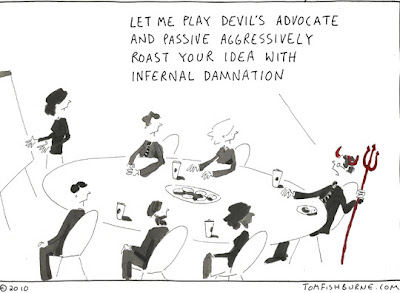
Eliminate devil’s advocacy (unless you’re the Pope). Disagreement without responsibility hinders your organization’s progress.
Teach your staff your job. Let them do it when you’re on vacation.
Take all your vacation days. No contact. Don’t ruin it by doubling your workload upon returning.
Make sure your full-time salary is less than 6x the full-time salary of anyone else.
Stepping in Moral Quicksand: When a Horrible Person/Company Gives to Your Nonprofit

I was going to write about all the charities to which Donald Sterling donated.
I was going to ask if the standards of the organization should stand up against the horror of the donor.
After all, UCLA gave back $3 million of Sterling’s money.
Then I was going to ask about donations from companies that peddle “evil” – tobacco, liquor, oil, etc.
But then I thought about individual donors’ morals. Not just unethical oligarchs like Henry Ford, Rupert Murdoch, John D. MacArthur, or even Sterling. What about all the philanthropists whose fortunes were built on a million broken backs? Or a few? Or one? And I thought about my experiences with morally corrupt donors.
I’m sinking.
Help.
You Gotta Live in the House You Live in

Hypothetical: Strategically speaking, what would your charity do if money were not an issue at all?
The answer to this question is significant. Because if it begins with anything but “we’d do exactly what we’re doing now,” then it’s likely that either you or your mission have to go.
I live in a 1950s house. Typical low ceilings. Small, utilitarian rooms. If I had all the money in the world to renovate it, I’d enhance its 1950s nature, not build 4 additional stories to get a Puget Sound view and in doing so, ruin the house’s charm.
Same with charities, arts or otherwise. You created a mission for a reason…there was a need. A societal wrong to be righted. If you want to accomplish something other than your organization’s mission, go do it.
Just do it somewhere else.
Jack and Jill: Why Smart Nonprofits Search for Interim Leadership

Executive Director Jack resigns.
Jack leads the committee to replace himself. The committee selects Jill.
Jill is not Jack.
Jill discovers too late that she been enlisted to follow Jack’s path rather than set her own.
After a year, not only is Jill unhappy, but trustees and employees resign.
After a second year, Jill resigns. Or is fired.
The reeling company hires Fred – who is neither Jack nor Jill.
Uneasy lies the head that breaks a crown.
Succession planning needn’t require permanence. It might be best to hire an interim leader from outside the organization (not a board member) while the permanent search is carefully executed.
Every organizational leader’s legacy ends the day the leader leaves. Which means it is never a good idea to have the outgoing director have a say on a permanent successor.
Personality, Talent, Intellect, Experience, Spirit, Passion, and the Ability to Inspire. Good Qualities for You but Intimidating as Hell to Insecure Leaders

I have a friend (not me) who is a sensational grant writer. She’s brilliant (Ivy League educated), inspirational (magnetic personality), talented (great references), and people genuinely like her.
She’s also ethical, sensible, positive, quite attractive, and a snappy dresser.
And without a job.
Lately, when she meets with prospective employers, they are impressed by her prowess, references, and samples. Sadly, they don’t hire her. It’s plausible that insecure bosses-to-be fear she is more impressive than they are and look elsewhere.
Look, if you’re in greater Seattle and need a hell of a grant writer for a full-time gig, contact me and I’ll forward your info to her. But if you’re unstable enough just to want someone inferior to you (even if your grants are being denied) because “anyone can write a grant,” then you deserve your results.
40 years in the Desert – Advice for Leaders Taking the Helm and Those Whose Helm is being Taken

Happy Passover. Story goes: Jews escaped slavery and spent 40 years finding “the Promised Land.”
A popular idea on why it took so long: the generation that escaped were slaves. The generation after that was prepared to lead the new world. People found leadership abilities only after shedding the slave mentality.
When a change in staff or board leadership occurs, it is incumbent upon the incumbent organizational leaders to adapt, not the other way around. You didn’t hire (or elect) a “new” former leader. You hired an exemplary individual with different (but complementary) values, aspirations, and ideas. Shed the mentality of an organization run by the previous leader. That culture vanished when that person left.
If you’re the new leader, remember that you were hired to lead on your terms. Your feet won’t fit in someone else’s footprints.
Charity-Nonprofit. Tomato-Tomahto? Potato-Potahto? Not so much.

Charity as defined by the OED. Helping those in need.
Nonprofit as defined by the OED. Having to do with the financial aspects of a company and specifically designated in definition 2 as being separate from a charity.
Nonprofit organization as defined by the United States. Makes possible some companies to be tax-exempt if they participate in specified exempt purposes: charitable, religious, educational, scientific, literary, testing for public safety, fostering national or international amateur sports competition, and preventing cruelty to children or animals.
Charity as defined by the United States. Key words: “the poor, distressed, or underprivileged,” “religion,” “education,” “science,” “public buildings, monuments, or works,” “the burdens of government,” “neighborhood tensions,” “prejudice and discrimination,” “human and civil rights,” and “community deterioration and juvenile delinquency.”
I’d rather run a charity than a nonprofit, wouldn’t you?
More importantly, do you?
Even Endowments Don’t Want You to Have an Endowment

Went to a foundation’s financial conference a few years back. Before the economy went south.
The COO of the foundation said (a direct quote), “If you’re not pulling 20% of your annual budget from your endowment roll-off, then you probably shouldn’t have an endowment.”
And now, the math:
Assuming the annual payment is 5%, your endowment would have to outnumber your annual budget by a ratio of 4-1.
Endowments are not reserve funds. They are not liquid. They have little to do with an organization’s stability. Often, the endowment campaign is successful, but the organization teeters on bankruptcy in vast oceans of red ink.
Endowments do not prove an organization’s worth, nor does it assure its future. Although, I suppose, it does offer a bankrupt organization the chance to pay off its bills before closing for good. So there’s that.
“I Wanna!” The Fatal Game of Power About Nonprofit Arts. Ages infantile and up.
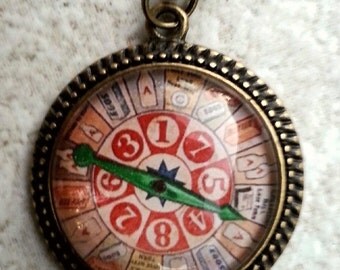
How to play:
Players select their tokens to start play. Each token designates their role in nonprofit art.
Marionette: Performing Artists/Designers
Blob of Clay: Writers/Composers/Visual Artists
Pawn: All technical/administrative/volunteer personnel (one token represents all)
Change Purse: Audience
Louis Vuitton Pocketbook: Donor/Funder
Fake Louis Vuitton Pocketbook: Development Director
Hammer: Trustee
Bent nail: Managing/Executive Director
Telescope looking up: Artistic Director/Curator
Microscope looking down: General Manager/CFO
Bloody leech: Critic/Journalist
Sorry: designated tokens for marketing/pr directors were deleted in the last budget cycle.
All players spin the Great Glass Wheel Of Art simultaneously in all directions and yell, “I Wanna!” The Wheel comes off its bearings; breaks into millions of pieces. Players move tokens anyplace in the room that feels most advantageous, regardless of the playing board or other players.
End of game:
Chaos. All players proclaim victory. None actually win.
U-Better, U-Better, UBIT

Watching arts nonprofits seek funding in unusual ways leads to same old/new discussions on Unrelated Business Income Tax.
Taking a group of donors for a London theatre tour (even if all the finances are handled by an independent agent)…UBIT, you betcha.
The percentage of time spent in London at a lecture about your company’s particular brand of theatre…OK.
Selling t-shirts with just the logo of your natural history museum…UBIT, you betcha.
Selling t-shirts with dinosaurs on them at your natural history museum…OK.
Leasing part of your building to a separate business…UBIT, you betcha.
Items sold at a gift shop with a separate public entrance…UBIT off more than you can chew.
Items sold at a gift shop only accessible to ticket-buyers…UBIT only items not related to the tax-exempt purpose of the organization.
UBIT. Not just another 4-letter acronym.
You’re faking it. You know you are. So why would you hire someone who knows less than you do?

Deep in your soul, you understand that you have no idea what you’re doing. You’ve been faking it for years.
You have years of experience and an important-sounding title. But you know the truth.
Now that it’s time to hire someone to report to you, who do you want?
“Someone young I can mold,” said an ED acquaintance recently. What he meant was, “Someone who won’t outshine me in front of my board.” Idiot.
“Someone who has fought the fight,” said a board member I know. “Someone who can offer great perspective and can innovate intelligently.” Wise.
We are imperfect. We have weaknesses. So when you accept that you don’t know everything, the best thing you can do is hire to those weaknesses.
When you do, you’ll be a leader. Until then, you really are a fake.
Nonprofit Arts Organizations – Are you aware that the other parts of the sector believe that you’re stealing money?

In most nonprofits, a donor gives and someone else benefits. Food banks solve hunger, which promotes family stability, which stimulates re-entry into society for the impoverished. Environmental nonprofits encourage clean air and water, which promotes health, which supports longer, happier lives for everyone. Many religious organizations sponsor high morals (“Do unto others…”), which provides a sense of community, which fosters a safety net.
In the arts, the donor and the recipient are often the same person. The donor gives to a company, the company produces a performance or exhibit, and the donor/recipient enjoys the event. The arts are seen by many as elitist and unworthy of support.
We in the arts have to recognize that there is an enmity-laden relationship between arts nonprofits and all the other charities.
And then we have to do something about it.
Nonprofit hiring… Consensus…check. Fairness…check. Zombie interviewers…GRAXAGHZ.

Employees are your biggest asset as an organization. Nonprofit employees hold greater importance. Relationship-building through positive, passionate human interaction are better portents to success than technological advances.
And yet, too often the hiring process – especially in communities seeking “consensus” or “fairness” – has devolved into “Interviews in Zombieland.”
“Consensus” is not unanimity. “Fairness” is irrelevant when you’re seeking great people.
The group interview is quickly disintegrating. Every person takes turns reading pre-designed, pre-printed questions in the dullest drones imaginable. Your staff turns into a cast of Zombies in a badly-written, badly-acted play, and everyone uses the same dull inflection to every candidate.
And then, invariably, zombie staff members complain about the candidates’ dullness.
Nonprofit leaders: is your hiring process as undead as your results? And are zombie interviews the best way to show off your organization?
This. Happened.

Years ago, I dined with a board member/lawyer who’d given $100,000 of unrestricted funding for four consecutive years. Ninety miles from home. Nice restaurant. Just us two.
Asked for this year’s gift.
Silence.
Then, he said, “Now, why do you do all these plays for the n**g**s? They’re uneducated, unsophisticated, they don’t like us, and you’re just rubbing our noses in it?”
I wanted simultaneously to vomit, slug, and flee, none of which are socially acceptable responses.
Dad once said that using the bathroom is the most socially acceptable way to buy ten minutes. I bought ten minutes.
“It’s not my money. It’s not my money,” I chanted to myself for about ten minutes. “It’s for the company. It’s unrestricted. We can spend it any way we see fit.”
Came back.
What would you say and do?
Positive Signs in the Nonprofit Arts Community
Some nonprofit arts organizations are making new, better choices – and it’s working.
One theater company, eschewing the managing director template (part operations director, part fundraiser, part CPA), has chosen to split the duties. They’ve brought on a strategy director to handle outside duties (fundraising, speaking, lobbying) and strategic plan piloting. The operations and financial duties lie with the general manager.
One children’s arts company, eschewing the arts-revenue template (part production house, part arts education academy), produces in the same facility as several social service agencies. They incorporate the other nonprofits into everything they do, produce a specific style of performance art that speaks to the values of their ethnically, linguistically diverse neighborhood, and gauge success by how well all the nonprofits are bettering the lives of their constituents.
New prototypes. New measurements. New realizations. Excellent work.
Cue the heavenly chorus…your nonprofit arts organization will never be hungry again!

Acting is not about performing; nor is painting about artistry; nor is music is about musicianship; nor is dancing about prowess.
Similarly, nonprofit arts organizations cannot be about exhibitions/performances.
The impact of the arts can be quantified. There are myriad studies. But the impact of any individual arts organization is not an equivalent discussion. Each organization must provide specific impact, or better, impact2.
Impact2 is the impact’s impact. As a food bank provides positive impact to a concrete number of families, its impact2 may be the number of households that escaped poverty from having had the gift of food in its worst times.
Many nonprofit arts organizations often define themselves by the quality of production. No surprise, then, that so many struggle to reach new donors. Quantify the impact2 of your nonprofit, and you’ll find your Grail.
Which core is the real core?

Nonprofits are all experiments of arrogance. None are finished products, nor should they be.
Championing a cause is an onion-peeling exercise of conceit, intended to solve hard problems.
Conceits share a common trait. When closely-held, personally-motivated core values are involved, arrogances can serve as both driver and hindrance. And they can save or kill your nonprofit.
Let’s say that you have a colleague who believes that the intention of a program speaks to the heart of the mission. But the program is costly, inefficient, and glorifies the colleague more than the nonprofit.
Your colleague’s investment is in a program that isn’t serving the mission. But your colleague is a charismatic leader who believes that the program just needs more of the organization’s limited resources to work.
Attack the program (and your colleague’s values) or let it be?
Really bad ideas for nonprofit arts boards!

- Be the “idea” person. Provide valuable insight. Have employees carry out those ideas in addition to their jobs. Give continual feedback at every board meeting.
- Eschew fundraising. It’s begging for money. You don’t beg.
- Make sure that your annual gala is the organization’s primary activity… above all else.
- Play “Pick Your Favorite Line Item” at the board meeting where the budget is approved. Spend forty-five minutes on depreciation, for example.
- Bring in consultants. Find ones with a single patented technique that works for every organization.
- Build a hierarchy. Successful corporations build hierarchies.
- Do not read anything sent to you before attending meetings. You’re there as the “idea” person, remember?
- Ensure that the company’s activities define the mission, not the other way around. Make sure that the mission contains the words, “fiscal responsibility.”
For success, do the opposite.
 137 Words