I’m baaaaa-aaaaack — “He who’s down one day can be up the next, unless he really wants to stay in bed, that is…”

For 8 months, I’ve been temporarily working in Detroit, mixing Cervantes (above) with Kerouac (below). Detroit was fascinating.
Where to go next is the issue.
I’ve studied nonprofit arts cultures across the country and (so far) settled on regions surrounding Seattle, Portland, Chicago, and Washington, DC.
The house and TK are in Seattle. TG is in Detroit. I’ll give you a great deal on the house, but not the others.
Criterion #1: When a region’s arts community is comprised of a whole bunch of discrete mission-based organizations – rather than everybody doing everything – then that region’s organizations succeed. That’s for me.
Criterion #2: When a region’s arts community is comprised of a precious few large arts organizations, those organizations are doomed to irrelevance. Not for me.
But my mind wanders…
“What’s in store for me in the direction I don’t take?”
Marketing Arts Charities: In 2014, It’s about Me (Not You… Me)
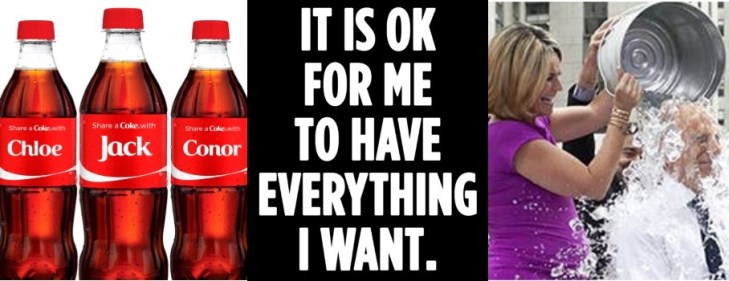
Attracting Millennials to the arts isn’t the easiest thing in the world. What worked with the Greatest Generation hasn’t worked with Boomers or Millennials.
This summer, Coca-Cola put names on the bottles (common first names for those born in the 80s and 90s). Then, a Coke turned into something about “me.”
Look what I’m drinking… it’s me!
We’ve also seen hundreds of bucket challenges to support ALS research, which is great. The product sold in the videos is “me.”
Look what I’m using to do good in the world… it’s me!
Marketing the transformative experience of the arts works best when it’s about “me.”
Look at that amazing artwork/ballet/opera/play/musical… it’s me!
If you can make the experience about the patron (not for the patron), you’ll have a fan for life.
Or at least until the next big thing.
Careers in the Arts: It’s Pretty Ugly Out There

Paul Begala said, “Politics is show business for ugly people.”
The converse, that show business is politics for pretty people, is equally true.
Pretty (young) people enter nonprofit arts leadership believing that they should land a high-paying managing director’s job within 3 years. Ginormous student debt is predicated on that prospect.
Ugly (old) people, therefore, had better vamoose, and decrease the surplus population, to paraphrase C-Dick.
Pretty people panic at red ink. They leave. No experience or belief in failure.
Ugly people see an opportunity. They know when to duck and when to charge.
Consider for your next important hire:
- When hiring for “fit,” by definition, you’re hiring to appease. Don’t expect much change.
- When hiring for “innovation,” you’re hiring to anticipate obstacles. And only someone who has experienced obstacles (and carried on) knows how to do that.
Good and Bad in Charity Funding

Milk, Nicolas Cage’s acting; mugs saving trees or cups saving wash water; bottled water — good or bad?
Good:
Unrestricted funding.
Ice Buckets/Challenges (unless you’re Charity:Water. Then bad.)
Matching gifts.
Nihil Pro Quo.
Public funding.
Multi-year gifts.
Endowments that cover >20% of the organization’s annual budget.
In-kind gifts that are already in the budget.
Thousands of low-level donors.
Dozens of high-level donors.
100% of trustees/board members donate.
100% of trustees/board members donate one of the 3 highest gifts they give all year.
100% of employees want to at least donate $1.
Bad:
Funding restricted to programs unsupported by the mission.
Funding restricted to vanity projects.
Quid pro quo.
Corporations choosing charities via popularity contests/computer click-offs.
Large donations that overly entitle either donor or recipient.
Endowments that cover <20% of the organization’s annual budget.
Panicky, deleterious “Going-Out-Of-Business-Unless-We-Raise-Millions-By-Tuesday” funding schemes.
More on Charities and Families: Find a Way to Answer “NO” to Form 990, Part VI, Line 2

“XYX YXYXYXYX (WHO SERVES AS GENERAL DIRECTOR AND ARTISTIC DIRECTOR, CEO) AND XXX XXXXXXXX (WHO SERVES AS EXECUTIVE DIRECTOR – DEVELOPMENT AND MARKETING) HAVE A FAMILY RELATIONSHIP”
Their two combined salaries (excluding payroll taxes) to total budget: 6.0%.
Their two salaries to all salaries: 12.7%
These two employees to all 406 employees: 0.5%
Ratio, these two employees’ salaries to all employees’ salaries: 25-1
Current year surplus/(deficit): ($3,239,641)
Are your decision-makers married or in some family relationship? For a for-profit company, that’s fine. Family businesses and for-profit nepotism are mostly fine.
But charities, owned by the community and answerable to its constituents, are not family businesses. And when they act irresponsibly, like the above arts organization, it’s a travesty that negatively affects the whole industry.
Because now we have to convince supporters that this won’t happen to their donation.
Arrogance, thy name is YXYXYXYX.
Negatively Commenting on the Title of a Post (What You’re Reading Now) is Akin to PETA Boycotting “To Kill a Mockingbird” Because, You Know, They’re Killing a Mockingbird.
Recently, a foundation advocate negatively commented on the title of a 137 Words blog post. On the title, not the post.
As Ben Franklin once said, “We are all born ignorant, but one must work hard to remain stupid.”
Thank you for reading 137 Words and sharing it with your colleagues. We’re pretty amazed when 137 Words evokes derision, praise, or questions.
If you haven’t shared yet, please do – karma will be kind.
In 6 months, 137 Words has picked up about 6,000 readers. That exceeds all our expectations. We are truly grateful.
And to those like this advocate who only read the title and not the posting (what you’re reading now), I only wish bliss. Or, should I say, additional bliss.
Harsh? Maybe so. Because I am all too often a card-carrying member of the Right to Extreme Stupidity League.
Arts Charity Leaders: The Economic Impact Argument Has Become a Losing Proposition…Move On

From ArtsFund, Seattle:
“Together the activity of nonprofit arts organizations [in our region]…generates close to $2 billion in the Central Puget Sound’s economy creating 32,520 jobs, $882 million in labor income and $83 million in taxes.”
From Viking Stadium (new NFL stadium), Minneapolis:
“Construction will support approximately 13,000 jobs…almost $300 million in wages…upon completion, 3,400 full and part-time jobs…the economic activity from a new stadium will generate over $26 million per year in tax revenue and over $145 million in direct spending by Vikings fans inside the State of Minnesota.”
From McDonald’s:
“McDonald’s provides tax revenue for local, state and national governments…$1.3 billion in United States national and state corporate taxes in 2011…McDonald’s spends hundreds of millions upgrading or building new locations.”
Let’s move on to quantifying our outcomes before we bury ourselves with more “economic impact” studies. It’s just not a winning argument for the arts.
Charity Culture: If Doing the Right Thing Makes You an Endangered Species, Do It Anyway

Sadly, few people know “Profiles in Courage.” Ask around.
Among performing arts charities, some leaders shrewdly keep their positions because they fear appearing impolitic. They seek sustainability for themselves first, and then, secondarily, their organizations.
To them I implore:
- Pay performers wages, on the books, legal standard or better, for every hour they spend: rehearsals, performances, fittings, etc.
- If your charity isn’t making a substantial difference, merge or close. If it is, share your secrets.
- It’s about social progress, not black ink. Both are preferable, but you’ve failed if your best work is 30 years of balanced budgets.
- Take a stand. Don’t buy trouble, of course, but don’t become invisible to save your own skin.
- Theatres: plays aren’t written, they’re wrought. It’s about the production and the viewpoint, not the script and sets.
- Do something. Don’t be something.
Playing Chicken – For Arts Charities, Not a Game for the Faint of Heart, Because, Well, It’s Impossible and Doesn’t Make a Compelling Case

I read an article recently called A Day Without Art. Stephanie Milling suggests scenarios in which the arts hypothetically disappear for a day. But hypothetical threats are terrible tools of advocacy.
We can’t not have art. Look at your coffee cup, even if it’s paper. It has form, function, and looky there, art on it.
Here’s the ant at this particular picnic:
If art is ubiquitous, does it have value? Why pay for it?
Rather than forecasting the impossible – a day without art – could we better spend our energies measuring our specific organization’s specific outcomes and advocate by trumpeting those to the world?
No one responds well to this particular game of chicken. It’s akin to the idea of eating your kids – it may solve the messy bathroom problem, but it’s neither realistic nor sustainable.
Have You Heard? I’m a “Bomb-Throwing Provocateur!” Who’d Have Thought an Artist Could be One of Those?
A few posts ago, we talked about the enmity brewing between the arts charities and the rest of the charity sector. That many US arts charities concentrate on the quality of their art while the rest of the sector concentrates on outcomes. That arts charities are pretty much the only part of the charity sector in which the donor also uses the charity, exacerbating the arts’ reputation as being elitist.
Responses were 50-50. Those that agreed tended to come from arts marketers and fundraisers while the rest came from artistic directors and producers. Break it up…nothing to infer here.
Funniest comment was from a 36-year arts veteran decrying elitism; it’s part of the title here. She could have said, “You’re an asshole.” Or “jerk.” Or just plain “wrong.”
I might be all those things. After all, I’m an artist.
Successful Trusteeship, or “Isn’t Writing a Big Honking Check Enough?”

Good board members:
- aren’t ambassadors. Ambassadors wait for people to come to them. They’re zealots. They zealously get donations and zealously get new board members.
- don’t try to get. They work together and with staff and they get.
- personally donate among their three largest monetary donations that year. Not from their company…from them.
- are forensic analysts, (not governors). Remember, the bottom line is “Are we living our mission? Is the mission working?” They see to it that it does, regardless of the financials.
- insist that board meetings are too important to be reporting vehicles. Productive monthly board meetings can be like having twelve mini-retreats.
Think of it this way: if each board member’s consulting rate is $100/hour and your charity has 20 board members, do you want to spend $2,000/hour talking about the past or the future?
For Arts Charities, Everything Powerful Stems from a Great Mission…Including a Great Mission Statement
Many arts organizations craft mission statements that promote activities, art, and excellence. Unfortunately, those things are irrelevant.
“[Theater] presents engaging dramatic work that celebrates the intimate relationship among artist, audience and language.”
That’s not a mission statement. No surprise: that theater died.
A mission is the unspeakable acme of a societal obligation. A mission statement expresses that mission, the product of an organizational manifesto, as best it can.
“[Company’s] mission is to create theatre so strikingly original in form, content or both, that it instills in young people an enduring awe, love and respect for the medium, thus preserving imagination and wonder, those hallmarks of childhood which are the keys to the future.”
See the difference? This mission statement discusses the mission’s impact – “preserving imagination and wonder” – as a crucial need. That’s a supportable argument.
Disinterested Advocacy: When Issues Become Global, the Pool for Support Grows Exponentially

Women’s issues are not about women. Race issues are not about people of color.
And when Mars attacks Oklahoma, the issues will not be about Oklahoma.
I visited a domestic abuse nonprofit. They do great work, but are ghettoized by donors as a “women’s issue” charity. The executive director wondered how they might be able to globalize the cause (and increase revenues).
“Domestic abuse is a societal problem,” she complained. “And I worry that without some men providing disinterested advocacy, we’ll only attract women donors.”
But every time she interviewed qualified men for marketing or development positions (and they’d graduate to a final 10-on-1 group interview), the staff and board balked. “Just not a good fit,” they’d euphemize. And they’d recommend another qualified woman.
Is your charity’s issue exclusively yours? If not, how are you communicating that?
Hiring 102: Breaking the Code on Ageism (We’re on to You.)

You don’t have to be Alan Turing to break the HR “can’t-ask-how-old-you-are” code:
“How is your energy level?” = “Are you a geezer?”
…Correct response: “I run 26 marathons daily.”
“What were you doing before 2001?” = “What were you doing before I turned 10?”
…Correct response: “I’m 35 years old with 30 years’ experience.”
“When did you graduate college?” = “I’m checking my arithmetic to determine your age.”
…Correct response: “When I was 22.”
“How flexible are you?” = “Is your mind as ossified as a petrified fossil?”
…Correct response: “I’m currently holding the phone with my pinkie toe while simultaneously writing Iraq’s new constitution.”
Seriously, though, hiring managers: according to the US Bureau of Labor Statistics, workers 45–64 stayed twice as long as those 25–34 — so those under 40 are a much higher risk of leaving you high and dry.
So stop it.
Dream Job…and My Title Would Be Chief Dream Merchant

What I want:
An arts charity that makes my community better.
Value to the community:
Safety. Knowledge. Personal Power. Issue solutions.
Artistic Tools:
Provocation. Entertainment. Populism. Progressiveness. Mischief.
Other Tools:
Educational residencies in both art and topic.
Partners:
Every other charity, educational institution, or NGO with similar values.
Differentiation:
50-50 split on revenues with partners. Partners open their mailing lists to help themselves financially through ticket sales.
Quantifiable outcomes:
The measured outcomes of the partners. Quantity of classes, students, and schools participating.
Non-quantifiable outcomes:
Populist results defeat the arts’ elitist reputation. The needs of the charities are filled.
Initial budget:
Enough so that all artists receive at least $15/hour (in 2014 dollars) and no full-time hourly rate is more than 4x anyone else’s.
Impact:
Arts moves people to action. Thorny issues seen can never be unseen. Life is better.
Stepping in Moral Quicksand: When a Horrible Person/Company Gives to Your Nonprofit

I was going to write about all the charities to which Donald Sterling donated.
I was going to ask if the standards of the organization should stand up against the horror of the donor.
After all, UCLA gave back $3 million of Sterling’s money.
Then I was going to ask about donations from companies that peddle “evil” – tobacco, liquor, oil, etc.
But then I thought about individual donors’ morals. Not just unethical oligarchs like Henry Ford, Rupert Murdoch, John D. MacArthur, or even Sterling. What about all the philanthropists whose fortunes were built on a million broken backs? Or a few? Or one? And I thought about my experiences with morally corrupt donors.
I’m sinking.
Help.
You Gotta Live in the House You Live in

Hypothetical: Strategically speaking, what would your charity do if money were not an issue at all?
The answer to this question is significant. Because if it begins with anything but “we’d do exactly what we’re doing now,” then it’s likely that either you or your mission have to go.
I live in a 1950s house. Typical low ceilings. Small, utilitarian rooms. If I had all the money in the world to renovate it, I’d enhance its 1950s nature, not build 4 additional stories to get a Puget Sound view and in doing so, ruin the house’s charm.
Same with charities, arts or otherwise. You created a mission for a reason…there was a need. A societal wrong to be righted. If you want to accomplish something other than your organization’s mission, go do it.
Just do it somewhere else.
Personality, Talent, Intellect, Experience, Spirit, Passion, and the Ability to Inspire. Good Qualities for You but Intimidating as Hell to Insecure Leaders

I have a friend (not me) who is a sensational grant writer. She’s brilliant (Ivy League educated), inspirational (magnetic personality), talented (great references), and people genuinely like her.
She’s also ethical, sensible, positive, quite attractive, and a snappy dresser.
And without a job.
Lately, when she meets with prospective employers, they are impressed by her prowess, references, and samples. Sadly, they don’t hire her. It’s plausible that insecure bosses-to-be fear she is more impressive than they are and look elsewhere.
Look, if you’re in greater Seattle and need a hell of a grant writer for a full-time gig, contact me and I’ll forward your info to her. But if you’re unstable enough just to want someone inferior to you (even if your grants are being denied) because “anyone can write a grant,” then you deserve your results.
Even Endowments Don’t Want You to Have an Endowment

Went to a foundation’s financial conference a few years back. Before the economy went south.
The COO of the foundation said (a direct quote), “If you’re not pulling 20% of your annual budget from your endowment roll-off, then you probably shouldn’t have an endowment.”
And now, the math:
Assuming the annual payment is 5%, your endowment would have to outnumber your annual budget by a ratio of 4-1.
Endowments are not reserve funds. They are not liquid. They have little to do with an organization’s stability. Often, the endowment campaign is successful, but the organization teeters on bankruptcy in vast oceans of red ink.
Endowments do not prove an organization’s worth, nor does it assure its future. Although, I suppose, it does offer a bankrupt organization the chance to pay off its bills before closing for good. So there’s that.
“I Wanna!” The Fatal Game of Power About Nonprofit Arts. Ages infantile and up.
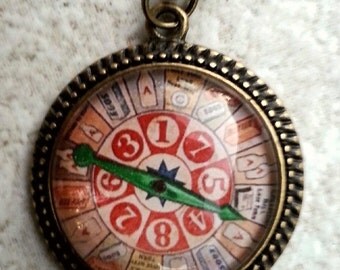
How to play:
Players select their tokens to start play. Each token designates their role in nonprofit art.
Marionette: Performing Artists/Designers
Blob of Clay: Writers/Composers/Visual Artists
Pawn: All technical/administrative/volunteer personnel (one token represents all)
Change Purse: Audience
Louis Vuitton Pocketbook: Donor/Funder
Fake Louis Vuitton Pocketbook: Development Director
Hammer: Trustee
Bent nail: Managing/Executive Director
Telescope looking up: Artistic Director/Curator
Microscope looking down: General Manager/CFO
Bloody leech: Critic/Journalist
Sorry: designated tokens for marketing/pr directors were deleted in the last budget cycle.
All players spin the Great Glass Wheel Of Art simultaneously in all directions and yell, “I Wanna!” The Wheel comes off its bearings; breaks into millions of pieces. Players move tokens anyplace in the room that feels most advantageous, regardless of the playing board or other players.
End of game:
Chaos. All players proclaim victory. None actually win.
Legacy-building is not derived from a legacy building

The intention of legacy is a killer.
Many nonprofits in the arts have chosen to engage in massive fundraising efforts to build buildings. But buildings in and of themselves are not your duty.
A capital campaign is like raising money for launch pads. NASA’s mission is to “pioneer the future in space exploration, scientific discovery and aeronautics research.” Not “build the best launch pad.”
Your nonprofit’s mission may tangentially benefit from capital expenditures. But when EDs, ADs, or philanthropists intentionally attempt to leave a legacy by building venues, they put the organization at risk of irrelevance. Some call that the “Edifice Complex.”
The building may last, but the company may die from spent energy, mission drift, and rationalizing programming for the new space.
Your legacy with a nonprofit organization ends when you leave. As it should be.
Isn’t Great Art Enough?

Doesn’t the artwork of a Van Gogh or Diego Rivera exhibit at a nonprofit museum make one seek insight into the meaning of life?
Doesn’t the performance of a nonprofit dance company’s production of Copland/DeMille’s “Rodeo” or Ailey’s “Revelations” make one try to restore the American dream?
Doesn’t the experience of a nonprofit theater’s production of “A Raisin in the Sun,” “Romeo and Juliet,” or “Angels in America” make one try to become more tolerant?
Do nonprofit arts organizations need more than those responses to justify charitable funding?
While many nonprofit arts organizations choose “art for art’s sake,” populist sentiment seeks quantifiable results to validate contributions to any portion of the nonprofit sector (social service, education, etc.).
So: shouldn’t great art be enough? Absolutely. Art can be produced for its own sake when no donations are requested.
Nonprofit Arts Organizations – Are you aware that the other parts of the sector believe that you’re stealing money?

In most nonprofits, a donor gives and someone else benefits. Food banks solve hunger, which promotes family stability, which stimulates re-entry into society for the impoverished. Environmental nonprofits encourage clean air and water, which promotes health, which supports longer, happier lives for everyone. Many religious organizations sponsor high morals (“Do unto others…”), which provides a sense of community, which fosters a safety net.
In the arts, the donor and the recipient are often the same person. The donor gives to a company, the company produces a performance or exhibit, and the donor/recipient enjoys the event. The arts are seen by many as elitist and unworthy of support.
We in the arts have to recognize that there is an enmity-laden relationship between arts nonprofits and all the other charities.
And then we have to do something about it.
This. Happened.

Years ago, I dined with a board member/lawyer who’d given $100,000 of unrestricted funding for four consecutive years. Ninety miles from home. Nice restaurant. Just us two.
Asked for this year’s gift.
Silence.
Then, he said, “Now, why do you do all these plays for the n**g**s? They’re uneducated, unsophisticated, they don’t like us, and you’re just rubbing our noses in it?”
I wanted simultaneously to vomit, slug, and flee, none of which are socially acceptable responses.
Dad once said that using the bathroom is the most socially acceptable way to buy ten minutes. I bought ten minutes.
“It’s not my money. It’s not my money,” I chanted to myself for about ten minutes. “It’s for the company. It’s unrestricted. We can spend it any way we see fit.”
Came back.
What would you say and do?
How to raise first time gifts (or any meaningful donations)

Step One: be a good person.
Gather information.
Discuss prospects.
Research history.
Decide who.
Decide whose.
Get introduction.
Meet prospect.
Discuss organization.
Change perspective.
Make friend.
Seek advice.
Send news.
Continue contact.
Explore potential.
Seek advice.
Send news.
Continue contact.
Select target.
Add 20%
Seek advice.
Discover favorites.
Send news.
Continue contact.
Select when.
Select who.
Select where.
Select why.
Schedule meeting.
Inform purpose.
Rehearse meeting.
Rehearse ask.
Refine ask.
Attend meeting.
Renew relationships.
Discuss challenges.
Embrace confidence.
Ask.
Hush.
Wait.
Listen.
Respect decision.
Accept donation.
Accept non-donation.
Thank donor.
Close meeting.
Conduct postmortem.
Discuss ramifications.
Contact donor.
Seek advice.
Send news.
Continue friendship.
Thank again.
Get referrals.
Repeat often.
People give to people – not buildings, causes, or database programs. First time gifts require relationship development. For best results on how to develop relationships, see Step One.
 137 Words