Arts Charity Leaders: The Economic Impact Argument Has Become a Losing Proposition…Move On

From ArtsFund, Seattle:
“Together the activity of nonprofit arts organizations [in our region]…generates close to $2 billion in the Central Puget Sound’s economy creating 32,520 jobs, $882 million in labor income and $83 million in taxes.”
From Viking Stadium (new NFL stadium), Minneapolis:
“Construction will support approximately 13,000 jobs…almost $300 million in wages…upon completion, 3,400 full and part-time jobs…the economic activity from a new stadium will generate over $26 million per year in tax revenue and over $145 million in direct spending by Vikings fans inside the State of Minnesota.”
From McDonald’s:
“McDonald’s provides tax revenue for local, state and national governments…$1.3 billion in United States national and state corporate taxes in 2011…McDonald’s spends hundreds of millions upgrading or building new locations.”
Let’s move on to quantifying our outcomes before we bury ourselves with more “economic impact” studies. It’s just not a winning argument for the arts.
Charity Culture: If Doing the Right Thing Makes You an Endangered Species, Do It Anyway

Sadly, few people know “Profiles in Courage.” Ask around.
Among performing arts charities, some leaders shrewdly keep their positions because they fear appearing impolitic. They seek sustainability for themselves first, and then, secondarily, their organizations.
To them I implore:
- Pay performers wages, on the books, legal standard or better, for every hour they spend: rehearsals, performances, fittings, etc.
- If your charity isn’t making a substantial difference, merge or close. If it is, share your secrets.
- It’s about social progress, not black ink. Both are preferable, but you’ve failed if your best work is 30 years of balanced budgets.
- Take a stand. Don’t buy trouble, of course, but don’t become invisible to save your own skin.
- Theatres: plays aren’t written, they’re wrought. It’s about the production and the viewpoint, not the script and sets.
- Do something. Don’t be something.
Playing Chicken – For Arts Charities, Not a Game for the Faint of Heart, Because, Well, It’s Impossible and Doesn’t Make a Compelling Case

I read an article recently called A Day Without Art. Stephanie Milling suggests scenarios in which the arts hypothetically disappear for a day. But hypothetical threats are terrible tools of advocacy.
We can’t not have art. Look at your coffee cup, even if it’s paper. It has form, function, and looky there, art on it.
Here’s the ant at this particular picnic:
If art is ubiquitous, does it have value? Why pay for it?
Rather than forecasting the impossible – a day without art – could we better spend our energies measuring our specific organization’s specific outcomes and advocate by trumpeting those to the world?
No one responds well to this particular game of chicken. It’s akin to the idea of eating your kids – it may solve the messy bathroom problem, but it’s neither realistic nor sustainable.
The Creation of Art: Diamonds and Great Art Come from Tension and Pressure

Artists don’t work alone. They require collaborators.
A script isn’t a play. A score isn’t a symphony. A scene isn’t a painting. Choreography isn’t a dance. A libretto and score isn’t an opera.
And a vision isn’t an arts charity.
For any piece of art to be considered finished (and viable), a team is required. Playwrights, composers, choreographers, visual artists, and arts charities may be the ones who create artistic launching pads, but art, like space exploration, requires a slew of equal partners. Among those: directors, performers, designers, interpreters, tools and toolmakers, and audiences. All partners create tension. And that’s good.
No single artist deserves immunity from collaborative pressure. A piece of true art isn’t done until it’s done. Not before. Not after. The immutable pressure of the finish line makes the race exciting, meaningful, and artistic.
Successful Trusteeship, or “Isn’t Writing a Big Honking Check Enough?”

Good board members:
- aren’t ambassadors. Ambassadors wait for people to come to them. They’re zealots. They zealously get donations and zealously get new board members.
- don’t try to get. They work together and with staff and they get.
- personally donate among their three largest monetary donations that year. Not from their company…from them.
- are forensic analysts, (not governors). Remember, the bottom line is “Are we living our mission? Is the mission working?” They see to it that it does, regardless of the financials.
- insist that board meetings are too important to be reporting vehicles. Productive monthly board meetings can be like having twelve mini-retreats.
Think of it this way: if each board member’s consulting rate is $100/hour and your charity has 20 board members, do you want to spend $2,000/hour talking about the past or the future?
Nonprofit Strategy: Managing Change is Hard; Managing Stasis is Impossible

I had breakfast with a trustee for an educational organization in a wealthy community within the last five years.
He bemoaned the fact that an über-wealthy benefactor was annually bailing them out with huge sums of money, but the organization was still always crying for cash. And the company refused to upgrade its business practices.
“Why is she bailing them out?” I paraphrased.
“Because it’s her legacy to her kid,” he paraphrased. “And let’s face it, for vanity.”
“And if it folds?”
“She won’t let it.”
“Are they always in a cash crisis?”
“Yes – and not only that, it’s just not serving all that many children.”
“And they can’t change the way they do business?”
“She won’t let them.”
Can’t change. Can’t succeed. Can’t close.
Bad for the organization? Bad for the industry? Bad for the community?
For Arts Charities, Everything Powerful Stems from a Great Mission…Including a Great Mission Statement
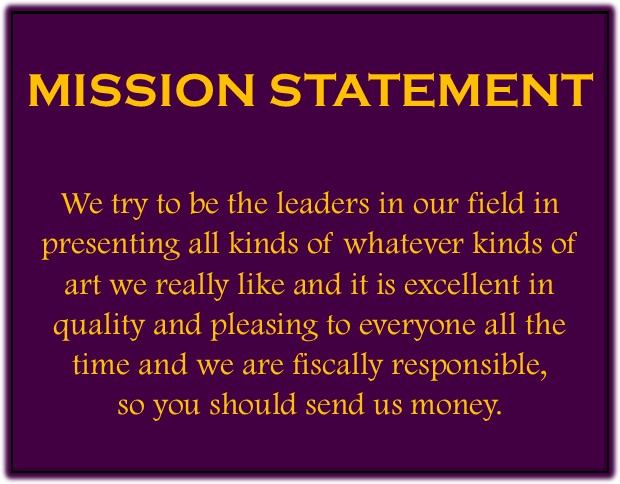
Many arts organizations craft mission statements that promote activities, art, and excellence. Unfortunately, those things are irrelevant.
“[Theater] presents engaging dramatic work that celebrates the intimate relationship among artist, audience and language.”
That’s not a mission statement. No surprise: that theater died.
A mission is the unspeakable acme of a societal obligation. A mission statement expresses that mission, the product of an organizational manifesto, as best it can.
“[Company’s] mission is to create theatre so strikingly original in form, content or both, that it instills in young people an enduring awe, love and respect for the medium, thus preserving imagination and wonder, those hallmarks of childhood which are the keys to the future.”
See the difference? This mission statement discusses the mission’s impact – “preserving imagination and wonder” – as a crucial need. That’s a supportable argument.
Nonprofit Management Counter-Intuition 2 — “Throwing Out the Baby with the Bathwater” Might Be a Better Risk than Listening to the Sirens

There is a Siren-like fatal lure to “almost there” for some charity leaders.
Let’s say that despite success in other programs, a few of the more ambitious risk-reward programs are flailing. The Sirens entice you to put more time, more effort, more personnel, and more money into the flailing programs.
When you explain to them that by moving time, personal, and financial resources away from the programs that are working into the programs that are not, the company risks the success of the working programs, the Sirens entice you to do it anyway.
Sirens are evil.
Why not take this opportunity to refresh your organization’s ambitions, goals, and programs? The smart move might be to throw all the programs out (at least on paper) and build a new list of activities that support the mission from scratch.
Dream Job…and My Title Would Be Chief Dream Merchant

What I want:
An arts charity that makes my community better.
Value to the community:
Safety. Knowledge. Personal Power. Issue solutions.
Artistic Tools:
Provocation. Entertainment. Populism. Progressiveness. Mischief.
Other Tools:
Educational residencies in both art and topic.
Partners:
Every other charity, educational institution, or NGO with similar values.
Differentiation:
50-50 split on revenues with partners. Partners open their mailing lists to help themselves financially through ticket sales.
Quantifiable outcomes:
The measured outcomes of the partners. Quantity of classes, students, and schools participating.
Non-quantifiable outcomes:
Populist results defeat the arts’ elitist reputation. The needs of the charities are filled.
Initial budget:
Enough so that all artists receive at least $15/hour (in 2014 dollars) and no full-time hourly rate is more than 4x anyone else’s.
Impact:
Arts moves people to action. Thorny issues seen can never be unseen. Life is better.
Sustainability is Neither Reaching for Relevance nor Selling Out. It’s More Important than That.

The art of sustainability in arts charities is akin to performing a balance beam routine on a Ginsu knife. You can sacrifice mission for dollars or dollars for mission, but even if you maintain a perfect balance, there will still be substantial blood on both sides.
We talk way too much about relevance in the arts. The tag in the back of the shirt is relevant for a description of content and washing instructions, but the design of the shirt can reveal personal characteristics of the wearer. Let’s aim higher. How about “integral”?
Integral arts charities are those that are so entwined with other charities that they become essential to the health of the community. “Integral” obviates this useless discussion of relevance and moves us to the more useful question:
How do the arts make communities thrive?
A Version Aversion (or: Why It’s More Important That The Whole Thing Works And Not Just The Elements)

Saw a play recently. The story was appropriately troubling and deftly told. But great art is not about literary proficiency or good acting.
Often in any of the artistic ventures, we render our version of a piece, and are judged by some version of accolade. Our study becomes about acting excellence or mind-blowing special effect or the brilliant manipulation of color and light. And critics judge on those foundations. Even in a new work, we cling to “our version.”
Fans don’t care. Fans are, fittingly, binary. Either the art makes one transform or it doesn’t. When we seek outcomes that make it jarring to return to reality, we do well. If fans only enjoy the elements created to produce the art’s reality, then “our version of art” is to “great art” as “Matchbox Cars” are to “Lamborghinis.”
You Gotta Live in the House You Live in

Hypothetical: Strategically speaking, what would your charity do if money were not an issue at all?
The answer to this question is significant. Because if it begins with anything but “we’d do exactly what we’re doing now,” then it’s likely that either you or your mission have to go.
I live in a 1950s house. Typical low ceilings. Small, utilitarian rooms. If I had all the money in the world to renovate it, I’d enhance its 1950s nature, not build 4 additional stories to get a Puget Sound view and in doing so, ruin the house’s charm.
Same with charities, arts or otherwise. You created a mission for a reason…there was a need. A societal wrong to be righted. If you want to accomplish something other than your organization’s mission, go do it.
Just do it somewhere else.
Jack and Jill: Why Smart Nonprofits Search for Interim Leadership
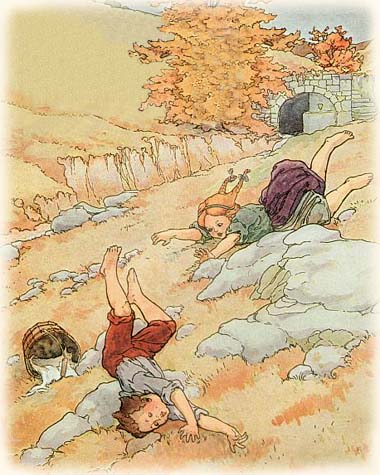
Executive Director Jack resigns.
Jack leads the committee to replace himself. The committee selects Jill.
Jill is not Jack.
Jill discovers too late that she been enlisted to follow Jack’s path rather than set her own.
After a year, not only is Jill unhappy, but trustees and employees resign.
After a second year, Jill resigns. Or is fired.
The reeling company hires Fred – who is neither Jack nor Jill.
Uneasy lies the head that breaks a crown.
Succession planning needn’t require permanence. It might be best to hire an interim leader from outside the organization (not a board member) while the permanent search is carefully executed.
Every organizational leader’s legacy ends the day the leader leaves. Which means it is never a good idea to have the outgoing director have a say on a permanent successor.
Like licking honey off a thorn – Art, why we do it, who it’s for, and why it has power

Painters sing.
Actors play.
Writers choreograph.
Singers paint.
Dancers conduct.
Choreographers sculpt.
Sculptors act.
Musicians paint.
Directors sing.
Conductors write.
And in doing so, no issue, thought, or attitude can be unseen, unfelt, or unheard. It is not for the singing, the painting, etc., that art is produced. The glory of art is in its scope of power. To inspire peace or revolution. To cause great comfort or great discomfort. To provide joy or desolation.
As a populist, I believe that visual and performing arts serve great groups of people. I fear that many in power judge art as dangerous. Their battle plan continues to manipulate those same great groups of people into despising it, to consider it as foreign. As the other.
And I fear that they’ve won that battle. But not the war. Not yet.
More words and phrases that ought to be outlawed from the lexicon

“If you build it, they will come.” – Originally written by WP Kinsella in his best-selling novel, Shoeless Joe, and popularized in FIELD OF DREAMS, these six words have rationalized arts capital campaigns across the US, many of the fruits of which have predictably become money pits.
(The original quote was “If you build it, he will come,” and referred to the protagonist’s father. They had a catch.)
“Art for art’s sake” – coined in the 19th century to justify Aestheticism, in which art was thought to exist for the sake of its beauty alone, and that it need serve no other purpose. Today used to justify programming for many arts organizations.
“Community” – here’s the OED definition. Used by nonprofits in a mercurial manner to keep from describing the very people they wish to positively affect.
Nag, nag, nag. So, Mr. Big Shot, how do you make a perfect nonprofit arts organization?

There is no perfect nonprofit organization of any kind. All nonprofits are experiments in righting some crucial societal wrong.
For the arts, that wrong is ignorance. It is complacence. It is the invisibility of the big picture. The visual and performing arts bring us beauty, power, and intellect. The opposite of all those words, of course, is nothingness.
Art is never for art’s sake because it is condescending to anthropomorphize it.
When great nonprofit arts organizations look at their core ambitions and value, they view their work as an innovative tool toward the betterment of society.
Commercial arts organizations’ goals begin and end with profits. Mediocre arts nonprofits goals are measured by their art. Great arts organizations’ goals involve righting the crucial societal wrong.
Final note: Great nonprofits don’t consider self-survival a worthy mission. Mediocre ones do.
Legacy-building is not derived from a legacy building

The intention of legacy is a killer.
Many nonprofits in the arts have chosen to engage in massive fundraising efforts to build buildings. But buildings in and of themselves are not your duty.
A capital campaign is like raising money for launch pads. NASA’s mission is to “pioneer the future in space exploration, scientific discovery and aeronautics research.” Not “build the best launch pad.”
Your nonprofit’s mission may tangentially benefit from capital expenditures. But when EDs, ADs, or philanthropists intentionally attempt to leave a legacy by building venues, they put the organization at risk of irrelevance. Some call that the “Edifice Complex.”
The building may last, but the company may die from spent energy, mission drift, and rationalizing programming for the new space.
Your legacy with a nonprofit organization ends when you leave. As it should be.
Isn’t Great Art Enough?

Doesn’t the artwork of a Van Gogh or Diego Rivera exhibit at a nonprofit museum make one seek insight into the meaning of life?
Doesn’t the performance of a nonprofit dance company’s production of Copland/DeMille’s “Rodeo” or Ailey’s “Revelations” make one try to restore the American dream?
Doesn’t the experience of a nonprofit theater’s production of “A Raisin in the Sun,” “Romeo and Juliet,” or “Angels in America” make one try to become more tolerant?
Do nonprofit arts organizations need more than those responses to justify charitable funding?
While many nonprofit arts organizations choose “art for art’s sake,” populist sentiment seeks quantifiable results to validate contributions to any portion of the nonprofit sector (social service, education, etc.).
So: shouldn’t great art be enough? Absolutely. Art can be produced for its own sake when no donations are requested.
Nonprofit Arts Organizations – Are you aware that the other parts of the sector believe that you’re stealing money?

In most nonprofits, a donor gives and someone else benefits. Food banks solve hunger, which promotes family stability, which stimulates re-entry into society for the impoverished. Environmental nonprofits encourage clean air and water, which promotes health, which supports longer, happier lives for everyone. Many religious organizations sponsor high morals (“Do unto others…”), which provides a sense of community, which fosters a safety net.
In the arts, the donor and the recipient are often the same person. The donor gives to a company, the company produces a performance or exhibit, and the donor/recipient enjoys the event. The arts are seen by many as elitist and unworthy of support.
We in the arts have to recognize that there is an enmity-laden relationship between arts nonprofits and all the other charities.
And then we have to do something about it.
Flagship or Dreadnought: Regional Theaters in America

With the recent blog by Annah Feinberg currently making the circuit, it seems a good time to chronicle the regional theater “movement.”
1910-1930s: The “Little Theatre Movement.” Few paid artists, but it reflected a community need. Killed by the Depression/WWII.
1947: Dallas – Margo Jones founded Theatre ’47.
1950: Washington, D.C. – Zelda Fichandler founded Arena Stage.
1959: Tyrone Guthrie placed an ad in The New York Times. Asked if any communities wanted to sponsor a resident theatre. 1963 – Guthrie Theatre opens in Minneapolis.
But this did not become a “movement” until the late ’60s when some plays moved from regionals to Broadway, turning many regional theater companies into minor-league baseball clubs.
People outside New York want to experience great plays relevant to their lives.
Unwieldy regionals often gauge success in the form of plays transferring to Broadway.
Irony or disconnect?
Neither artists nor nonprofit arts organizations are entitled, they just act that way sometimes

Every kid wins trophies.
There are two possible takeaways from this fact:
a) Trophies don’t mean much; or
b) Every kid deserves trophies.
Or both.
If a), then the result is that external recognition must be useless. Which means:
1) We reward mediocrity.
2) We foster cynicism to greatness.
If b), then the result is that external recognition must be unrelenting. Which means:
3) We reward everything.
4) We foster entitlement to greatness.
I have rarely seen folks as entitled as those in the performing arts today, at least here in Seattle, the epicenter of externally-based self-esteem. I’ve known dozens of actors who have insisted that they’re too talented to audition. Dozens more of nonprofit arts organizations feeling too holy to follow a mission.
Consider: Oscar Isaac had to audition for the role of Llewyn Davis. It wasn’t handed to him.
“That Happened to Me!” – Can nonprofit arts organizations figure out a way to quantify personal meaning?

I wrote a strange and pretty bad play.
One scene took place at the World Trade Center in the wee hours of September 11, 2001. A financial analyst for Cantor Fitzgerald berates a brown-skinned file clerk. The scene was meant to be darkly humorous and uncomfortable.
After one public reading, a woman screamed about that scene.
Tearfully, she raged, “That happened to me! The World Trade Center happened to me!”
I asked, “Oh, were you in New York?”
“No. Baltimore.”
While social impact nonprofits exhibit myriad ways to show purpose beyond basic human needs, arts organizations struggle to show any measurable societal value. However, if we can quantify personal meaning with specific results and stories of value, then we can become successful charitable organizations.
For in every “That happened to me,” the impact is genuinely meaningful.
“Here we go, Rembrandt, here we go!” – Fans (who cheer) or audiences (who hear)?

“HOLD THAT NOTE! HOLD THAT NOTE!”
“PUSH ‘EM BACK! PUSH ‘EM BACK! NOW STEP, TOUCH, JETÉ AND HOLD!”
“S-C-E-N-E, SCEE-EEENE, SCEE-EEENE!”
Years ago, I sat in the third-to-top row of an NFL stadium with an artistic director friend. First game of the season. Even people behind us were screaming their heads off and waving their foam fingers. And the experience was more personally meaningful to them than many arts experiences I’ve loved.
Sports fans no more control the action of a game than arts fans do a play or concert. But they’re encouraged to be blitheringly engaged. And all too often, arts fans are encouraged to sit back and relax. Or shut up and listen. Like a lecture at school.
We wondered, can arts organizations find ways to encourage blithering? Or are we too clubby for that?
Cue the heavenly chorus…your nonprofit arts organization will never be hungry again!

Acting is not about performing; nor is painting about artistry; nor is music is about musicianship; nor is dancing about prowess.
Similarly, nonprofit arts organizations cannot be about exhibitions/performances.
The impact of the arts can be quantified. There are myriad studies. But the impact of any individual arts organization is not an equivalent discussion. Each organization must provide specific impact, or better, impact2.
Impact2 is the impact’s impact. As a food bank provides positive impact to a concrete number of families, its impact2 may be the number of households that escaped poverty from having had the gift of food in its worst times.
Many nonprofit arts organizations often define themselves by the quality of production. No surprise, then, that so many struggle to reach new donors. Quantify the impact2 of your nonprofit, and you’ll find your Grail.
‘Twas the week before Christmas and all o’er the glade, the galleries, ballets, and playhouse got paid… And the board chair exclaimed, ere he took his tax break, “Merry Christmas to all, and to all a good take.”

Ebenezer Scrooge and George Bailey…
Langston Hughes and the Four Plaids…
Handel and the Mormon Tabernacle Choir…
Christmas in Wales and Christmas in Macy*s…
The Mouse King and the Sugar Plum Fairy…
Your local carolers, buskers, jazz artists, ornament craft-makers, and pageant participants know what it’s about. Joy, family, charity, peace, and goodwill toward mankind.
And a boatload of cash. The Holiday-Cash-Cow sings, “Moo-moo-moo, moo-moo-moo, moo-moo-moo-moo-moo.”
“But we pay for the stuff no one wants to see all year with this one production of ‘A Christmas Carol!” said a board president pal of mine.
And as one managing director famously said, “We do the mission all year long. Except Christmas. That’s where we try to make money.”
Last I checked, one of the morals of “A Christmas Carol” had something to do with, what was it again…?
 137 Words