Nonprofit Strategy: Managing Change is Hard; Managing Stasis is Impossible

I had breakfast with a trustee for an educational organization in a wealthy community within the last five years.
He bemoaned the fact that an über-wealthy benefactor was annually bailing them out with huge sums of money, but the organization was still always crying for cash. And the company refused to upgrade its business practices.
“Why is she bailing them out?” I paraphrased.
“Because it’s her legacy to her kid,” he paraphrased. “And let’s face it, for vanity.”
“And if it folds?”
“She won’t let it.”
“Are they always in a cash crisis?”
“Yes – and not only that, it’s just not serving all that many children.”
“And they can’t change the way they do business?”
“She won’t let them.”
Can’t change. Can’t succeed. Can’t close.
Bad for the organization? Bad for the industry? Bad for the community?
For Arts Charities, Everything Powerful Stems from a Great Mission…Including a Great Mission Statement
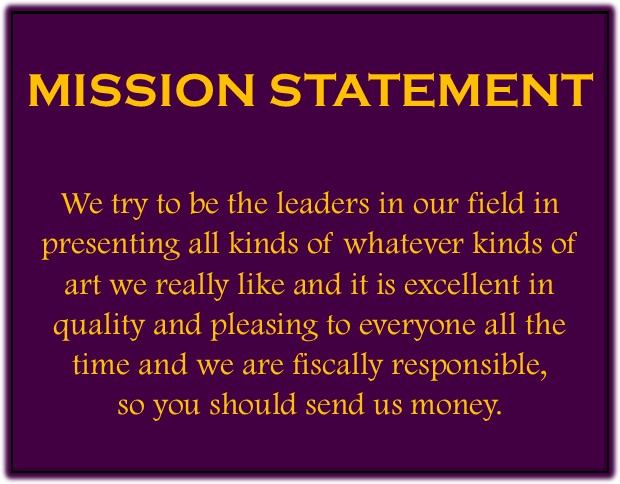
Many arts organizations craft mission statements that promote activities, art, and excellence. Unfortunately, those things are irrelevant.
“[Theater] presents engaging dramatic work that celebrates the intimate relationship among artist, audience and language.”
That’s not a mission statement. No surprise: that theater died.
A mission is the unspeakable acme of a societal obligation. A mission statement expresses that mission, the product of an organizational manifesto, as best it can.
“[Company’s] mission is to create theatre so strikingly original in form, content or both, that it instills in young people an enduring awe, love and respect for the medium, thus preserving imagination and wonder, those hallmarks of childhood which are the keys to the future.”
See the difference? This mission statement discusses the mission’s impact – “preserving imagination and wonder” – as a crucial need. That’s a supportable argument.
Dream Job…and My Title Would Be Chief Dream Merchant

What I want:
An arts charity that makes my community better.
Value to the community:
Safety. Knowledge. Personal Power. Issue solutions.
Artistic Tools:
Provocation. Entertainment. Populism. Progressiveness. Mischief.
Other Tools:
Educational residencies in both art and topic.
Partners:
Every other charity, educational institution, or NGO with similar values.
Differentiation:
50-50 split on revenues with partners. Partners open their mailing lists to help themselves financially through ticket sales.
Quantifiable outcomes:
The measured outcomes of the partners. Quantity of classes, students, and schools participating.
Non-quantifiable outcomes:
Populist results defeat the arts’ elitist reputation. The needs of the charities are filled.
Initial budget:
Enough so that all artists receive at least $15/hour (in 2014 dollars) and no full-time hourly rate is more than 4x anyone else’s.
Impact:
Arts moves people to action. Thorny issues seen can never be unseen. Life is better.
Sustainability is Neither Reaching for Relevance nor Selling Out. It’s More Important than That.

The art of sustainability in arts charities is akin to performing a balance beam routine on a Ginsu knife. You can sacrifice mission for dollars or dollars for mission, but even if you maintain a perfect balance, there will still be substantial blood on both sides.
We talk way too much about relevance in the arts. The tag in the back of the shirt is relevant for a description of content and washing instructions, but the design of the shirt can reveal personal characteristics of the wearer. Let’s aim higher. How about “integral”?
Integral arts charities are those that are so entwined with other charities that they become essential to the health of the community. “Integral” obviates this useless discussion of relevance and moves us to the more useful question:
How do the arts make communities thrive?
A Version Aversion (or: Why It’s More Important That The Whole Thing Works And Not Just The Elements)
Saw a play recently. The story was appropriately troubling and deftly told. But great art is not about literary proficiency or good acting.
Often in any of the artistic ventures, we render our version of a piece, and are judged by some version of accolade. Our study becomes about acting excellence or mind-blowing special effect or the brilliant manipulation of color and light. And critics judge on those foundations. Even in a new work, we cling to “our version.”
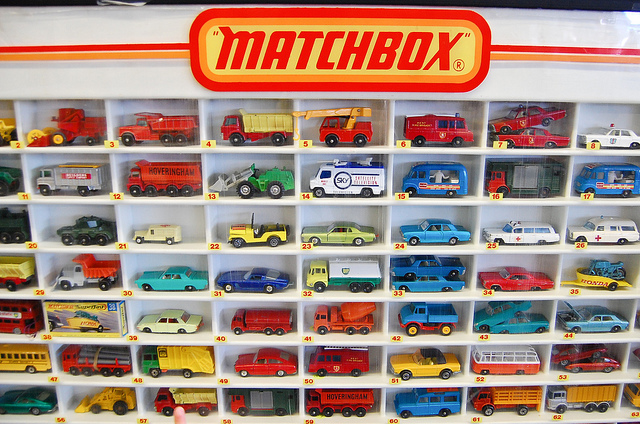
Fans don’t care. Fans are, fittingly, binary. Either the art makes one transform or it doesn’t. When we seek outcomes that make it jarring to return to reality, we do well. If fans only enjoy the elements created to produce the art’s reality, then “our version of art” is to “great art” as “Matchbox Cars” are to “Lamborghinis.”
Like licking honey off a thorn – Art, why we do it, who it’s for, and why it has power

Painters sing.
Actors play.
Writers choreograph.
Singers paint.
Dancers conduct.
Choreographers sculpt.
Sculptors act.
Musicians paint.
Directors sing.
Conductors write.
And in doing so, no issue, thought, or attitude can be unseen, unfelt, or unheard. It is not for the singing, the painting, etc., that art is produced. The glory of art is in its scope of power. To inspire peace or revolution. To cause great comfort or great discomfort. To provide joy or desolation.
As a populist, I believe that visual and performing arts serve great groups of people. I fear that many in power judge art as dangerous. Their battle plan continues to manipulate those same great groups of people into despising it, to consider it as foreign. As the other.
And I fear that they’ve won that battle. But not the war. Not yet.
More words and phrases that ought to be outlawed from the lexicon

“If you build it, they will come.” – Originally written by WP Kinsella in his best-selling novel, Shoeless Joe, and popularized in FIELD OF DREAMS, these six words have rationalized arts capital campaigns across the US, many of the fruits of which have predictably become money pits.
(The original quote was “If you build it, he will come,” and referred to the protagonist’s father. They had a catch.)
“Art for art’s sake” – coined in the 19th century to justify Aestheticism, in which art was thought to exist for the sake of its beauty alone, and that it need serve no other purpose. Today used to justify programming for many arts organizations.
“Community” – here’s the OED definition. Used by nonprofits in a mercurial manner to keep from describing the very people they wish to positively affect.
“I Wanna!” The Fatal Game of Power About Nonprofit Arts. Ages infantile and up.
How to play:
Players select their tokens to start play. Each token designates their role in nonprofit art.
Marionette: Performing Artists/Designers
Blob of Clay: Writers/Composers/Visual Artists
Pawn: All technical/administrative/volunteer personnel (one token represents all)
Change Purse: Audience
Louis Vuitton Pocketbook: Donor/Funder
Fake Louis Vuitton Pocketbook: Development Director
Hammer: Trustee
Bent nail: Managing/Executive Director
Telescope looking up: Artistic Director/Curator
Microscope looking down: General Manager/CFO
Bloody leech: Critic/Journalist
Sorry: designated tokens for marketing/pr directors were deleted in the last budget cycle.
All players spin the Great Glass Wheel Of Art simultaneously in all directions and yell, “I Wanna!” The Wheel comes off its bearings; breaks into millions of pieces. Players move tokens anyplace in the room that feels most advantageous, regardless of the playing board or other players.
End of game:
Chaos. All players proclaim victory. None actually win.
Nag, nag, nag. So, Mr. Big Shot, how do you make a perfect nonprofit arts organization?

There is no perfect nonprofit organization of any kind. All nonprofits are experiments in righting some crucial societal wrong.
For the arts, that wrong is ignorance. It is complacence. It is the invisibility of the big picture. The visual and performing arts bring us beauty, power, and intellect. The opposite of all those words, of course, is nothingness.
Art is never for art’s sake because it is condescending to anthropomorphize it.
When great nonprofit arts organizations look at their core ambitions and value, they view their work as an innovative tool toward the betterment of society.
Commercial arts organizations’ goals begin and end with profits. Mediocre arts nonprofits goals are measured by their art. Great arts organizations’ goals involve righting the crucial societal wrong.
Final note: Great nonprofits don’t consider self-survival a worthy mission. Mediocre ones do.
Isn’t Great Art Enough?

Doesn’t the artwork of a Van Gogh or Diego Rivera exhibit at a nonprofit museum make one seek insight into the meaning of life?
Doesn’t the performance of a nonprofit dance company’s production of Copland/DeMille’s “Rodeo” or Ailey’s “Revelations” make one try to restore the American dream?
Doesn’t the experience of a nonprofit theater’s production of “A Raisin in the Sun,” “Romeo and Juliet,” or “Angels in America” make one try to become more tolerant?
Do nonprofit arts organizations need more than those responses to justify charitable funding?
While many nonprofit arts organizations choose “art for art’s sake,” populist sentiment seeks quantifiable results to validate contributions to any portion of the nonprofit sector (social service, education, etc.).
So: shouldn’t great art be enough? Absolutely. Art can be produced for its own sake when no donations are requested.
Nonprofit Arts Organizations – Are you aware that the other parts of the sector believe that you’re stealing money?

In most nonprofits, a donor gives and someone else benefits. Food banks solve hunger, which promotes family stability, which stimulates re-entry into society for the impoverished. Environmental nonprofits encourage clean air and water, which promotes health, which supports longer, happier lives for everyone. Many religious organizations sponsor high morals (“Do unto others…”), which provides a sense of community, which fosters a safety net.
In the arts, the donor and the recipient are often the same person. The donor gives to a company, the company produces a performance or exhibit, and the donor/recipient enjoys the event. The arts are seen by many as elitist and unworthy of support.
We in the arts have to recognize that there is an enmity-laden relationship between arts nonprofits and all the other charities.
And then we have to do something about it.
Flagship or Dreadnought: Regional Theaters in America

With the recent blog by Annah Feinberg currently making the circuit, it seems a good time to chronicle the regional theater “movement.”
1910-1930s: The “Little Theatre Movement.” Few paid artists, but it reflected a community need. Killed by the Depression/WWII.
1947: Dallas – Margo Jones founded Theatre ’47.
1950: Washington, D.C. – Zelda Fichandler founded Arena Stage.
1959: Tyrone Guthrie placed an ad in The New York Times. Asked if any communities wanted to sponsor a resident theatre. 1963 – Guthrie Theatre opens in Minneapolis.
But this did not become a “movement” until the late ’60s when some plays moved from regionals to Broadway, turning many regional theater companies into minor-league baseball clubs.
People outside New York want to experience great plays relevant to their lives.
Unwieldy regionals often gauge success in the form of plays transferring to Broadway.
Irony or disconnect?
Neither artists nor nonprofit arts organizations are entitled, they just act that way sometimes
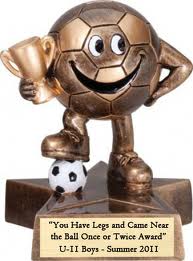
Every kid wins trophies.
There are two possible takeaways from this fact:
a) Trophies don’t mean much; or
b) Every kid deserves trophies.
Or both.
If a), then the result is that external recognition must be useless. Which means:
1) We reward mediocrity.
2) We foster cynicism to greatness.
If b), then the result is that external recognition must be unrelenting. Which means:
3) We reward everything.
4) We foster entitlement to greatness.
I have rarely seen folks as entitled as those in the performing arts today, at least here in Seattle, the epicenter of externally-based self-esteem. I’ve known dozens of actors who have insisted that they’re too talented to audition. Dozens more of nonprofit arts organizations feeling too holy to follow a mission.
Consider: Oscar Isaac had to audition for the role of Llewyn Davis. It wasn’t handed to him.
This. Happened.

Years ago, I dined with a board member/lawyer who’d given $100,000 of unrestricted funding for four consecutive years. Ninety miles from home. Nice restaurant. Just us two.
Asked for this year’s gift.
Silence.
Then, he said, “Now, why do you do all these plays for the n**g**s? They’re uneducated, unsophisticated, they don’t like us, and you’re just rubbing our noses in it?”
I wanted simultaneously to vomit, slug, and flee, none of which are socially acceptable responses.
Dad once said that using the bathroom is the most socially acceptable way to buy ten minutes. I bought ten minutes.
“It’s not my money. It’s not my money,” I chanted to myself for about ten minutes. “It’s for the company. It’s unrestricted. We can spend it any way we see fit.”
Came back.
What would you say and do?
“That Happened to Me!” – Can nonprofit arts organizations figure out a way to quantify personal meaning?

I wrote a strange and pretty bad play.
One scene took place at the World Trade Center in the wee hours of September 11, 2001. A financial analyst for Cantor Fitzgerald berates a brown-skinned file clerk. The scene was meant to be darkly humorous and uncomfortable.
After one public reading, a woman screamed about that scene.
Tearfully, she raged, “That happened to me! The World Trade Center happened to me!”
I asked, “Oh, were you in New York?”
“No. Baltimore.”
While social impact nonprofits exhibit myriad ways to show purpose beyond basic human needs, arts organizations struggle to show any measurable societal value. However, if we can quantify personal meaning with specific results and stories of value, then we can become successful charitable organizations.
For in every “That happened to me,” the impact is genuinely meaningful.
Positive Signs in the Nonprofit Arts Community
Some nonprofit arts organizations are making new, better choices – and it’s working.
One theater company, eschewing the managing director template (part operations director, part fundraiser, part CPA), has chosen to split the duties. They’ve brought on a strategy director to handle outside duties (fundraising, speaking, lobbying) and strategic plan piloting. The operations and financial duties lie with the general manager.
One children’s arts company, eschewing the arts-revenue template (part production house, part arts education academy), produces in the same facility as several social service agencies. They incorporate the other nonprofits into everything they do, produce a specific style of performance art that speaks to the values of their ethnically, linguistically diverse neighborhood, and gauge success by how well all the nonprofits are bettering the lives of their constituents.
New prototypes. New measurements. New realizations. Excellent work.
Nonprofit Arts Lingo Ready for Expunging…and Words to Use Instead

Subscription Season Tickets, Packages [“Subscription” = “Newspaper” = “Dying Industry”]
Audience Fans, Partners [Audiences hear, fans root, partners invest]
Watch Participate, Enjoy, Love [See “Audience”]
Us, we It, the [“We” requires “They”]
“Play a part” [Any non-cutesy non-cliche]
Spectacular, incredible, fabulous, gifted, talented, great, wonderful, delightful, fantastic, poignant, moving [Overused and does not describe the event – unless literally (big 3-ring circuses, for example, are spectacular); it also insults readers by dictating how they should feel]
Witty Funny, hilarious [“Witty” makes some feel as though the work is above their intellectual pay grade]
“Lost Ticket Insurance” [No one cares]
Engage, enlighten, educate Brighten, connect, involve [see “Witty”]
“Something for Everyone” [Never use this phrase. What your organization does is NOT for everyone; therefore, it’s a lie. It also implies that your organization is profit-seeking. Who would donate to McDonald’s?]
2014. A year of art awaits you. Predictions for the year to come…

A company you’ve never heard of will produce something special.
A famous company everyone knows will close down.
A play will shake your long-held beliefs.
A concert will move you to tears.
You’ll stop short and get lost in a painting.
You’ll attend an amazing performance that can’t be pigeonholed as theatre, dance, comedy, or music.
Another new study will come out proving that kids with in-school arts education will enjoy great test scores, not join gangs, and will have a tendency to be drug-free. Their community participation will be more extensive, and they’ll be likelier to enter college.
Despite that, in-school arts education will disappear.
Great arts nonprofits will find universally-accepted ways to quantify impact and will receive all the funding they require.
I wish you love, luck, and success in 2014. Oh yes, and art.
 137 Words