The Creation of Art: Diamonds and Great Art Come from Tension and Pressure

Artists don’t work alone. They require collaborators.
A script isn’t a play. A score isn’t a symphony. A scene isn’t a painting. Choreography isn’t a dance. A libretto and score isn’t an opera.
And a vision isn’t an arts charity.
For any piece of art to be considered finished (and viable), a team is required. Playwrights, composers, choreographers, visual artists, and arts charities may be the ones who create artistic launching pads, but art, like space exploration, requires a slew of equal partners. Among those: directors, performers, designers, interpreters, tools and toolmakers, and audiences. All partners create tension. And that’s good.
No single artist deserves immunity from collaborative pressure. A piece of true art isn’t done until it’s done. Not before. Not after. The immutable pressure of the finish line makes the race exciting, meaningful, and artistic.
This Just In: Artists Value Money Just Like You Do

I just read an article in the Chicago Tribune about actors receiving no payment for some performances. I’m not sure why it was written, except as acknowledgment that, well, actors receive no payment for some performances. Even for hit shows.
But why? “We can either pay you guys and not do a show — or not pay you and do a show,” said one producer in the article.
Here’s the thing: there are lots of performers. The competition forces them to undervalue themselves.
But that doesn’t mean that it’s ethical not to pay them. At least minimum wage. For rehearsal and performance time.
If that producer decides not to make money on a project, that’s his prerogative. But no pay to performers is abusive, unless he’s offering 40 acres and a mule after the run of the show.
Nonprofit Strategy: Managing Change is Hard; Managing Stasis is Impossible

I had breakfast with a trustee for an educational organization in a wealthy community within the last five years.
He bemoaned the fact that an über-wealthy benefactor was annually bailing them out with huge sums of money, but the organization was still always crying for cash. And the company refused to upgrade its business practices.
“Why is she bailing them out?” I paraphrased.
“Because it’s her legacy to her kid,” he paraphrased. “And let’s face it, for vanity.”
“And if it folds?”
“She won’t let it.”
“Are they always in a cash crisis?”
“Yes – and not only that, it’s just not serving all that many children.”
“And they can’t change the way they do business?”
“She won’t let them.”
Can’t change. Can’t succeed. Can’t close.
Bad for the organization? Bad for the industry? Bad for the community?
For Arts Charities, Everything Powerful Stems from a Great Mission…Including a Great Mission Statement
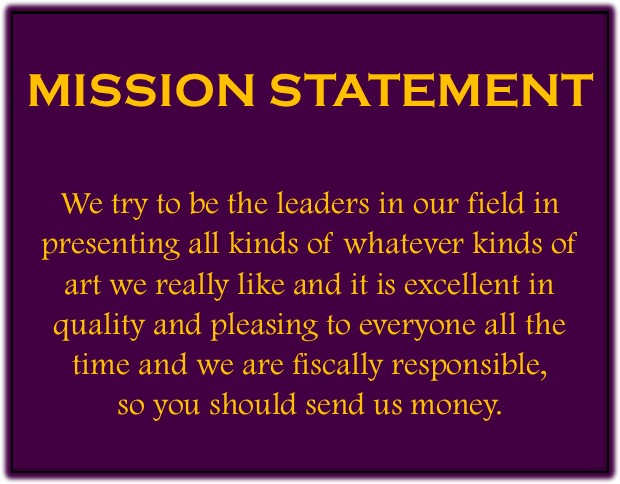
Many arts organizations craft mission statements that promote activities, art, and excellence. Unfortunately, those things are irrelevant.
“[Theater] presents engaging dramatic work that celebrates the intimate relationship among artist, audience and language.”
That’s not a mission statement. No surprise: that theater died.
A mission is the unspeakable acme of a societal obligation. A mission statement expresses that mission, the product of an organizational manifesto, as best it can.
“[Company’s] mission is to create theatre so strikingly original in form, content or both, that it instills in young people an enduring awe, love and respect for the medium, thus preserving imagination and wonder, those hallmarks of childhood which are the keys to the future.”
See the difference? This mission statement discusses the mission’s impact – “preserving imagination and wonder” – as a crucial need. That’s a supportable argument.
Nonprofit Management Counter-Intuition 2 — “Throwing Out the Baby with the Bathwater” Might Be a Better Risk than Listening to the Sirens

There is a Siren-like fatal lure to “almost there” for some charity leaders.
Let’s say that despite success in other programs, a few of the more ambitious risk-reward programs are flailing. The Sirens entice you to put more time, more effort, more personnel, and more money into the flailing programs.
When you explain to them that by moving time, personal, and financial resources away from the programs that are working into the programs that are not, the company risks the success of the working programs, the Sirens entice you to do it anyway.
Sirens are evil.
Why not take this opportunity to refresh your organization’s ambitions, goals, and programs? The smart move might be to throw all the programs out (at least on paper) and build a new list of activities that support the mission from scratch.
Rethinking the Group Job Interview – Consensus? Abdication? Or Focus Group?
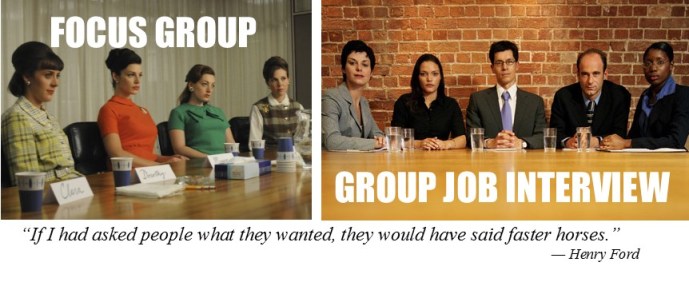
I’ve tortured people in the group interview process. I thought I was offering consensus. Buy-in. Group drive.
I was wrong.
Wrong. Wrong. Wrong.
Oh, so wrong.
To everyone I’ve ever put through that, on either side of the table, I apologize. I’ll never do it again. Promise.
There are four decisions: autocratic (I say), consultative (I say with your input), democratic (we vote, losers weep), consensus (we vote and everyone backs the decision).
As practiced, the group interview might have evolved into a method for managers to abdicate responsibility in the name of consensus. While consensus is ideal, the group-think process can too often be dominated by a crank in the corner with issues, motives, and insecurities. And, possibly, an unknown agenda.
Group-think promises consensus but can preclude innovation.
And why would you ever choose to preclude innovation?
Disinterested Advocacy: When Issues Become Global, the Pool for Support Grows Exponentially

Women’s issues are not about women. Race issues are not about people of color.
And when Mars attacks Oklahoma, the issues will not be about Oklahoma.
I visited a domestic abuse nonprofit. They do great work, but are ghettoized by donors as a “women’s issue” charity. The executive director wondered how they might be able to globalize the cause (and increase revenues).
“Domestic abuse is a societal problem,” she complained. “And I worry that without some men providing disinterested advocacy, we’ll only attract women donors.”
But every time she interviewed qualified men for marketing or development positions (and they’d graduate to a final 10-on-1 group interview), the staff and board balked. “Just not a good fit,” they’d euphemize. And they’d recommend another qualified woman.
Is your charity’s issue exclusively yours? If not, how are you communicating that?
Hiring 102: Breaking the Code on Ageism (We’re on to You.)

You don’t have to be Alan Turing to break the HR “can’t-ask-how-old-you-are” code:
“How is your energy level?” = “Are you a geezer?”
…Correct response: “I run 26 marathons daily.”
“What were you doing before 2001?” = “What were you doing before I turned 10?”
…Correct response: “I’m 35 years old with 30 years’ experience.”
“When did you graduate college?” = “I’m checking my arithmetic to determine your age.”
…Correct response: “When I was 22.”
“How flexible are you?” = “Is your mind as ossified as a petrified fossil?”
…Correct response: “I’m currently holding the phone with my pinkie toe while simultaneously writing Iraq’s new constitution.”
Seriously, though, hiring managers: according to the US Bureau of Labor Statistics, workers 45–64 stayed twice as long as those 25–34 — so those under 40 are a much higher risk of leaving you high and dry.
So stop it.
Dream Job…and My Title Would Be Chief Dream Merchant

What I want:
An arts charity that makes my community better.
Value to the community:
Safety. Knowledge. Personal Power. Issue solutions.
Artistic Tools:
Provocation. Entertainment. Populism. Progressiveness. Mischief.
Other Tools:
Educational residencies in both art and topic.
Partners:
Every other charity, educational institution, or NGO with similar values.
Differentiation:
50-50 split on revenues with partners. Partners open their mailing lists to help themselves financially through ticket sales.
Quantifiable outcomes:
The measured outcomes of the partners. Quantity of classes, students, and schools participating.
Non-quantifiable outcomes:
Populist results defeat the arts’ elitist reputation. The needs of the charities are filled.
Initial budget:
Enough so that all artists receive at least $15/hour (in 2014 dollars) and no full-time hourly rate is more than 4x anyone else’s.
Impact:
Arts moves people to action. Thorny issues seen can never be unseen. Life is better.
Sustainability is Neither Reaching for Relevance nor Selling Out. It’s More Important than That.

The art of sustainability in arts charities is akin to performing a balance beam routine on a Ginsu knife. You can sacrifice mission for dollars or dollars for mission, but even if you maintain a perfect balance, there will still be substantial blood on both sides.
We talk way too much about relevance in the arts. The tag in the back of the shirt is relevant for a description of content and washing instructions, but the design of the shirt can reveal personal characteristics of the wearer. Let’s aim higher. How about “integral”?
Integral arts charities are those that are so entwined with other charities that they become essential to the health of the community. “Integral” obviates this useless discussion of relevance and moves us to the more useful question:
How do the arts make communities thrive?
A Version Aversion (or: Why It’s More Important That The Whole Thing Works And Not Just The Elements)

Saw a play recently. The story was appropriately troubling and deftly told. But great art is not about literary proficiency or good acting.
Often in any of the artistic ventures, we render our version of a piece, and are judged by some version of accolade. Our study becomes about acting excellence or mind-blowing special effect or the brilliant manipulation of color and light. And critics judge on those foundations. Even in a new work, we cling to “our version.”
Fans don’t care. Fans are, fittingly, binary. Either the art makes one transform or it doesn’t. When we seek outcomes that make it jarring to return to reality, we do well. If fans only enjoy the elements created to produce the art’s reality, then “our version of art” is to “great art” as “Matchbox Cars” are to “Lamborghinis.”
Innovation: not just for production managers and marketing directors

I love production managers. The good ones tend to come from a background of experimentation. Using the improv-tested training mantra of “Yes And,” their work ethic promotes wildly thoughtful experimentation.
I love marketing directors, too. Good ones aim for reaction rather than beauty. No fan cares about “Addy” awards. They care about having a personally meaningful experience.
Innovation in arts charities need not be limited to the production manager or marketing director, the two lead staff members dedicated to translating the art to fans.
To innovate, all you need to do is innovate. Which requires…
Identifying the need…
Honor for the ideas of the team…
Synthesizing the data…
10% more time than is available…
500% more patience…
A vision of success…
And the acceptance that, as more than one production manager has famously said, “This could suck.”
Like licking honey off a thorn – Art, why we do it, who it’s for, and why it has power

Painters sing.
Actors play.
Writers choreograph.
Singers paint.
Dancers conduct.
Choreographers sculpt.
Sculptors act.
Musicians paint.
Directors sing.
Conductors write.
And in doing so, no issue, thought, or attitude can be unseen, unfelt, or unheard. It is not for the singing, the painting, etc., that art is produced. The glory of art is in its scope of power. To inspire peace or revolution. To cause great comfort or great discomfort. To provide joy or desolation.
As a populist, I believe that visual and performing arts serve great groups of people. I fear that many in power judge art as dangerous. Their battle plan continues to manipulate those same great groups of people into despising it, to consider it as foreign. As the other.
And I fear that they’ve won that battle. But not the war. Not yet.
“I Wanna!” The Fatal Game of Power About Nonprofit Arts. Ages infantile and up.
How to play:
Players select their tokens to start play. Each token designates their role in nonprofit art.
Marionette: Performing Artists/Designers
Blob of Clay: Writers/Composers/Visual Artists
Pawn: All technical/administrative/volunteer personnel (one token represents all)
Change Purse: Audience
Louis Vuitton Pocketbook: Donor/Funder
Fake Louis Vuitton Pocketbook: Development Director
Hammer: Trustee
Bent nail: Managing/Executive Director
Telescope looking up: Artistic Director/Curator
Microscope looking down: General Manager/CFO
Bloody leech: Critic/Journalist
Sorry: designated tokens for marketing/pr directors were deleted in the last budget cycle.
All players spin the Great Glass Wheel Of Art simultaneously in all directions and yell, “I Wanna!” The Wheel comes off its bearings; breaks into millions of pieces. Players move tokens anyplace in the room that feels most advantageous, regardless of the playing board or other players.
End of game:
Chaos. All players proclaim victory. None actually win.
Positive Signs in the Nonprofit Arts Community
Some nonprofit arts organizations are making new, better choices – and it’s working.
One theater company, eschewing the managing director template (part operations director, part fundraiser, part CPA), has chosen to split the duties. They’ve brought on a strategy director to handle outside duties (fundraising, speaking, lobbying) and strategic plan piloting. The operations and financial duties lie with the general manager.
One children’s arts company, eschewing the arts-revenue template (part production house, part arts education academy), produces in the same facility as several social service agencies. They incorporate the other nonprofits into everything they do, produce a specific style of performance art that speaks to the values of their ethnically, linguistically diverse neighborhood, and gauge success by how well all the nonprofits are bettering the lives of their constituents.
New prototypes. New measurements. New realizations. Excellent work.
One size fits one.
 I recently worked with a nonprofit theater company to find ways to increase its revenue. The assignment was through a parent volunteer organization. There were a slew of rules dictated by that organization, mostly leading to lots of pre-printed worksheets.
This is a longstanding theatrical outfit that’s doing fine, but outside the current audience and tiny board, there is little chatter. That was the issue.
Even the mission statement only described their activities. It did not define their goals.
The best project would have been to aim higher, enhance internal branding, and take steps to build a fan base (instead of audience). But that advice wasn’t allowed.
It’s too bad. Each nonprofit is unique. Leaders are too often drawn to uninspired project management tools because they’re easy, and obviously worked at some time for some company somewhere.

