Differentiating Between What’s Great About the Arts and What’s Great About YOUR Arts Organization
You can look anywhere to discover what’s important about the arts. Try here, here, here, here, and here for starters.
The key to “sustainability” (which, as previously written, is not “survival”) is proof that your particular arts charity is achieving specific community goals.
Each social service and social justice charity measures its results toward the execution of their mission. Those results have a direct link to funding and community support. Your arts charity, then, must find results that apply specifically to your organization.
Charitable results cannot be measured by paid attendance or positive economic impact. Those are commercial results and byproducts — data used by sports teams to get cities to build them stadiums or by entertainment conglomerates to allow regions to let them build casinos.
So what makes your arts charity charitable? Answer that and you’re 99% there.
Confusing the Messenger with the Message: Artistic Direction Fulfills the Arts Organization (Not Vice-Versa)
Being a great director has little to do with being a great artistic director.
Directors direct projects. Artistic directors use a collection of projects to fulfill a mission that serves a community. These are completely separate skills.
ADs who direct some projects for their own company risk treating those projects as precious. Too often, they break rules for their project (organizational mission, budget, marketing, etc.) that they would never allow an “outside” director to break.
And in too many cases, when the identity of a nonprofit arts organization is too closely entangled with the vision of an artistic director, the organization’s brand is that much more difficult to recuperate when inevitable leadership change occurs.
After all, succession is not merely an artistic director handpicking a successor, is it? A company is greater than any individual leader, right?
The Psychology of Being Last and 4 Other Ways to Level the Board Meeting Room Table
 Board meetings are often reporting festivals. Endless polite reports reminiscent of “what I did last summer” essays from the first day of elementary school. It’s too bad.
Calculate the hourly consulting rate of the people in the room (for example, 15 board members x $100/hour = $1,500/hour). At $1,500/hour, do you want to talk about the past or the future?
Board members, inside the meeting room…
- Never do what the last person in the conversation advocates. It’s a trick manipulative people do.
- Consensus is not unanimity; votes needn’t be unanimous. After the decision is made, however, everyone needs to back it.
- No devil’s advocates; take responsibility for your disagreement.
- Read the ED’s report beforehand. EDs: issue your report at least a week before the meeting.
- Your ED is not responsible for writing and executing your strategic plan. You are.
“In This Scene, Could You Be a Little Funnier?” – A Perspective on Performance Reviews
“Fire ’em the first time you think about it.” This was the mantra of the board chair of a company with which I was affiliated. I’ve always appreciated the portion that means that I should know when things are not working with a company or individual – from the perspective of employer or employee.
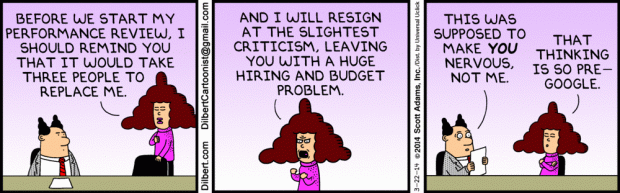
Which brings me to performance reviews. Gack. Many formal performance reviews within arts organizations waste time and energy and breed unnecessary anxiety. That’s not to say that you shouldn’t do them – but do them continually rather than once a year or when a contract demands it.
If your company has a horrible work environment, a performance review is about as helpful as a Band-Aid on a heart attack. Similarly, if the environment is open-minded, so should your inter-reactions. You’ll know if it’s working out.
Quantifiable Outcomes and Social Impact Applies to All Nonprofits – Including Arts Organizations
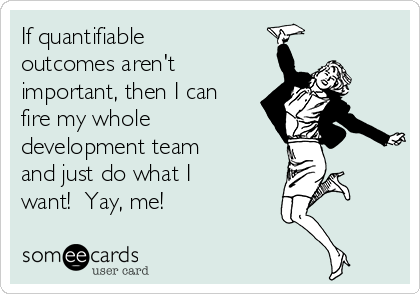
Oh, I can hear it now.
“See?” they’ll say. “People don’t care about outcomes when they make donations. The Washington Post said so. Ergo: we don’t need outcomes.”
To come to that conclusion is just whistling past the graveyard.
Remember these hard facts:
- The arts are not mentioned in section 501 (c) (3) of the US tax code (you know…the law). The arts fall under “charitable organizations,” which require a measure of public good.
- Using the arts as a cover for an individual’s vanity vision is fine, as long as it’s a commercial venture. Once you pull the taxpaying public into it, ethics demand an outcome.
- The arts can be transformative, both on a commercial and nonprofit level. What differentiates the nonprofit is that a measurement of positive change of the human condition is necessary to rationalize funding.
Don’t Be a Company with a Mission; Be a Mission with a Company

I’ve been reading a number of articles discussing arts charity marketing as a whole-company tool, not a ticket-sales tool. Here’s one from TRG.
I was disappointed by Advancement Northwest’s Major Gifts Symposium keynote speakers’ idea of including donors within a charity’s mission.
I have been met with resistance from key artistic and production personnel who have been taught that “we do the art and everything else is a necessary evil.” (Actual quote.)
It’s just human nature for stakeholders to overvalue their contribution. Board members do it. Employees. Volunteers. Audience. Artists. Donors.
Here’s the thing: arts nonprofits that are created to solve a societal problem don’t have these issues. These issues fester when the company is created prior to creating (and rationalizing) a mission.
Create your company as an answer and horses and carts will sort themselves out.
There’s Not An App for That
There are an endless number of costly, effective CRM systems for the arts. One costs hundreds of thousands of dollars and it’s superb at what it does.
One might say, “It had better be.”
Before that expensive, expansive piece of software, there were others. Some great at some things, some at others.
Not one of these pieces of software ever raised a dime. People do that.
Not one of these pieces of software ever performed, exhibited, or created a compelling artistic experience. People do that.
Not one of these pieces of software ever governed, advocated, cajoled, or counseled. People do that.
Before CRMs that cost various ulnae, fibulae, and tibiae, there were inexpensive off-the-shelf database software solutions.
Before that, we did it all on paper.
Millions attended. Millions still do.
And the best relationships are still person-to-person.
Stop Kibbitzing Your Nonprofit Arts Marketers — They’re the Experts at What They Do (And You’re Probably Not)
Jerry Yoshitomi wrote a brilliant article last October. And in learning and unlearning of audience development skills, all too often marketing people are brutally disrespected by the other areas of the organization. I’ve heard marketing departments referred to as “a necessary evil” dozens of times.
Compare the following sentences:
“Anyone can market your arts organization.”
“Anyone can market your arts organization SUCCESSFULLY.”
“Anyone can act, paint, sing, dance, sculpt, direct, and play the tuba.”
“Anyone can act, paint, sing, dance, sculpt, direct, and play the tuba SUCCESSFULLY.”
Don’t be caught in ancient thinking. Just because all consumers react to marketing doesn’t make them good marketers. Treat marketers as you would treat other artists, because that’s what they are. They are the best interpreters of your product to the public. Don’t stand between them and your organization’s success.
Aphorisms for the Modern Arts Charity Leader

If it ain’t broke, break it. Then fix it.
You only read books in one direction.
Your legacy ends when you leave.
Institutional survival is not the goal.
Missions are gods; mission statements are bibles.
The best leaders are the best assistants.
Learn why before you continue.
Success is measured by impact, not excellence.
“Fiscal responsibility” is a business practice, not a mission statement.
Volunteers are employees who work for $0.
If your people are averaging 50+ hours a week, you’re failing.
Always use transitive verbs in your mission statements.
The cool kids are back in high school.
Sharpen your point of view; that’s why it’s a point.
Be completely, spectacularly wrong.
Treat candidates like employees.
Treat employees like human beings.
Treat human beings as though you are one.
Fire yourself regularly; interview yourself for your job.
Be funnier.
Leadership by Forcing Audiences to Follow: “This is How We’ve Always Done It” Didn’t Work in 1776 and It’s Not Working Now

Overall, there are 28% fewer television viewers between 18 and 49 than there were 4 years ago. The average television viewer is now 50.
They’re streaming and DVRing. “Appointment Television” is becoming increasingly obsolete, apart from the Super Bowl…so far.
Broadcasters are sweating bullets and taking golden parachutes. It’s guerrilla consumer behavior and to them, it’s just not fair.
Just like the Colonial armies – they didn’t stand in neat, straight lines as the British did in the Revolutionary War. They broke the rules of battle. Not fair.
Just like younger people bolting from old-school arts organizations – those whose customs and rules work for the producer without working for the video streamer. Not fair.
Predictable, season-oriented, excellently-produced but inadequately result-oriented programming has become today’s version of Artistic Redcoats. Pretty, stubborn, old-fashioned, and easily destroyed by Artistic Neo-Colonials.
Guess who wins that battle?
In Charities, The Chicken Came First. There. Settled. (But Each Chicken has the Ability to Hatch a Whole Passel of Eggs.)

When communities are in trouble, specific needs arise. Charities embark on social experiments aimed at addressing issues not easily solved when profit is king.
In the arts, we tend to loudly cluck about indirect results. Economic impact. The “Anti-Gang.” Higher math scores…happy by-products, but not arts’ reason for being.
But do regions address their specific needs – or even their happy by-products – when dominated by single museums, ballets, operas, theaters, or symphonies? Doesn’t it really take hen-houses full of them to increase a region’s vibrancy?
To achieve a community’s cultural success, dominating arts charities might consider the counter-intuitive notion of creating their own competition, risking their own vibrancy for the community’s sake. It’s certainly better for the region to incubate dozens of arts charities rather than one, especially when those “chicks” do the same once they’re able.
I’m baaaaa-aaaaack — “He who’s down one day can be up the next, unless he really wants to stay in bed, that is…”

For 8 months, I’ve been temporarily working in Detroit, mixing Cervantes (above) with Kerouac (below). Detroit was fascinating.
Where to go next is the issue.
I’ve studied nonprofit arts cultures across the country and (so far) settled on regions surrounding Seattle, Portland, Chicago, and Washington, DC.
The house and TK are in Seattle. TG is in Detroit. I’ll give you a great deal on the house, but not the others.
Criterion #1: When a region’s arts community is comprised of a whole bunch of discrete mission-based organizations – rather than everybody doing everything – then that region’s organizations succeed. That’s for me.
Criterion #2: When a region’s arts community is comprised of a precious few large arts organizations, those organizations are doomed to irrelevance. Not for me.
But my mind wanders…
“What’s in store for me in the direction I don’t take?”
“Diversify” Does Not Mean “Assimilate”

Diversify the audience? Yes. Diversify the experience? Not so much.
Generally speaking, arts audiences are asked to follow privileged Euro-centric (often described as “old” and “white”) behaviors. There are long-standing limitations: no talking, no eating, no drinking, no touching. Sit. Watch. Listen. Clap.
There’s a strict sensibility about enjoyment – so much so, that when a theatre allows its patrons to bring in beverages, arguments ensue as though the end of civilization is nigh.
In any arts endeavor, the key is to invite participation, not ask others to follow your conventions as though they were the default.
The same holds true in the board room. “To change (something) so that it has more different kinds of people or things.” (Webster’s definition of “diversify”) denotes change in the “something,” not changing the people to assimilate to the “something.”
Marketing Arts Charities: In 2014, It’s about Me (Not You… Me)
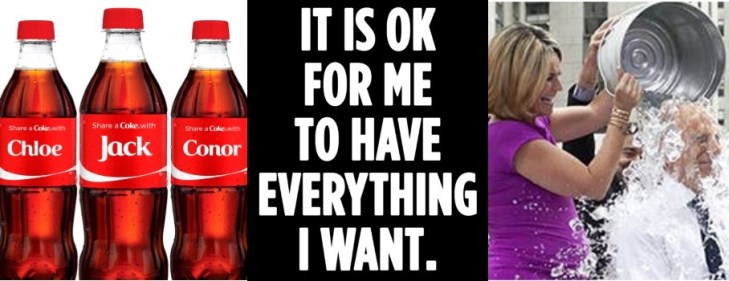
Attracting Millennials to the arts isn’t the easiest thing in the world. What worked with the Greatest Generation hasn’t worked with Boomers or Millennials.
This summer, Coca-Cola put names on the bottles (common first names for those born in the 80s and 90s). Then, a Coke turned into something about “me.”
Look what I’m drinking… it’s me!
We’ve also seen hundreds of bucket challenges to support ALS research, which is great. The product sold in the videos is “me.”
Look what I’m using to do good in the world… it’s me!
Marketing the transformative experience of the arts works best when it’s about “me.”
Look at that amazing artwork/ballet/opera/play/musical… it’s me!
If you can make the experience about the patron (not for the patron), you’ll have a fan for life.
Or at least until the next big thing.
The Creation of Art: Diamonds and Great Art Come from Tension and Pressure

Artists don’t work alone. They require collaborators.
A script isn’t a play. A score isn’t a symphony. A scene isn’t a painting. Choreography isn’t a dance. A libretto and score isn’t an opera.
And a vision isn’t an arts charity.
For any piece of art to be considered finished (and viable), a team is required. Playwrights, composers, choreographers, visual artists, and arts charities may be the ones who create artistic launching pads, but art, like space exploration, requires a slew of equal partners. Among those: directors, performers, designers, interpreters, tools and toolmakers, and audiences. All partners create tension. And that’s good.
No single artist deserves immunity from collaborative pressure. A piece of true art isn’t done until it’s done. Not before. Not after. The immutable pressure of the finish line makes the race exciting, meaningful, and artistic.
This Just In: Artists Value Money Just Like You Do

I just read an article in the Chicago Tribune about actors receiving no payment for some performances. I’m not sure why it was written, except as acknowledgment that, well, actors receive no payment for some performances. Even for hit shows.
But why? “We can either pay you guys and not do a show — or not pay you and do a show,” said one producer in the article.
Here’s the thing: there are lots of performers. The competition forces them to undervalue themselves.
But that doesn’t mean that it’s ethical not to pay them. At least minimum wage. For rehearsal and performance time.
If that producer decides not to make money on a project, that’s his prerogative. But no pay to performers is abusive, unless he’s offering 40 acres and a mule after the run of the show.
Nonprofit Strategy: Managing Change is Hard; Managing Stasis is Impossible

I had breakfast with a trustee for an educational organization in a wealthy community within the last five years.
He bemoaned the fact that an über-wealthy benefactor was annually bailing them out with huge sums of money, but the organization was still always crying for cash. And the company refused to upgrade its business practices.
“Why is she bailing them out?” I paraphrased.
“Because it’s her legacy to her kid,” he paraphrased. “And let’s face it, for vanity.”
“And if it folds?”
“She won’t let it.”
“Are they always in a cash crisis?”
“Yes – and not only that, it’s just not serving all that many children.”
“And they can’t change the way they do business?”
“She won’t let them.”
Can’t change. Can’t succeed. Can’t close.
Bad for the organization? Bad for the industry? Bad for the community?
Dream Job…and My Title Would Be Chief Dream Merchant

What I want:
An arts charity that makes my community better.
Value to the community:
Safety. Knowledge. Personal Power. Issue solutions.
Artistic Tools:
Provocation. Entertainment. Populism. Progressiveness. Mischief.
Other Tools:
Educational residencies in both art and topic.
Partners:
Every other charity, educational institution, or NGO with similar values.
Differentiation:
50-50 split on revenues with partners. Partners open their mailing lists to help themselves financially through ticket sales.
Quantifiable outcomes:
The measured outcomes of the partners. Quantity of classes, students, and schools participating.
Non-quantifiable outcomes:
Populist results defeat the arts’ elitist reputation. The needs of the charities are filled.
Initial budget:
Enough so that all artists receive at least $15/hour (in 2014 dollars) and no full-time hourly rate is more than 4x anyone else’s.
Impact:
Arts moves people to action. Thorny issues seen can never be unseen. Life is better.
A Version Aversion (or: Why It’s More Important That The Whole Thing Works And Not Just The Elements)

Saw a play recently. The story was appropriately troubling and deftly told. But great art is not about literary proficiency or good acting.
Often in any of the artistic ventures, we render our version of a piece, and are judged by some version of accolade. Our study becomes about acting excellence or mind-blowing special effect or the brilliant manipulation of color and light. And critics judge on those foundations. Even in a new work, we cling to “our version.”
Fans don’t care. Fans are, fittingly, binary. Either the art makes one transform or it doesn’t. When we seek outcomes that make it jarring to return to reality, we do well. If fans only enjoy the elements created to produce the art’s reality, then “our version of art” is to “great art” as “Matchbox Cars” are to “Lamborghinis.”
Isn’t Great Art Enough?

Doesn’t the artwork of a Van Gogh or Diego Rivera exhibit at a nonprofit museum make one seek insight into the meaning of life?
Doesn’t the performance of a nonprofit dance company’s production of Copland/DeMille’s “Rodeo” or Ailey’s “Revelations” make one try to restore the American dream?
Doesn’t the experience of a nonprofit theater’s production of “A Raisin in the Sun,” “Romeo and Juliet,” or “Angels in America” make one try to become more tolerant?
Do nonprofit arts organizations need more than those responses to justify charitable funding?
While many nonprofit arts organizations choose “art for art’s sake,” populist sentiment seeks quantifiable results to validate contributions to any portion of the nonprofit sector (social service, education, etc.).
So: shouldn’t great art be enough? Absolutely. Art can be produced for its own sake when no donations are requested.
Nonprofit Arts Organizations – Are you aware that the other parts of the sector believe that you’re stealing money?

In most nonprofits, a donor gives and someone else benefits. Food banks solve hunger, which promotes family stability, which stimulates re-entry into society for the impoverished. Environmental nonprofits encourage clean air and water, which promotes health, which supports longer, happier lives for everyone. Many religious organizations sponsor high morals (“Do unto others…”), which provides a sense of community, which fosters a safety net.
In the arts, the donor and the recipient are often the same person. The donor gives to a company, the company produces a performance or exhibit, and the donor/recipient enjoys the event. The arts are seen by many as elitist and unworthy of support.
We in the arts have to recognize that there is an enmity-laden relationship between arts nonprofits and all the other charities.
And then we have to do something about it.
Flagship or Dreadnought: Regional Theaters in America

With the recent blog by Annah Feinberg currently making the circuit, it seems a good time to chronicle the regional theater “movement.”
1910-1930s: The “Little Theatre Movement.” Few paid artists, but it reflected a community need. Killed by the Depression/WWII.
1947: Dallas – Margo Jones founded Theatre ’47.
1950: Washington, D.C. – Zelda Fichandler founded Arena Stage.
1959: Tyrone Guthrie placed an ad in The New York Times. Asked if any communities wanted to sponsor a resident theatre. 1963 – Guthrie Theatre opens in Minneapolis.
But this did not become a “movement” until the late ’60s when some plays moved from regionals to Broadway, turning many regional theater companies into minor-league baseball clubs.
People outside New York want to experience great plays relevant to their lives.
Unwieldy regionals often gauge success in the form of plays transferring to Broadway.
Irony or disconnect?
Positive Signs in the Nonprofit Arts Community
Some nonprofit arts organizations are making new, better choices – and it’s working.
One theater company, eschewing the managing director template (part operations director, part fundraiser, part CPA), has chosen to split the duties. They’ve brought on a strategy director to handle outside duties (fundraising, speaking, lobbying) and strategic plan piloting. The operations and financial duties lie with the general manager.
One children’s arts company, eschewing the arts-revenue template (part production house, part arts education academy), produces in the same facility as several social service agencies. They incorporate the other nonprofits into everything they do, produce a specific style of performance art that speaks to the values of their ethnically, linguistically diverse neighborhood, and gauge success by how well all the nonprofits are bettering the lives of their constituents.
New prototypes. New measurements. New realizations. Excellent work.
2014. A year of art awaits you. Predictions for the year to come…

A company you’ve never heard of will produce something special.
A famous company everyone knows will close down.
A play will shake your long-held beliefs.
A concert will move you to tears.
You’ll stop short and get lost in a painting.
You’ll attend an amazing performance that can’t be pigeonholed as theatre, dance, comedy, or music.
Another new study will come out proving that kids with in-school arts education will enjoy great test scores, not join gangs, and will have a tendency to be drug-free. Their community participation will be more extensive, and they’ll be likelier to enter college.
Despite that, in-school arts education will disappear.
Great arts nonprofits will find universally-accepted ways to quantify impact and will receive all the funding they require.
I wish you love, luck, and success in 2014. Oh yes, and art.
If I ignore you, then you don’t exist! Hey! Why are you still there, existing???

Recent impressions from an interview for a development director position at a well-known theatre.
Managing director picks me up at airport. Interviews me in car. First impression… he drives, in more ways than one.
Dinner for eight. Laughs, rowdiness, and Malbec. Second impression…an uninhibited group.
The play. Well-performed one-man show. Third impression…no money.
The interview marathon. 6½ hours, no breaks. Fourth impression: disorganized thinkers.
Complete silence. For over two months, despite leaving message for managing director on his cell. Fifth impression: brutal place to work.
Sent email taking myself out of the search. Direct quote from board president: “I don’t know the protocol in the nonprofit world. In the engineering world, where [we] are both from, you don’t hear anything unless you are hired.” Final impression: they’re horrible at human relations…must be why they have no money.
 137 Words