I died this morning.

I was an energetic, charismatic, visionary leader.
I worked at least 60 hours a week.
The office is by turns chaotic and paralyzed.
Some are crying.
Some are ecstatic.
Outside the charity, most don’t care.
Not their problem.
Trustees are panicking. Staff members are traumatized.
Some are taking charge, Alexander Haig-style.
Others are forming committees to decide what to decide.
Still others are composing resignations.
Reporter on line 1.
I knew every board and staff member.
And their families.
I knew every major donor.
I knew local foundation leaders.
Benefactors on line 2.
Beneficiaries on line 3.
I knew financials.
I knew history.
I had passwords.
Vendors on line 4.
I knew where everything was.
I shared that information.
But that was 5 years ago.
To employees who are no longer here.
Too bad there wasn’t a written succession policy.
Not my problem.
Hiring 102: Breaking the Code on Ageism (We’re on to You.)

You don’t have to be Alan Turing to break the HR “can’t-ask-how-old-you-are” code:
“How is your energy level?” = “Are you a geezer?”
…Correct response: “I run 26 marathons daily.”
“What were you doing before 2001?” = “What were you doing before I turned 10?”
…Correct response: “I’m 35 years old with 30 years’ experience.”
“When did you graduate college?” = “I’m checking my arithmetic to determine your age.”
…Correct response: “When I was 22.”
“How flexible are you?” = “Is your mind as ossified as a petrified fossil?”
…Correct response: “I’m currently holding the phone with my pinkie toe while simultaneously writing Iraq’s new constitution.”
Seriously, though, hiring managers: according to the US Bureau of Labor Statistics, workers 45–64 stayed twice as long as those 25–34 — so those under 40 are a much higher risk of leaving you high and dry.
So stop it.
Dream Job…and My Title Would Be Chief Dream Merchant

What I want:
An arts charity that makes my community better.
Value to the community:
Safety. Knowledge. Personal Power. Issue solutions.
Artistic Tools:
Provocation. Entertainment. Populism. Progressiveness. Mischief.
Other Tools:
Educational residencies in both art and topic.
Partners:
Every other charity, educational institution, or NGO with similar values.
Differentiation:
50-50 split on revenues with partners. Partners open their mailing lists to help themselves financially through ticket sales.
Quantifiable outcomes:
The measured outcomes of the partners. Quantity of classes, students, and schools participating.
Non-quantifiable outcomes:
Populist results defeat the arts’ elitist reputation. The needs of the charities are filled.
Initial budget:
Enough so that all artists receive at least $15/hour (in 2014 dollars) and no full-time hourly rate is more than 4x anyone else’s.
Impact:
Arts moves people to action. Thorny issues seen can never be unseen. Life is better.
Sustainability is Neither Reaching for Relevance nor Selling Out. It’s More Important than That.

The art of sustainability in arts charities is akin to performing a balance beam routine on a Ginsu knife. You can sacrifice mission for dollars or dollars for mission, but even if you maintain a perfect balance, there will still be substantial blood on both sides.
We talk way too much about relevance in the arts. The tag in the back of the shirt is relevant for a description of content and washing instructions, but the design of the shirt can reveal personal characteristics of the wearer. Let’s aim higher. How about “integral”?
Integral arts charities are those that are so entwined with other charities that they become essential to the health of the community. “Integral” obviates this useless discussion of relevance and moves us to the more useful question:
How do the arts make communities thrive?
Nonprofit Management Counter-Intuition: Every Now and Then, You Have to Fire Yourself
 Every now and then, fire yourself. Then interview yourself for your job. Would you get it? What attributes would best suit you for it? (Do you even want it?)
Don’t schedule a meeting for one entire week each quarter. Stop being “too busy.” Find your value as a resource (rather than as a boss).
Take down all the cubicle and office doors. Then, every morning, say hello to each human you see before you walk into your door-free office.
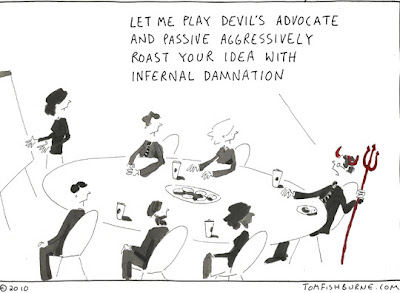
Eliminate devil’s advocacy (unless you’re the Pope). Disagreement without responsibility hinders your organization’s progress.
Teach your staff your job. Let them do it when you’re on vacation.
Take all your vacation days. No contact. Don’t ruin it by doubling your workload upon returning.
Make sure your full-time salary is less than 6x the full-time salary of anyone else.
You Gotta Live in the House You Live in

Hypothetical: Strategically speaking, what would your charity do if money were not an issue at all?
The answer to this question is significant. Because if it begins with anything but “we’d do exactly what we’re doing now,” then it’s likely that either you or your mission have to go.
I live in a 1950s house. Typical low ceilings. Small, utilitarian rooms. If I had all the money in the world to renovate it, I’d enhance its 1950s nature, not build 4 additional stories to get a Puget Sound view and in doing so, ruin the house’s charm.
Same with charities, arts or otherwise. You created a mission for a reason…there was a need. A societal wrong to be righted. If you want to accomplish something other than your organization’s mission, go do it.
Just do it somewhere else.
Verbal Tics and Jargon Reduce Your Ability to Communicate Effectively. What’s Your Fingernails-on-the-Chalkboard Verbal Tic?
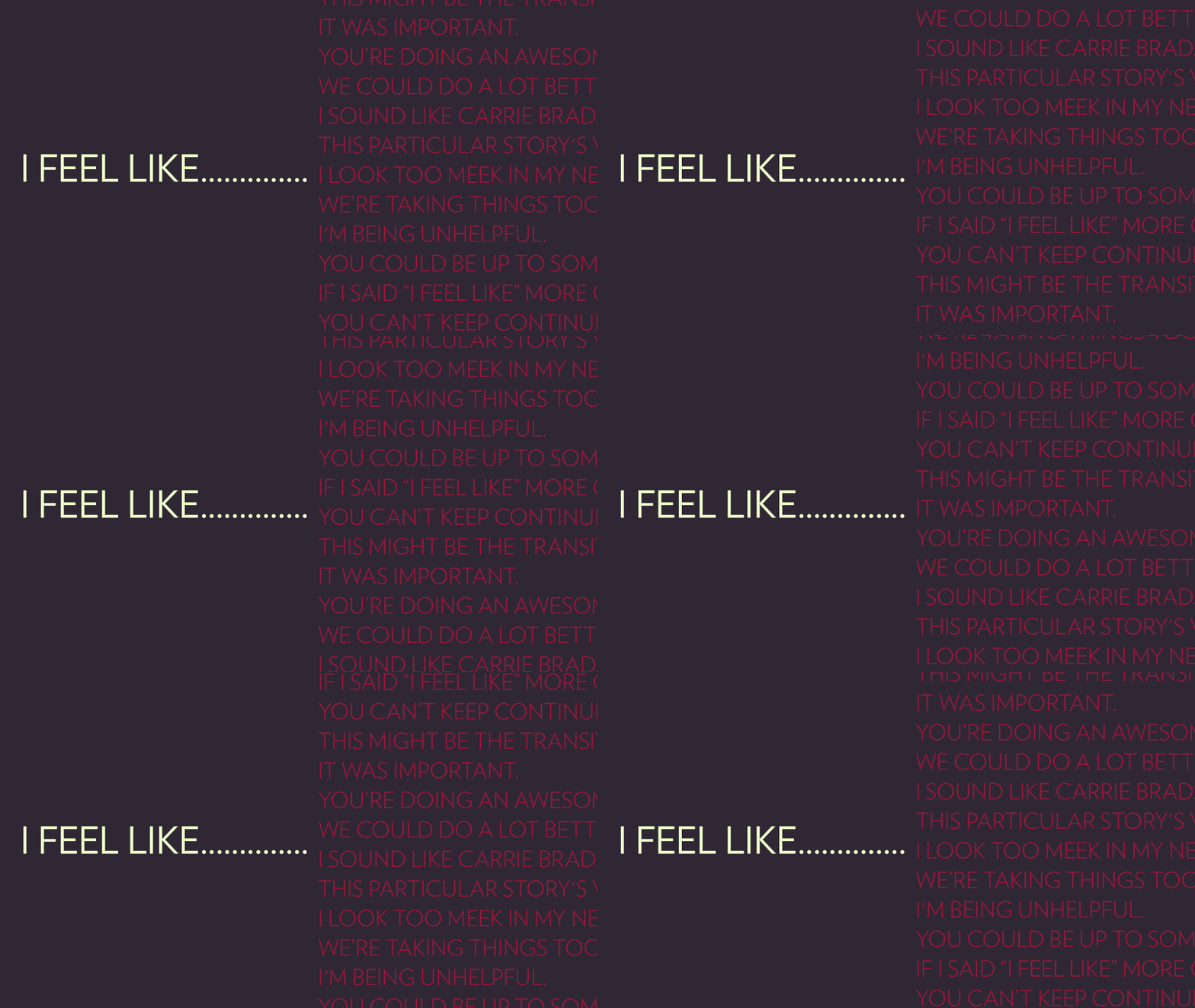
So the word I overuse most lists “accordingly,” “consequently,” “ergo,” “hence,” “therefore,” and “thus” among its synonyms. I’m among many who have this unfortunate tic.
So we’ve used it to reframe questions to fit our answers. We’ve used it as a replacement for “uh,” “um,” “y’know,” or “well.” We’ve used it to preface an opinion for the purpose of making it sound as though we represent universal consensus.
So honestly, we’ve stopped knowing why we use it at all. Or that we use it at all.
So I discovered the tic by listening to Harry Shearer’s brilliant radio program, Le Show.
So I have other communication peeves having to do with the words “literally” and “notoriety,” the phrase “the exact opposite,” and the valley-girl end-of-statement uptick, now prevalent among both genders. But “glass houses” and all that.
Personality, Talent, Intellect, Experience, Spirit, Passion, and the Ability to Inspire. Good Qualities for You but Intimidating as Hell to Insecure Leaders

I have a friend (not me) who is a sensational grant writer. She’s brilliant (Ivy League educated), inspirational (magnetic personality), talented (great references), and people genuinely like her.
She’s also ethical, sensible, positive, quite attractive, and a snappy dresser.
And without a job.
Lately, when she meets with prospective employers, they are impressed by her prowess, references, and samples. Sadly, they don’t hire her. It’s plausible that insecure bosses-to-be fear she is more impressive than they are and look elsewhere.
Look, if you’re in greater Seattle and need a hell of a grant writer for a full-time gig, contact me and I’ll forward your info to her. But if you’re unstable enough just to want someone inferior to you (even if your grants are being denied) because “anyone can write a grant,” then you deserve your results.
Like licking honey off a thorn – Art, why we do it, who it’s for, and why it has power

Painters sing.
Actors play.
Writers choreograph.
Singers paint.
Dancers conduct.
Choreographers sculpt.
Sculptors act.
Musicians paint.
Directors sing.
Conductors write.
And in doing so, no issue, thought, or attitude can be unseen, unfelt, or unheard. It is not for the singing, the painting, etc., that art is produced. The glory of art is in its scope of power. To inspire peace or revolution. To cause great comfort or great discomfort. To provide joy or desolation.
As a populist, I believe that visual and performing arts serve great groups of people. I fear that many in power judge art as dangerous. Their battle plan continues to manipulate those same great groups of people into despising it, to consider it as foreign. As the other.
And I fear that they’ve won that battle. But not the war. Not yet.
More words and phrases that ought to be outlawed from the lexicon

“If you build it, they will come.” – Originally written by WP Kinsella in his best-selling novel, Shoeless Joe, and popularized in FIELD OF DREAMS, these six words have rationalized arts capital campaigns across the US, many of the fruits of which have predictably become money pits.
(The original quote was “If you build it, he will come,” and referred to the protagonist’s father. They had a catch.)
“Art for art’s sake” – coined in the 19th century to justify Aestheticism, in which art was thought to exist for the sake of its beauty alone, and that it need serve no other purpose. Today used to justify programming for many arts organizations.
“Community” – here’s the OED definition. Used by nonprofits in a mercurial manner to keep from describing the very people they wish to positively affect.
You’re faking it. You know you are. So why would you hire someone who knows less than you do?

Deep in your soul, you understand that you have no idea what you’re doing. You’ve been faking it for years.
You have years of experience and an important-sounding title. But you know the truth.
Now that it’s time to hire someone to report to you, who do you want?
“Someone young I can mold,” said an ED acquaintance recently. What he meant was, “Someone who won’t outshine me in front of my board.” Idiot.
“Someone who has fought the fight,” said a board member I know. “Someone who can offer great perspective and can innovate intelligently.” Wise.
We are imperfect. We have weaknesses. So when you accept that you don’t know everything, the best thing you can do is hire to those weaknesses.
When you do, you’ll be a leader. Until then, you really are a fake.
Nonprofit hiring… Consensus…check. Fairness…check. Zombie interviewers…GRAXAGHZ.

Employees are your biggest asset as an organization. Nonprofit employees hold greater importance. Relationship-building through positive, passionate human interaction are better portents to success than technological advances.
And yet, too often the hiring process – especially in communities seeking “consensus” or “fairness” – has devolved into “Interviews in Zombieland.”
“Consensus” is not unanimity. “Fairness” is irrelevant when you’re seeking great people.
The group interview is quickly disintegrating. Every person takes turns reading pre-designed, pre-printed questions in the dullest drones imaginable. Your staff turns into a cast of Zombies in a badly-written, badly-acted play, and everyone uses the same dull inflection to every candidate.
And then, invariably, zombie staff members complain about the candidates’ dullness.
Nonprofit leaders: is your hiring process as undead as your results? And are zombie interviews the best way to show off your organization?
The black ten goes on the red Jack, Jack

The worst thing you can say is “I’m too busy.”
There are reasons, remedies, and repercussions available here and here and here.
Therefore:
If someone you know calls, call them back. Don’t write. Call. Today.
If someone you know writes, write them back. Or call. Today.
If you have an appointment with someone, do not text them a “crazy busy” excuse in the hopes they’ll go away. Meet. You said you would. Passive aggressiveness is still aggression…and it’s repugnant.
Be fifteen minutes early. Honoring time is the ultimate respect.
Stop being afraid that people will catch you playing Solitaire. We know you’re playing Solitaire. Everyone’s playing Solitaire of a kind. We’re not actually speaking with other people, seeking ideas and help, or evolving curiosity.
If we only express things we already know, then how do we grow?
No contact necessary! Never have to talk again! But wait…there’s much, much less!

As an ED, I hired many talented people who, surprisingly (given the industry – nonprofit arts organizations), did not care for interaction. One told me, “I communicate best through email. You should email me.” Her desk was thirty feet from mine.
It is the custom among many to jump to the latest innovation, a practice that is not in itself innovative. Operating technology is no less clubby than ordering at Starbucks. If a customer is unaware of the script, the club members become twitchy.
Cyber-innovation, however, offers addictive isolation as an objective. Solely to rely on it to do person-to-person activities for a nonprofit organization – especially one in the arts – is tantamount to reading directions on how to build IKEA furniture and assume that the building process will be complete without physically interaction with the tools and materials.
 137 Words