Successful Trusteeship, or “Isn’t Writing a Big Honking Check Enough?”

Good board members:
- aren’t ambassadors. Ambassadors wait for people to come to them. They’re zealots. They zealously get donations and zealously get new board members.
- don’t try to get. They work together and with staff and they get.
- personally donate among their three largest monetary donations that year. Not from their company…from them.
- are forensic analysts, (not governors). Remember, the bottom line is “Are we living our mission? Is the mission working?” They see to it that it does, regardless of the financials.
- insist that board meetings are too important to be reporting vehicles. Productive monthly board meetings can be like having twelve mini-retreats.
Think of it this way: if each board member’s consulting rate is $100/hour and your charity has 20 board members, do you want to spend $2,000/hour talking about the past or the future?
This Just In: Artists Value Money Just Like You Do

I just read an article in the Chicago Tribune about actors receiving no payment for some performances. I’m not sure why it was written, except as acknowledgment that, well, actors receive no payment for some performances. Even for hit shows.
But why? “We can either pay you guys and not do a show — or not pay you and do a show,” said one producer in the article.
Here’s the thing: there are lots of performers. The competition forces them to undervalue themselves.
But that doesn’t mean that it’s ethical not to pay them. At least minimum wage. For rehearsal and performance time.
If that producer decides not to make money on a project, that’s his prerogative. But no pay to performers is abusive, unless he’s offering 40 acres and a mule after the run of the show.
Nonprofit Strategy: Managing Change is Hard; Managing Stasis is Impossible

I had breakfast with a trustee for an educational organization in a wealthy community within the last five years.
He bemoaned the fact that an über-wealthy benefactor was annually bailing them out with huge sums of money, but the organization was still always crying for cash. And the company refused to upgrade its business practices.
“Why is she bailing them out?” I paraphrased.
“Because it’s her legacy to her kid,” he paraphrased. “And let’s face it, for vanity.”
“And if it folds?”
“She won’t let it.”
“Are they always in a cash crisis?”
“Yes – and not only that, it’s just not serving all that many children.”
“And they can’t change the way they do business?”
“She won’t let them.”
Can’t change. Can’t succeed. Can’t close.
Bad for the organization? Bad for the industry? Bad for the community?
For Arts Charities, Everything Powerful Stems from a Great Mission…Including a Great Mission Statement
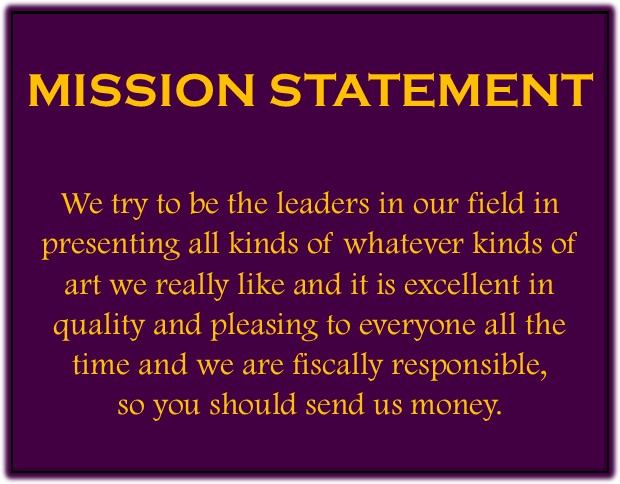
Many arts organizations craft mission statements that promote activities, art, and excellence. Unfortunately, those things are irrelevant.
“[Theater] presents engaging dramatic work that celebrates the intimate relationship among artist, audience and language.”
That’s not a mission statement. No surprise: that theater died.
A mission is the unspeakable acme of a societal obligation. A mission statement expresses that mission, the product of an organizational manifesto, as best it can.
“[Company’s] mission is to create theatre so strikingly original in form, content or both, that it instills in young people an enduring awe, love and respect for the medium, thus preserving imagination and wonder, those hallmarks of childhood which are the keys to the future.”
See the difference? This mission statement discusses the mission’s impact – “preserving imagination and wonder” – as a crucial need. That’s a supportable argument.
Nonprofit Management Counter-Intuition 2 — “Throwing Out the Baby with the Bathwater” Might Be a Better Risk than Listening to the Sirens

There is a Siren-like fatal lure to “almost there” for some charity leaders.
Let’s say that despite success in other programs, a few of the more ambitious risk-reward programs are flailing. The Sirens entice you to put more time, more effort, more personnel, and more money into the flailing programs.
When you explain to them that by moving time, personal, and financial resources away from the programs that are working into the programs that are not, the company risks the success of the working programs, the Sirens entice you to do it anyway.
Sirens are evil.
Why not take this opportunity to refresh your organization’s ambitions, goals, and programs? The smart move might be to throw all the programs out (at least on paper) and build a new list of activities that support the mission from scratch.
Rethinking the Group Job Interview – Consensus? Abdication? Or Focus Group?
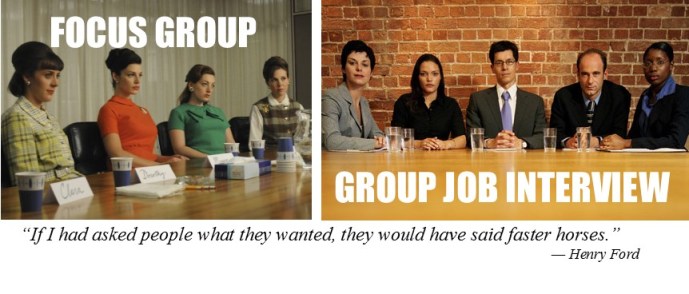
I’ve tortured people in the group interview process. I thought I was offering consensus. Buy-in. Group drive.
I was wrong.
Wrong. Wrong. Wrong.
Oh, so wrong.
To everyone I’ve ever put through that, on either side of the table, I apologize. I’ll never do it again. Promise.
There are four decisions: autocratic (I say), consultative (I say with your input), democratic (we vote, losers weep), consensus (we vote and everyone backs the decision).
As practiced, the group interview might have evolved into a method for managers to abdicate responsibility in the name of consensus. While consensus is ideal, the group-think process can too often be dominated by a crank in the corner with issues, motives, and insecurities. And, possibly, an unknown agenda.
Group-think promises consensus but can preclude innovation.
And why would you ever choose to preclude innovation?
Disinterested Advocacy: When Issues Become Global, the Pool for Support Grows Exponentially

Women’s issues are not about women. Race issues are not about people of color.
And when Mars attacks Oklahoma, the issues will not be about Oklahoma.
I visited a domestic abuse nonprofit. They do great work, but are ghettoized by donors as a “women’s issue” charity. The executive director wondered how they might be able to globalize the cause (and increase revenues).
“Domestic abuse is a societal problem,” she complained. “And I worry that without some men providing disinterested advocacy, we’ll only attract women donors.”
But every time she interviewed qualified men for marketing or development positions (and they’d graduate to a final 10-on-1 group interview), the staff and board balked. “Just not a good fit,” they’d euphemize. And they’d recommend another qualified woman.
Is your charity’s issue exclusively yours? If not, how are you communicating that?
Hiring 103: Do Unto Others, for Pete’s Sake!

Oh, those shoddy, “industry standard” hiring practices. They’re still here.
To follow up on this, this, this, this and this,
1) Communicate quickly, at least twice.
- We got your resume.
- Thanks for your interest, but you are not being considered (within a week of close).
2) When you’ve interviewed someone, call them (no email) within a week.
- Thanks for your interest, but you are no longer being considered.
- We’re still interviewing people. I’ll call you on [date range].
3) When you’ve interviewed someone more than once and have hired someone else, call them (no email) immediately.
- Thanks for your interest, but we’ve chosen someone else.
4) Never…
- …send communications stating who you’ve hired (salt, meet wound)
- …let them know they were in the final cut (see above)
- …say you’ll be in touch and then disappear.
- …be rude.
- …assume job-seekers are psychics.
I died this morning.

I was an energetic, charismatic, visionary leader.
I worked at least 60 hours a week.
The office is by turns chaotic and paralyzed.
Some are crying.
Some are ecstatic.
Outside the charity, most don’t care.
Not their problem.
Trustees are panicking. Staff members are traumatized.
Some are taking charge, Alexander Haig-style.
Others are forming committees to decide what to decide.
Still others are composing resignations.
Reporter on line 1.
I knew every board and staff member.
And their families.
I knew every major donor.
I knew local foundation leaders.
Benefactors on line 2.
Beneficiaries on line 3.
I knew financials.
I knew history.
I had passwords.
Vendors on line 4.
I knew where everything was.
I shared that information.
But that was 5 years ago.
To employees who are no longer here.
Too bad there wasn’t a written succession policy.
Not my problem.
Hiring 102: Breaking the Code on Ageism (We’re on to You.)

You don’t have to be Alan Turing to break the HR “can’t-ask-how-old-you-are” code:
“How is your energy level?” = “Are you a geezer?”
…Correct response: “I run 26 marathons daily.”
“What were you doing before 2001?” = “What were you doing before I turned 10?”
…Correct response: “I’m 35 years old with 30 years’ experience.”
“When did you graduate college?” = “I’m checking my arithmetic to determine your age.”
…Correct response: “When I was 22.”
“How flexible are you?” = “Is your mind as ossified as a petrified fossil?”
…Correct response: “I’m currently holding the phone with my pinkie toe while simultaneously writing Iraq’s new constitution.”
Seriously, though, hiring managers: according to the US Bureau of Labor Statistics, workers 45–64 stayed twice as long as those 25–34 — so those under 40 are a much higher risk of leaving you high and dry.
So stop it.
Sustainability is Neither Reaching for Relevance nor Selling Out. It’s More Important than That.

The art of sustainability in arts charities is akin to performing a balance beam routine on a Ginsu knife. You can sacrifice mission for dollars or dollars for mission, but even if you maintain a perfect balance, there will still be substantial blood on both sides.
We talk way too much about relevance in the arts. The tag in the back of the shirt is relevant for a description of content and washing instructions, but the design of the shirt can reveal personal characteristics of the wearer. Let’s aim higher. How about “integral”?
Integral arts charities are those that are so entwined with other charities that they become essential to the health of the community. “Integral” obviates this useless discussion of relevance and moves us to the more useful question:
How do the arts make communities thrive?
Nonprofit Management Counter-Intuition: Every Now and Then, You Have to Fire Yourself
 Every now and then, fire yourself. Then interview yourself for your job. Would you get it? What attributes would best suit you for it? (Do you even want it?)
Don’t schedule a meeting for one entire week each quarter. Stop being “too busy.” Find your value as a resource (rather than as a boss).
Take down all the cubicle and office doors. Then, every morning, say hello to each human you see before you walk into your door-free office.
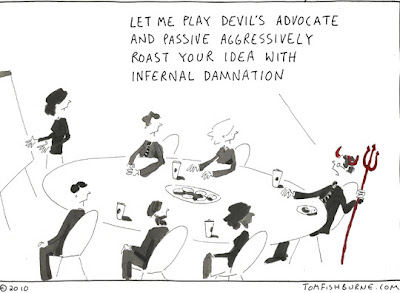
Eliminate devil’s advocacy (unless you’re the Pope). Disagreement without responsibility hinders your organization’s progress.
Teach your staff your job. Let them do it when you’re on vacation.
Take all your vacation days. No contact. Don’t ruin it by doubling your workload upon returning.
Make sure your full-time salary is less than 6x the full-time salary of anyone else.
Stepping in Moral Quicksand: When a Horrible Person/Company Gives to Your Nonprofit

I was going to write about all the charities to which Donald Sterling donated.
I was going to ask if the standards of the organization should stand up against the horror of the donor.
After all, UCLA gave back $3 million of Sterling’s money.
Then I was going to ask about donations from companies that peddle “evil” – tobacco, liquor, oil, etc.
But then I thought about individual donors’ morals. Not just unethical oligarchs like Henry Ford, Rupert Murdoch, John D. MacArthur, or even Sterling. What about all the philanthropists whose fortunes were built on a million broken backs? Or a few? Or one? And I thought about my experiences with morally corrupt donors.
I’m sinking.
Help.
You Gotta Live in the House You Live in

Hypothetical: Strategically speaking, what would your charity do if money were not an issue at all?
The answer to this question is significant. Because if it begins with anything but “we’d do exactly what we’re doing now,” then it’s likely that either you or your mission have to go.
I live in a 1950s house. Typical low ceilings. Small, utilitarian rooms. If I had all the money in the world to renovate it, I’d enhance its 1950s nature, not build 4 additional stories to get a Puget Sound view and in doing so, ruin the house’s charm.
Same with charities, arts or otherwise. You created a mission for a reason…there was a need. A societal wrong to be righted. If you want to accomplish something other than your organization’s mission, go do it.
Just do it somewhere else.
Personality, Talent, Intellect, Experience, Spirit, Passion, and the Ability to Inspire. Good Qualities for You but Intimidating as Hell to Insecure Leaders

I have a friend (not me) who is a sensational grant writer. She’s brilliant (Ivy League educated), inspirational (magnetic personality), talented (great references), and people genuinely like her.
She’s also ethical, sensible, positive, quite attractive, and a snappy dresser.
And without a job.
Lately, when she meets with prospective employers, they are impressed by her prowess, references, and samples. Sadly, they don’t hire her. It’s plausible that insecure bosses-to-be fear she is more impressive than they are and look elsewhere.
Look, if you’re in greater Seattle and need a hell of a grant writer for a full-time gig, contact me and I’ll forward your info to her. But if you’re unstable enough just to want someone inferior to you (even if your grants are being denied) because “anyone can write a grant,” then you deserve your results.
40 years in the Desert – Advice for Leaders Taking the Helm and Those Whose Helm is being Taken

Happy Passover. Story goes: Jews escaped slavery and spent 40 years finding “the Promised Land.”
A popular idea on why it took so long: the generation that escaped were slaves. The generation after that was prepared to lead the new world. People found leadership abilities only after shedding the slave mentality.
When a change in staff or board leadership occurs, it is incumbent upon the incumbent organizational leaders to adapt, not the other way around. You didn’t hire (or elect) a “new” former leader. You hired an exemplary individual with different (but complementary) values, aspirations, and ideas. Shed the mentality of an organization run by the previous leader. That culture vanished when that person left.
If you’re the new leader, remember that you were hired to lead on your terms. Your feet won’t fit in someone else’s footprints.
Even Endowments Don’t Want You to Have an Endowment

Went to a foundation’s financial conference a few years back. Before the economy went south.
The COO of the foundation said (a direct quote), “If you’re not pulling 20% of your annual budget from your endowment roll-off, then you probably shouldn’t have an endowment.”
And now, the math:
Assuming the annual payment is 5%, your endowment would have to outnumber your annual budget by a ratio of 4-1.
Endowments are not reserve funds. They are not liquid. They have little to do with an organization’s stability. Often, the endowment campaign is successful, but the organization teeters on bankruptcy in vast oceans of red ink.
Endowments do not prove an organization’s worth, nor does it assure its future. Although, I suppose, it does offer a bankrupt organization the chance to pay off its bills before closing for good. So there’s that.
More words and phrases that ought to be outlawed from the lexicon

“If you build it, they will come.” – Originally written by WP Kinsella in his best-selling novel, Shoeless Joe, and popularized in FIELD OF DREAMS, these six words have rationalized arts capital campaigns across the US, many of the fruits of which have predictably become money pits.
(The original quote was “If you build it, he will come,” and referred to the protagonist’s father. They had a catch.)
“Art for art’s sake” – coined in the 19th century to justify Aestheticism, in which art was thought to exist for the sake of its beauty alone, and that it need serve no other purpose. Today used to justify programming for many arts organizations.
“Community” – here’s the OED definition. Used by nonprofits in a mercurial manner to keep from describing the very people they wish to positively affect.
“I Wanna!” The Fatal Game of Power About Nonprofit Arts. Ages infantile and up.
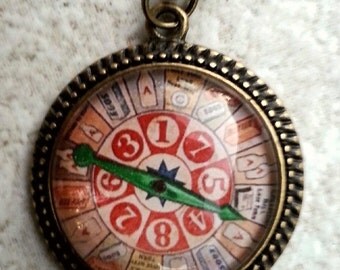
How to play:
Players select their tokens to start play. Each token designates their role in nonprofit art.
Marionette: Performing Artists/Designers
Blob of Clay: Writers/Composers/Visual Artists
Pawn: All technical/administrative/volunteer personnel (one token represents all)
Change Purse: Audience
Louis Vuitton Pocketbook: Donor/Funder
Fake Louis Vuitton Pocketbook: Development Director
Hammer: Trustee
Bent nail: Managing/Executive Director
Telescope looking up: Artistic Director/Curator
Microscope looking down: General Manager/CFO
Bloody leech: Critic/Journalist
Sorry: designated tokens for marketing/pr directors were deleted in the last budget cycle.
All players spin the Great Glass Wheel Of Art simultaneously in all directions and yell, “I Wanna!” The Wheel comes off its bearings; breaks into millions of pieces. Players move tokens anyplace in the room that feels most advantageous, regardless of the playing board or other players.
End of game:
Chaos. All players proclaim victory. None actually win.
U-Better, U-Better, UBIT

Watching arts nonprofits seek funding in unusual ways leads to same old/new discussions on Unrelated Business Income Tax.
Taking a group of donors for a London theatre tour (even if all the finances are handled by an independent agent)…UBIT, you betcha.
The percentage of time spent in London at a lecture about your company’s particular brand of theatre…OK.
Selling t-shirts with just the logo of your natural history museum…UBIT, you betcha.
Selling t-shirts with dinosaurs on them at your natural history museum…OK.
Leasing part of your building to a separate business…UBIT, you betcha.
Items sold at a gift shop with a separate public entrance…UBIT off more than you can chew.
Items sold at a gift shop only accessible to ticket-buyers…UBIT only items not related to the tax-exempt purpose of the organization.
UBIT. Not just another 4-letter acronym.
Legacy-building is not derived from a legacy building

The intention of legacy is a killer.
Many nonprofits in the arts have chosen to engage in massive fundraising efforts to build buildings. But buildings in and of themselves are not your duty.
A capital campaign is like raising money for launch pads. NASA’s mission is to “pioneer the future in space exploration, scientific discovery and aeronautics research.” Not “build the best launch pad.”
Your nonprofit’s mission may tangentially benefit from capital expenditures. But when EDs, ADs, or philanthropists intentionally attempt to leave a legacy by building venues, they put the organization at risk of irrelevance. Some call that the “Edifice Complex.”
The building may last, but the company may die from spent energy, mission drift, and rationalizing programming for the new space.
Your legacy with a nonprofit organization ends when you leave. As it should be.
You’re faking it. You know you are. So why would you hire someone who knows less than you do?

Deep in your soul, you understand that you have no idea what you’re doing. You’ve been faking it for years.
You have years of experience and an important-sounding title. But you know the truth.
Now that it’s time to hire someone to report to you, who do you want?
“Someone young I can mold,” said an ED acquaintance recently. What he meant was, “Someone who won’t outshine me in front of my board.” Idiot.
“Someone who has fought the fight,” said a board member I know. “Someone who can offer great perspective and can innovate intelligently.” Wise.
We are imperfect. We have weaknesses. So when you accept that you don’t know everything, the best thing you can do is hire to those weaknesses.
When you do, you’ll be a leader. Until then, you really are a fake.
Nonprofit Arts Organizations – Are you aware that the other parts of the sector believe that you’re stealing money?

In most nonprofits, a donor gives and someone else benefits. Food banks solve hunger, which promotes family stability, which stimulates re-entry into society for the impoverished. Environmental nonprofits encourage clean air and water, which promotes health, which supports longer, happier lives for everyone. Many religious organizations sponsor high morals (“Do unto others…”), which provides a sense of community, which fosters a safety net.
In the arts, the donor and the recipient are often the same person. The donor gives to a company, the company produces a performance or exhibit, and the donor/recipient enjoys the event. The arts are seen by many as elitist and unworthy of support.
We in the arts have to recognize that there is an enmity-laden relationship between arts nonprofits and all the other charities.
And then we have to do something about it.
Nonprofit hiring… Consensus…check. Fairness…check. Zombie interviewers…GRAXAGHZ.

Employees are your biggest asset as an organization. Nonprofit employees hold greater importance. Relationship-building through positive, passionate human interaction are better portents to success than technological advances.
And yet, too often the hiring process – especially in communities seeking “consensus” or “fairness” – has devolved into “Interviews in Zombieland.”
“Consensus” is not unanimity. “Fairness” is irrelevant when you’re seeking great people.
The group interview is quickly disintegrating. Every person takes turns reading pre-designed, pre-printed questions in the dullest drones imaginable. Your staff turns into a cast of Zombies in a badly-written, badly-acted play, and everyone uses the same dull inflection to every candidate.
And then, invariably, zombie staff members complain about the candidates’ dullness.
Nonprofit leaders: is your hiring process as undead as your results? And are zombie interviews the best way to show off your organization?
The black ten goes on the red Jack, Jack

The worst thing you can say is “I’m too busy.”
There are reasons, remedies, and repercussions available here and here and here.
Therefore:
If someone you know calls, call them back. Don’t write. Call. Today.
If someone you know writes, write them back. Or call. Today.
If you have an appointment with someone, do not text them a “crazy busy” excuse in the hopes they’ll go away. Meet. You said you would. Passive aggressiveness is still aggression…and it’s repugnant.
Be fifteen minutes early. Honoring time is the ultimate respect.
Stop being afraid that people will catch you playing Solitaire. We know you’re playing Solitaire. Everyone’s playing Solitaire of a kind. We’re not actually speaking with other people, seeking ideas and help, or evolving curiosity.
If we only express things we already know, then how do we grow?
 137 Words