Arts Charity Strategy: When Substitutes and Competitors Blur, Does Your Organization Become Unfocused?

In 1979, Porter’s Five Forces Analysis tool was published by the Harvard Business Review. If you haven’t studied it, do so. But study it hard – it’s far more comprehensive and complex than “5 Tips to Get More Donors” or others in the current mini-list nonsense arena.
When arts charities view competitors (those that do what we do) and substitutes (those that do something that the customer will do instead of what we do) as one force, they lose mission focus, and once that happens, they begin the downward spiral.
To wit: if you run a theatre, your competition is “theatres.” If you make the mistake of thinking that “video games” is a competitor (rather than a substitute), the logical conclusion is that you need to provide “television” instead of “theatre.”
Be a theatre. That’s hard enough these days.
Good and Bad in Charity Funding

Milk, Nicolas Cage’s acting; mugs saving trees or cups saving wash water; bottled water — good or bad?
Good:
Unrestricted funding.
Ice Buckets/Challenges (unless you’re Charity:Water. Then bad.)
Matching gifts.
Nihil Pro Quo.
Public funding.
Multi-year gifts.
Endowments that cover >20% of the organization’s annual budget.
In-kind gifts that are already in the budget.
Thousands of low-level donors.
Dozens of high-level donors.
100% of trustees/board members donate.
100% of trustees/board members donate one of the 3 highest gifts they give all year.
100% of employees want to at least donate $1.
Bad:
Funding restricted to programs unsupported by the mission.
Funding restricted to vanity projects.
Quid pro quo.
Corporations choosing charities via popularity contests/computer click-offs.
Large donations that overly entitle either donor or recipient.
Endowments that cover <20% of the organization’s annual budget.
Panicky, deleterious “Going-Out-Of-Business-Unless-We-Raise-Millions-By-Tuesday” funding schemes.
The Politics of Charity: Minding Your Speaking Your Mind

Some of us are more candid than we probably ought to be. We put ourselves out there. But remember this as you read this blog and other business columns: things change.
Each charity has a special mission (or at least should) that may relate to other charities in the universe, but not exactly. There is no right or wrong way to do it. And expressing a thought in a column – such as 137 Words – does not equate to either a Sermon on the Mount or a whisper from Jiminy Cricket about that charity. It is merely an expression based on the writer’s own vantage point.
So when Covey, Collins, Porter, or even Harrison proclaim a truth, it’s not backpedaling to say that the “truth” is a reaction to what’s happening right now. And that things change.
The Future of the Arts: It’s About the Impact Outside the Building
 I’ve been scouring mission statements. Some inspiring, some boring; some engaging, some self-indulgent. Indications of what the charity values? Absolutely.
Performing arts charities, more than any other, tend to value programming over impact:
“to sustain, encourage, and promote the performing arts and to educate the public with relation thereto” – Lincoln Center
“producing and presenting the greatest examples of music, dance, and theater; supporting artists in the creation of new work; and serving the nation as a leader in arts education” – Kennedy Center
In contrast, public broadcasting tends to value impact over programming:
“to create a more informed public – one challenged and invigorated by a deeper understanding and appreciation of events, ideas and cultures” – NPR
“to inform, to inspire, and to educate” – PBS
Do you see the difference? Do you want the difference?
Your Next Charity Leader: “Cool, Aloof, Efficient” or “Passionate, Assertive, Innovative?”

I suppose it’s not a binary choice. But ultimately, they seem to fall in exclusive constellations of attributes.
Few leaders are in both camps. And, depending on the organization’s life-stage, you may need more from one camp than the other.
Pope Benedict vs. Steve Jobs. Neither is perfect, but each offers different personality sets at the helm of your charity.
I prefer to work with those who are in the latter camp. They are invariably afraid of little, impolitic, guileless, insistent, and noisy. But they most often find solutions, tell the truth, and can make things happen.
Not that I don’t like the former group, but I’ve found they hold their cards tight, condescend, rarely make a definitive statement, defer, passively-aggressively ignore, and require others to make things happen.
But they rarely threaten change. So there’s that.
Negatively Commenting on the Title of a Post (What You’re Reading Now) is Akin to PETA Boycotting “To Kill a Mockingbird” Because, You Know, They’re Killing a Mockingbird.
Recently, a foundation advocate negatively commented on the title of a 137 Words blog post. On the title, not the post.
As Ben Franklin once said, “We are all born ignorant, but one must work hard to remain stupid.”
Thank you for reading 137 Words and sharing it with your colleagues. We’re pretty amazed when 137 Words evokes derision, praise, or questions.
If you haven’t shared yet, please do – karma will be kind.
In 6 months, 137 Words has picked up about 6,000 readers. That exceeds all our expectations. We are truly grateful.
And to those like this advocate who only read the title and not the posting (what you’re reading now), I only wish bliss. Or, should I say, additional bliss.
Harsh? Maybe so. Because I am all too often a card-carrying member of the Right to Extreme Stupidity League.
Arts Charity Leaders: The Economic Impact Argument Has Become a Losing Proposition…Move On

From ArtsFund, Seattle:
“Together the activity of nonprofit arts organizations [in our region]…generates close to $2 billion in the Central Puget Sound’s economy creating 32,520 jobs, $882 million in labor income and $83 million in taxes.”
From Viking Stadium (new NFL stadium), Minneapolis:
“Construction will support approximately 13,000 jobs…almost $300 million in wages…upon completion, 3,400 full and part-time jobs…the economic activity from a new stadium will generate over $26 million per year in tax revenue and over $145 million in direct spending by Vikings fans inside the State of Minnesota.”
From McDonald’s:
“McDonald’s provides tax revenue for local, state and national governments…$1.3 billion in United States national and state corporate taxes in 2011…McDonald’s spends hundreds of millions upgrading or building new locations.”
Let’s move on to quantifying our outcomes before we bury ourselves with more “economic impact” studies. It’s just not a winning argument for the arts.
Marketing the Arts, the Play-Doh® Fun Factory, and Marketman©
 “Have a response to ‘If it’s a hit, it’s the art. If it’s a bomb, it’s the marketing.’
It’ll keep you off death row.”
– Marketman©
Artistic events evolve. The elements may be eons old, but the results continue to change. With the squeeze of a contraption, like Play-Doh® in a Fun Factory, necessarily comes a different product. Different from the time before. Different from the next time.
This is a job for Marketman©, a copyrighted portion of this publication. Marketman© (not necessarily male) is your company’s Sea Gal/Jay Carney/Don Draper/Rob Petrie. Marketman© is charged with the task of launching a product to market, eliminating it, subsequently launching a new product.
Marketman© sells art, not tickets. There is no lasting inventory, like month-old sodas on the shelf, when the new product is introduced.
Kibitzing is the Road to Hell for Charitable Organizations: “You know what you SHOULD do…”

Kibitzing. Webster’s definition: “watching other people and making unwanted comments about what they are doing.”
Good intentions (egad). Some people pay for the privilege via their donation or board service. My mother believes it’s her birthright.
For arts charities, kibitzing mainly involves comments, programs, and activities that are unsupported by research or any evidence of success.
Instead: come with solutions rather than problems. Shortfalls are as unintentional as bad art. No one intends red ink or a lousy play with bad acting. But rather than more bake sales, auctions, galas, or (egad) a “give-a-million-dollars-or-we’ll-go-bankrupt-on-Tuesday” campaign; rather than creating a program committee (because anyone can pick plays) or a marketing committee (because anyone can market the arts), work with your ED toward real, verified solutions.
The road to hell is paved with kibitzers. The road to bankruptcy, too.
Executive Directors: How Do You Control Your Self-Righteous, Burnout-Induced Rage Because, Well, Nobody Knows the Trouble You’ve Seen and Nobody Knows Your Sorrow?

I read an earnest article about burnout and its inevitability for certain nonprofits. According to the article, everyone running a charity should watch for certain signs. Included: “chronic underfunding” (always stressful in any operation), “documentation demands” (spending extra hours issuing reports for funders who do not pay for the extra time/staff necessary to prepare that report), and more.
What to do about it? I’ve tried intense sarcasm, shouting at the top of my lungs, turning crimson, and bellowing the occasional Charlie Brown “AAUGH!” Those seemed like good ideas at the time, but proved to be exactly the opposite. Funny that.
The article recommends that funders provide additional funds for a) reports and for b) executive directors to take sabbaticals.
Wow. Sounds so simple when you put it that way, doesn’t it?
Wait, there’s that sarcasm again. AAUGH.
Charity Culture: If Doing the Right Thing Makes You an Endangered Species, Do It Anyway

Sadly, few people know “Profiles in Courage.” Ask around.
Among performing arts charities, some leaders shrewdly keep their positions because they fear appearing impolitic. They seek sustainability for themselves first, and then, secondarily, their organizations.
To them I implore:
- Pay performers wages, on the books, legal standard or better, for every hour they spend: rehearsals, performances, fittings, etc.
- If your charity isn’t making a substantial difference, merge or close. If it is, share your secrets.
- It’s about social progress, not black ink. Both are preferable, but you’ve failed if your best work is 30 years of balanced budgets.
- Take a stand. Don’t buy trouble, of course, but don’t become invisible to save your own skin.
- Theatres: plays aren’t written, they’re wrought. It’s about the production and the viewpoint, not the script and sets.
- Do something. Don’t be something.
Playing Chicken – For Arts Charities, Not a Game for the Faint of Heart, Because, Well, It’s Impossible and Doesn’t Make a Compelling Case

I read an article recently called A Day Without Art. Stephanie Milling suggests scenarios in which the arts hypothetically disappear for a day. But hypothetical threats are terrible tools of advocacy.
We can’t not have art. Look at your coffee cup, even if it’s paper. It has form, function, and looky there, art on it.
Here’s the ant at this particular picnic:
If art is ubiquitous, does it have value? Why pay for it?
Rather than forecasting the impossible – a day without art – could we better spend our energies measuring our specific organization’s specific outcomes and advocate by trumpeting those to the world?
No one responds well to this particular game of chicken. It’s akin to the idea of eating your kids – it may solve the messy bathroom problem, but it’s neither realistic nor sustainable.
The Creation of Art: Diamonds and Great Art Come from Tension and Pressure

Artists don’t work alone. They require collaborators.
A script isn’t a play. A score isn’t a symphony. A scene isn’t a painting. Choreography isn’t a dance. A libretto and score isn’t an opera.
And a vision isn’t an arts charity.
For any piece of art to be considered finished (and viable), a team is required. Playwrights, composers, choreographers, visual artists, and arts charities may be the ones who create artistic launching pads, but art, like space exploration, requires a slew of equal partners. Among those: directors, performers, designers, interpreters, tools and toolmakers, and audiences. All partners create tension. And that’s good.
No single artist deserves immunity from collaborative pressure. A piece of true art isn’t done until it’s done. Not before. Not after. The immutable pressure of the finish line makes the race exciting, meaningful, and artistic.
Successful Trusteeship, or “Isn’t Writing a Big Honking Check Enough?”

Good board members:
- aren’t ambassadors. Ambassadors wait for people to come to them. They’re zealots. They zealously get donations and zealously get new board members.
- don’t try to get. They work together and with staff and they get.
- personally donate among their three largest monetary donations that year. Not from their company…from them.
- are forensic analysts, (not governors). Remember, the bottom line is “Are we living our mission? Is the mission working?” They see to it that it does, regardless of the financials.
- insist that board meetings are too important to be reporting vehicles. Productive monthly board meetings can be like having twelve mini-retreats.
Think of it this way: if each board member’s consulting rate is $100/hour and your charity has 20 board members, do you want to spend $2,000/hour talking about the past or the future?
This Just In: Artists Value Money Just Like You Do

I just read an article in the Chicago Tribune about actors receiving no payment for some performances. I’m not sure why it was written, except as acknowledgment that, well, actors receive no payment for some performances. Even for hit shows.
But why? “We can either pay you guys and not do a show — or not pay you and do a show,” said one producer in the article.
Here’s the thing: there are lots of performers. The competition forces them to undervalue themselves.
But that doesn’t mean that it’s ethical not to pay them. At least minimum wage. For rehearsal and performance time.
If that producer decides not to make money on a project, that’s his prerogative. But no pay to performers is abusive, unless he’s offering 40 acres and a mule after the run of the show.
For Arts Charities, Everything Powerful Stems from a Great Mission…Including a Great Mission Statement
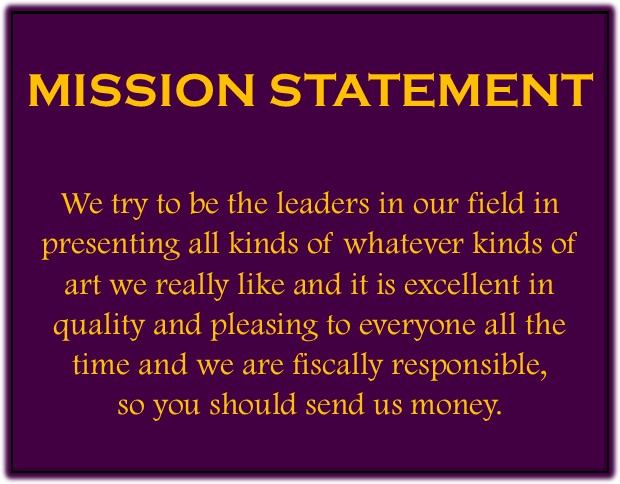
Many arts organizations craft mission statements that promote activities, art, and excellence. Unfortunately, those things are irrelevant.
“[Theater] presents engaging dramatic work that celebrates the intimate relationship among artist, audience and language.”
That’s not a mission statement. No surprise: that theater died.
A mission is the unspeakable acme of a societal obligation. A mission statement expresses that mission, the product of an organizational manifesto, as best it can.
“[Company’s] mission is to create theatre so strikingly original in form, content or both, that it instills in young people an enduring awe, love and respect for the medium, thus preserving imagination and wonder, those hallmarks of childhood which are the keys to the future.”
See the difference? This mission statement discusses the mission’s impact – “preserving imagination and wonder” – as a crucial need. That’s a supportable argument.
Nonprofit Management Counter-Intuition 2 — “Throwing Out the Baby with the Bathwater” Might Be a Better Risk than Listening to the Sirens

There is a Siren-like fatal lure to “almost there” for some charity leaders.
Let’s say that despite success in other programs, a few of the more ambitious risk-reward programs are flailing. The Sirens entice you to put more time, more effort, more personnel, and more money into the flailing programs.
When you explain to them that by moving time, personal, and financial resources away from the programs that are working into the programs that are not, the company risks the success of the working programs, the Sirens entice you to do it anyway.
Sirens are evil.
Why not take this opportunity to refresh your organization’s ambitions, goals, and programs? The smart move might be to throw all the programs out (at least on paper) and build a new list of activities that support the mission from scratch.
Disinterested Advocacy: When Issues Become Global, the Pool for Support Grows Exponentially

Women’s issues are not about women. Race issues are not about people of color.
And when Mars attacks Oklahoma, the issues will not be about Oklahoma.
I visited a domestic abuse nonprofit. They do great work, but are ghettoized by donors as a “women’s issue” charity. The executive director wondered how they might be able to globalize the cause (and increase revenues).
“Domestic abuse is a societal problem,” she complained. “And I worry that without some men providing disinterested advocacy, we’ll only attract women donors.”
But every time she interviewed qualified men for marketing or development positions (and they’d graduate to a final 10-on-1 group interview), the staff and board balked. “Just not a good fit,” they’d euphemize. And they’d recommend another qualified woman.
Is your charity’s issue exclusively yours? If not, how are you communicating that?
Hiring 103: Do Unto Others, for Pete’s Sake!

Oh, those shoddy, “industry standard” hiring practices. They’re still here.
To follow up on this, this, this, this and this,
1) Communicate quickly, at least twice.
- We got your resume.
- Thanks for your interest, but you are not being considered (within a week of close).
2) When you’ve interviewed someone, call them (no email) within a week.
- Thanks for your interest, but you are no longer being considered.
- We’re still interviewing people. I’ll call you on [date range].
3) When you’ve interviewed someone more than once and have hired someone else, call them (no email) immediately.
- Thanks for your interest, but we’ve chosen someone else.
4) Never…
- …send communications stating who you’ve hired (salt, meet wound)
- …let them know they were in the final cut (see above)
- …say you’ll be in touch and then disappear.
- …be rude.
- …assume job-seekers are psychics.
I died this morning.

I was an energetic, charismatic, visionary leader.
I worked at least 60 hours a week.
The office is by turns chaotic and paralyzed.
Some are crying.
Some are ecstatic.
Outside the charity, most don’t care.
Not their problem.
Trustees are panicking. Staff members are traumatized.
Some are taking charge, Alexander Haig-style.
Others are forming committees to decide what to decide.
Still others are composing resignations.
Reporter on line 1.
I knew every board and staff member.
And their families.
I knew every major donor.
I knew local foundation leaders.
Benefactors on line 2.
Beneficiaries on line 3.
I knew financials.
I knew history.
I had passwords.
Vendors on line 4.
I knew where everything was.
I shared that information.
But that was 5 years ago.
To employees who are no longer here.
Too bad there wasn’t a written succession policy.
Not my problem.
Hiring 102: Breaking the Code on Ageism (We’re on to You.)

You don’t have to be Alan Turing to break the HR “can’t-ask-how-old-you-are” code:
“How is your energy level?” = “Are you a geezer?”
…Correct response: “I run 26 marathons daily.”
“What were you doing before 2001?” = “What were you doing before I turned 10?”
…Correct response: “I’m 35 years old with 30 years’ experience.”
“When did you graduate college?” = “I’m checking my arithmetic to determine your age.”
…Correct response: “When I was 22.”
“How flexible are you?” = “Is your mind as ossified as a petrified fossil?”
…Correct response: “I’m currently holding the phone with my pinkie toe while simultaneously writing Iraq’s new constitution.”
Seriously, though, hiring managers: according to the US Bureau of Labor Statistics, workers 45–64 stayed twice as long as those 25–34 — so those under 40 are a much higher risk of leaving you high and dry.
So stop it.
Dream Job…and My Title Would Be Chief Dream Merchant

What I want:
An arts charity that makes my community better.
Value to the community:
Safety. Knowledge. Personal Power. Issue solutions.
Artistic Tools:
Provocation. Entertainment. Populism. Progressiveness. Mischief.
Other Tools:
Educational residencies in both art and topic.
Partners:
Every other charity, educational institution, or NGO with similar values.
Differentiation:
50-50 split on revenues with partners. Partners open their mailing lists to help themselves financially through ticket sales.
Quantifiable outcomes:
The measured outcomes of the partners. Quantity of classes, students, and schools participating.
Non-quantifiable outcomes:
Populist results defeat the arts’ elitist reputation. The needs of the charities are filled.
Initial budget:
Enough so that all artists receive at least $15/hour (in 2014 dollars) and no full-time hourly rate is more than 4x anyone else’s.
Impact:
Arts moves people to action. Thorny issues seen can never be unseen. Life is better.
Sustainability is Neither Reaching for Relevance nor Selling Out. It’s More Important than That.

The art of sustainability in arts charities is akin to performing a balance beam routine on a Ginsu knife. You can sacrifice mission for dollars or dollars for mission, but even if you maintain a perfect balance, there will still be substantial blood on both sides.
We talk way too much about relevance in the arts. The tag in the back of the shirt is relevant for a description of content and washing instructions, but the design of the shirt can reveal personal characteristics of the wearer. Let’s aim higher. How about “integral”?
Integral arts charities are those that are so entwined with other charities that they become essential to the health of the community. “Integral” obviates this useless discussion of relevance and moves us to the more useful question:
How do the arts make communities thrive?
Nonprofit Management Counter-Intuition: Every Now and Then, You Have to Fire Yourself
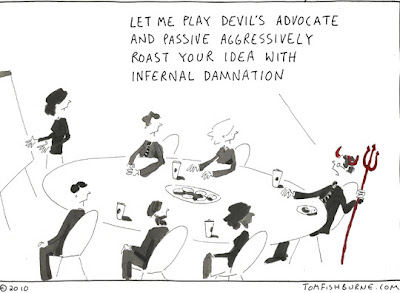 Every now and then, fire yourself. Then interview yourself for your job. Would you get it? What attributes would best suit you for it? (Do you even want it?)
Don’t schedule a meeting for one entire week each quarter. Stop being “too busy.” Find your value as a resource (rather than as a boss).
Take down all the cubicle and office doors. Then, every morning, say hello to each human you see before you walk into your door-free office.
Eliminate devil’s advocacy (unless you’re the Pope). Disagreement without responsibility hinders your organization’s progress.
Teach your staff your job. Let them do it when you’re on vacation.
Take all your vacation days. No contact. Don’t ruin it by doubling your workload upon returning.
Make sure your full-time salary is less than 6x the full-time salary of anyone else.
Stepping in Moral Quicksand: When a Horrible Person/Company Gives to Your Nonprofit

I was going to write about all the charities to which Donald Sterling donated.
I was going to ask if the standards of the organization should stand up against the horror of the donor.
After all, UCLA gave back $3 million of Sterling’s money.
Then I was going to ask about donations from companies that peddle “evil” – tobacco, liquor, oil, etc.
But then I thought about individual donors’ morals. Not just unethical oligarchs like Henry Ford, Rupert Murdoch, John D. MacArthur, or even Sterling. What about all the philanthropists whose fortunes were built on a million broken backs? Or a few? Or one? And I thought about my experiences with morally corrupt donors.
I’m sinking.
Help.
 137 Words