Just Because Someone Repeats It Doesn’t Make It True: Nonprofit Arts Organizations Must Serve a Charitable Purpose or Die Trying

Supposedly, Martin Van Buren wrote to Andrew Jackson imploring Jackson not to approve the railroads for fear of the loss of the canal system, citing mass unemployment, the closing of boating businesses, and the fear of trains moving at breakneck speeds of 15 mph. It never happened. I checked.
In W. P. Kinsella’s Shoeless Joe, “If you build it, they will come” was actually “If you build it, he will come” and referred to the farmer’s father. Not “If you build an arts center, thousands of new patrons will come, regardless of programming.” Read the book.
There is another fabrication that arts organizations are nonprofits simply by being arts organizations. It’s not true. I checked.
All over the US, there are myriad arts nonprofits that don’t serve a charitable purpose. Rightfully, foundations are noticing and diverting funds elsewhere.
There’s Not An App for That
There are an endless number of costly, effective CRM systems for the arts. One costs hundreds of thousands of dollars and it’s superb at what it does.
One might say, “It had better be.”
Before that expensive, expansive piece of software, there were others. Some great at some things, some at others.
Not one of these pieces of software ever raised a dime. People do that.
Not one of these pieces of software ever performed, exhibited, or created a compelling artistic experience. People do that.
Not one of these pieces of software ever governed, advocated, cajoled, or counseled. People do that.
Before CRMs that cost various ulnae, fibulae, and tibiae, there were inexpensive off-the-shelf database software solutions.
Before that, we did it all on paper.
Millions attended. Millions still do.
And the best relationships are still person-to-person.
Stop Kibbitzing Your Nonprofit Arts Marketers — They’re the Experts at What They Do (And You’re Probably Not)

Jerry Yoshitomi wrote a brilliant article last October. And in learning and unlearning of audience development skills, all too often marketing people are brutally disrespected by the other areas of the organization. I’ve heard marketing departments referred to as “a necessary evil” dozens of times.
Compare the following sentences:
“Anyone can market your arts organization.”
“Anyone can market your arts organization SUCCESSFULLY.”
“Anyone can act, paint, sing, dance, sculpt, direct, and play the tuba.”
“Anyone can act, paint, sing, dance, sculpt, direct, and play the tuba SUCCESSFULLY.”
Don’t be caught in ancient thinking. Just because all consumers react to marketing doesn’t make them good marketers. Treat marketers as you would treat other artists, because that’s what they are. They are the best interpreters of your product to the public. Don’t stand between them and your organization’s success.
Aphorisms for the Modern Arts Charity Leader

If it ain’t broke, break it. Then fix it.
You only read books in one direction.
Your legacy ends when you leave.
Institutional survival is not the goal.
Missions are gods; mission statements are bibles.
The best leaders are the best assistants.
Learn why before you continue.
Success is measured by impact, not excellence.
“Fiscal responsibility” is a business practice, not a mission statement.
Volunteers are employees who work for $0.
If your people are averaging 50+ hours a week, you’re failing.
Always use transitive verbs in your mission statements.
The cool kids are back in high school.
Sharpen your point of view; that’s why it’s a point.
Be completely, spectacularly wrong.
Treat candidates like employees.
Treat employees like human beings.
Treat human beings as though you are one.
Fire yourself regularly; interview yourself for your job.
Be funnier.
How to Build a Perfect Team in 5 Easy Steps

1. Never be the smartest person in the room. Hire candidates who are better than you. If you can’t, you’re probably an asshole.
2. Make clear what the goal is. In nonprofits, that goal is defined by the mission. If you can’t, your mission probably sucks.
3. Using their strengths (not yours), disseminate tasks rather than relying on calcified job descriptions. Create a human flow chart that leads to mission execution. If you can’t, people will keep quitting because of you.
4. Be their assistant, especially in small organizations, rather than insisting on having them be yours. If you can’t, you don’t really know what “team” means.
5. Don’t let “results” become your mood ring. Use “happiness” instead. Or “satisfaction.” If you can’t, quit your job so that someone else can do it better. If you think no one can, see Step 1.
Chief Instigation Officer: That’s Your Job, Too

A development director once told me that she worked “on behalf of donors.” No, not really. You work on behalf of the mission.
A marketing director once told me that “it’s all about the money.” No, not really. It’s all about the mission.
An artistic director once told me “we do it for the art.” No, not really. We do it to execute the mission.
Unless the mission, well, sucks.
Often it has fallen to me to gently (and sometimes not so gently) advise that without a compelling, singular mission that speaks to a specific, measurable societal improvement, a nonprofit arts organization is merely exchanging entertainment for money — like an organ grinder’s monkey, begging for pennies.
You are there to solve a problem. Make sure your company stands for something outside your little corner of the operation.
Next Time You’re On the Poseidon, Remember to Go Up – Organizational Culture and the Dangers of Sycophancy
If things are going well, the organizational culture is usually harmonious. If not, then it’s not. As Richard Branson recently wrote, “There’s no right or wrong way to go about creating a company culture, as long as you keep the staff that it’s designed for in mind every step of the way.”
Unless you don’t, of course.
Nonprofit leaders that seek knowledge, challenge their co-workers to wrestle with ideas rather than to rubber-stamp them – these people are golden. These people inspire the best in their communities. Their vision is not their own, but that of a collective.
Those who seek sycophancy, encouraged by well-meaning boards to behave autocratically – these people are leaden. They have no ability to rally, only to bully. Sadly, but inevitably, these folks excel at leading organizations straight into a toxic dump of irrelevance.
Cultural Fit: FIFA, North Korea, the Kardashians, the Nixon White House…and Your Nonprofit Arts Organization?

I just read an op-ed piece in The New York Times about the over-utilization of “cultural fit” as a criterion for hiring. “One recent survey found that more than 80 percent of employers worldwide named cultural fit as a top hiring priority.”
To an extent, cultural fit is interesting, but a “top hiring priority?” In the broadest sense, someone with an affinity for and experience in the nonprofit arts industry would seem to possess it for a nonprofit arts organization, as opposed to someone from Walmart.
But when challenges face the organization, or if an organization is seeking to “be taken to the next level,” cultural fit is the last thing you want in a key hire. Adding wax to a candle just makes a bigger candle. It doesn’t light up the night until you add the fire.
In Charities, The Chicken Came First. There. Settled. (But Each Chicken has the Ability to Hatch a Whole Passel of Eggs.)

When communities are in trouble, specific needs arise. Charities embark on social experiments aimed at addressing issues not easily solved when profit is king.
In the arts, we tend to loudly cluck about indirect results. Economic impact. The “Anti-Gang.” Higher math scores…happy by-products, but not arts’ reason for being.
But do regions address their specific needs – or even their happy by-products – when dominated by single museums, ballets, operas, theaters, or symphonies? Doesn’t it really take hen-houses full of them to increase a region’s vibrancy?
To achieve a community’s cultural success, dominating arts charities might consider the counter-intuitive notion of creating their own competition, risking their own vibrancy for the community’s sake. It’s certainly better for the region to incubate dozens of arts charities rather than one, especially when those “chicks” do the same once they’re able.
Marketing Arts Charities: In 2014, It’s about Me (Not You… Me)
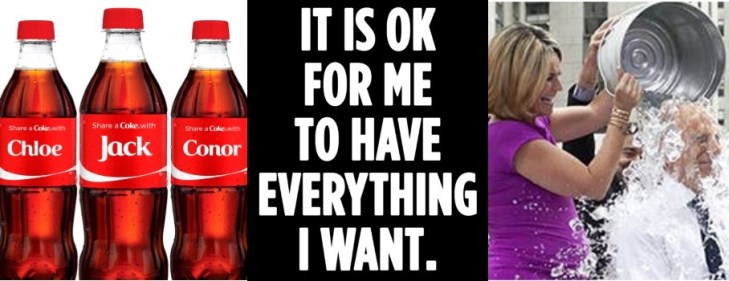
Attracting Millennials to the arts isn’t the easiest thing in the world. What worked with the Greatest Generation hasn’t worked with Boomers or Millennials.
This summer, Coca-Cola put names on the bottles (common first names for those born in the 80s and 90s). Then, a Coke turned into something about “me.”
Look what I’m drinking… it’s me!
We’ve also seen hundreds of bucket challenges to support ALS research, which is great. The product sold in the videos is “me.”
Look what I’m using to do good in the world… it’s me!
Marketing the transformative experience of the arts works best when it’s about “me.”
Look at that amazing artwork/ballet/opera/play/musical… it’s me!
If you can make the experience about the patron (not for the patron), you’ll have a fan for life.
Or at least until the next big thing.
Careers in the Arts: It’s Pretty Ugly Out There

Paul Begala said, “Politics is show business for ugly people.”
The converse, that show business is politics for pretty people, is equally true.
Pretty (young) people enter nonprofit arts leadership believing that they should land a high-paying managing director’s job within 3 years. Ginormous student debt is predicated on that prospect.
Ugly (old) people, therefore, had better vamoose, and decrease the surplus population, to paraphrase C-Dick.
Pretty people panic at red ink. They leave. No experience or belief in failure.
Ugly people see an opportunity. They know when to duck and when to charge.
Consider for your next important hire:
- When hiring for “fit,” by definition, you’re hiring to appease. Don’t expect much change.
- When hiring for “innovation,” you’re hiring to anticipate obstacles. And only someone who has experienced obstacles (and carried on) knows how to do that.
The Politics of Charity: Minding Your Speaking Your Mind

Some of us are more candid than we probably ought to be. We put ourselves out there. But remember this as you read this blog and other business columns: things change.
Each charity has a special mission (or at least should) that may relate to other charities in the universe, but not exactly. There is no right or wrong way to do it. And expressing a thought in a column – such as 137 Words – does not equate to either a Sermon on the Mount or a whisper from Jiminy Cricket about that charity. It is merely an expression based on the writer’s own vantage point.
So when Covey, Collins, Porter, or even Harrison proclaim a truth, it’s not backpedaling to say that the “truth” is a reaction to what’s happening right now. And that things change.
More on Charities and Families: Find a Way to Answer “NO” to Form 990, Part VI, Line 2

“XYX YXYXYXYX (WHO SERVES AS GENERAL DIRECTOR AND ARTISTIC DIRECTOR, CEO) AND XXX XXXXXXXX (WHO SERVES AS EXECUTIVE DIRECTOR – DEVELOPMENT AND MARKETING) HAVE A FAMILY RELATIONSHIP”
Their two combined salaries (excluding payroll taxes) to total budget: 6.0%.
Their two salaries to all salaries: 12.7%
These two employees to all 406 employees: 0.5%
Ratio, these two employees’ salaries to all employees’ salaries: 25-1
Current year surplus/(deficit): ($3,239,641)
Are your decision-makers married or in some family relationship? For a for-profit company, that’s fine. Family businesses and for-profit nepotism are mostly fine.
But charities, owned by the community and answerable to its constituents, are not family businesses. And when they act irresponsibly, like the above arts organization, it’s a travesty that negatively affects the whole industry.
Because now we have to convince supporters that this won’t happen to their donation.
Arrogance, thy name is YXYXYXYX.
Charity Leadership: Are “Family” and “Company” unconnected? Read on…

Family dynamic: parent(s), children, siblings. Extended to include: grandparents, aunts, uncles, cousins. Further extended to include: spouse(s), in-laws, in-laws’ spouses. May include lifelong friends and, sometimes, pets.
Company dynamic (charity): trustees, leaders, directors, managers, administrators, jobbers, customers, targeted beneficiaries. Extended to include: co-leaders, benefactors, additional management layers, corporate partners, colleagues. Further extended to include: advisors, non-targeted beneficiaries and, sometimes, the government.
Family is not company. Company is not family.
Each seeks a “home.” Neither seeks dysfunction. Few achieve functionality. Both are worthy.
Family members often yearn to be companies with direction: clear and evenhanded parents, rebellious and aspiring children who just need additional experience, collaborative siblings.
Company members often yearn to be families with humanity: caring but autocratic leaders, ambitious managers, iconoclastic jobbers, entitled customers, and grateful beneficiaries.
Is it best to treat families and companies as unconnected?
Your Next Charity Leader: “Cool, Aloof, Efficient” or “Passionate, Assertive, Innovative?”

I suppose it’s not a binary choice. But ultimately, they seem to fall in exclusive constellations of attributes.
Few leaders are in both camps. And, depending on the organization’s life-stage, you may need more from one camp than the other.
Pope Benedict vs. Steve Jobs. Neither is perfect, but each offers different personality sets at the helm of your charity.
I prefer to work with those who are in the latter camp. They are invariably afraid of little, impolitic, guileless, insistent, and noisy. But they most often find solutions, tell the truth, and can make things happen.
Not that I don’t like the former group, but I’ve found they hold their cards tight, condescend, rarely make a definitive statement, defer, passively-aggressively ignore, and require others to make things happen.
But they rarely threaten change. So there’s that.
Negatively Commenting on the Title of a Post (What You’re Reading Now) is Akin to PETA Boycotting “To Kill a Mockingbird” Because, You Know, They’re Killing a Mockingbird.
Recently, a foundation advocate negatively commented on the title of a 137 Words blog post. On the title, not the post.
As Ben Franklin once said, “We are all born ignorant, but one must work hard to remain stupid.”
Thank you for reading 137 Words and sharing it with your colleagues. We’re pretty amazed when 137 Words evokes derision, praise, or questions.
If you haven’t shared yet, please do – karma will be kind.
In 6 months, 137 Words has picked up about 6,000 readers. That exceeds all our expectations. We are truly grateful.
And to those like this advocate who only read the title and not the posting (what you’re reading now), I only wish bliss. Or, should I say, additional bliss.
Harsh? Maybe so. Because I am all too often a card-carrying member of the Right to Extreme Stupidity League.
Marketing the Arts, the Play-Doh® Fun Factory, and Marketman©
 “Have a response to ‘If it’s a hit, it’s the art. If it’s a bomb, it’s the marketing.’
It’ll keep you off death row.”
– Marketman©
Artistic events evolve. The elements may be eons old, but the results continue to change. With the squeeze of a contraption, like Play-Doh® in a Fun Factory, necessarily comes a different product. Different from the time before. Different from the next time.
This is a job for Marketman©, a copyrighted portion of this publication. Marketman© (not necessarily male) is your company’s Sea Gal/Jay Carney/Don Draper/Rob Petrie. Marketman© is charged with the task of launching a product to market, eliminating it, subsequently launching a new product.
Marketman© sells art, not tickets. There is no lasting inventory, like month-old sodas on the shelf, when the new product is introduced.
The 7 Most Important Things Not to Do About Not Doing the 52 Most Important Things

I write this blog and read many others. I find that people responding to nifty list posts (6 Strategic Ways to Get the Best Board of Directors) are looking for shorthand answers to longhand questions. I understand the appeal; work is complex and speed is valued over thoughtfulness. But the awkward and obvious question is:
“Are there only 6 ways to get the best board? Or are these just the first 6 you thought of?”
Same goes with negative posts (How NOT to Have a Sucky Board of Directors). I’ve been guilty of this, usually after a recent bad experience. Sorry about that, because the obvious and awkward question is:
“There are a kerjillion ways to have a sucky board. Can’t you help me get a good one?”
I’ll try to be a better poster. And here are 137 ways how…
Kibitzing is the Road to Hell for Charitable Organizations: “You know what you SHOULD do…”

Kibitzing. Webster’s definition: “watching other people and making unwanted comments about what they are doing.”
Good intentions (egad). Some people pay for the privilege via their donation or board service. My mother believes it’s her birthright.
For arts charities, kibitzing mainly involves comments, programs, and activities that are unsupported by research or any evidence of success.
Instead: come with solutions rather than problems. Shortfalls are as unintentional as bad art. No one intends red ink or a lousy play with bad acting. But rather than more bake sales, auctions, galas, or (egad) a “give-a-million-dollars-or-we’ll-go-bankrupt-on-Tuesday” campaign; rather than creating a program committee (because anyone can pick plays) or a marketing committee (because anyone can market the arts), work with your ED toward real, verified solutions.
The road to hell is paved with kibitzers. The road to bankruptcy, too.
Executive Directors: How Do You Control Your Self-Righteous, Burnout-Induced Rage Because, Well, Nobody Knows the Trouble You’ve Seen and Nobody Knows Your Sorrow?

I read an earnest article about burnout and its inevitability for certain nonprofits. According to the article, everyone running a charity should watch for certain signs. Included: “chronic underfunding” (always stressful in any operation), “documentation demands” (spending extra hours issuing reports for funders who do not pay for the extra time/staff necessary to prepare that report), and more.
What to do about it? I’ve tried intense sarcasm, shouting at the top of my lungs, turning crimson, and bellowing the occasional Charlie Brown “AAUGH!” Those seemed like good ideas at the time, but proved to be exactly the opposite. Funny that.
The article recommends that funders provide additional funds for a) reports and for b) executive directors to take sabbaticals.
Wow. Sounds so simple when you put it that way, doesn’t it?
Wait, there’s that sarcasm again. AAUGH.
Charity Culture: If Doing the Right Thing Makes You an Endangered Species, Do It Anyway

Sadly, few people know “Profiles in Courage.” Ask around.
Among performing arts charities, some leaders shrewdly keep their positions because they fear appearing impolitic. They seek sustainability for themselves first, and then, secondarily, their organizations.
To them I implore:
- Pay performers wages, on the books, legal standard or better, for every hour they spend: rehearsals, performances, fittings, etc.
- If your charity isn’t making a substantial difference, merge or close. If it is, share your secrets.
- It’s about social progress, not black ink. Both are preferable, but you’ve failed if your best work is 30 years of balanced budgets.
- Take a stand. Don’t buy trouble, of course, but don’t become invisible to save your own skin.
- Theatres: plays aren’t written, they’re wrought. It’s about the production and the viewpoint, not the script and sets.
- Do something. Don’t be something.
Have You Heard? I’m a “Bomb-Throwing Provocateur!” Who’d Have Thought an Artist Could be One of Those?
A few posts ago, we talked about the enmity brewing between the arts charities and the rest of the charity sector. That many US arts charities concentrate on the quality of their art while the rest of the sector concentrates on outcomes. That arts charities are pretty much the only part of the charity sector in which the donor also uses the charity, exacerbating the arts’ reputation as being elitist.
Responses were 50-50. Those that agreed tended to come from arts marketers and fundraisers while the rest came from artistic directors and producers. Break it up…nothing to infer here.
Funniest comment was from a 36-year arts veteran decrying elitism; it’s part of the title here. She could have said, “You’re an asshole.” Or “jerk.” Or just plain “wrong.”
I might be all those things. After all, I’m an artist.
Successful Trusteeship, or “Isn’t Writing a Big Honking Check Enough?”

Good board members:
- aren’t ambassadors. Ambassadors wait for people to come to them. They’re zealots. They zealously get donations and zealously get new board members.
- don’t try to get. They work together and with staff and they get.
- personally donate among their three largest monetary donations that year. Not from their company…from them.
- are forensic analysts, (not governors). Remember, the bottom line is “Are we living our mission? Is the mission working?” They see to it that it does, regardless of the financials.
- insist that board meetings are too important to be reporting vehicles. Productive monthly board meetings can be like having twelve mini-retreats.
Think of it this way: if each board member’s consulting rate is $100/hour and your charity has 20 board members, do you want to spend $2,000/hour talking about the past or the future?
Nonprofit Strategy: Managing Change is Hard; Managing Stasis is Impossible

I had breakfast with a trustee for an educational organization in a wealthy community within the last five years.
He bemoaned the fact that an über-wealthy benefactor was annually bailing them out with huge sums of money, but the organization was still always crying for cash. And the company refused to upgrade its business practices.
“Why is she bailing them out?” I paraphrased.
“Because it’s her legacy to her kid,” he paraphrased. “And let’s face it, for vanity.”
“And if it folds?”
“She won’t let it.”
“Are they always in a cash crisis?”
“Yes – and not only that, it’s just not serving all that many children.”
“And they can’t change the way they do business?”
“She won’t let them.”
Can’t change. Can’t succeed. Can’t close.
Bad for the organization? Bad for the industry? Bad for the community?
Nonprofit Management Counter-Intuition 2 — “Throwing Out the Baby with the Bathwater” Might Be a Better Risk than Listening to the Sirens

There is a Siren-like fatal lure to “almost there” for some charity leaders.
Let’s say that despite success in other programs, a few of the more ambitious risk-reward programs are flailing. The Sirens entice you to put more time, more effort, more personnel, and more money into the flailing programs.
When you explain to them that by moving time, personal, and financial resources away from the programs that are working into the programs that are not, the company risks the success of the working programs, the Sirens entice you to do it anyway.
Sirens are evil.
Why not take this opportunity to refresh your organization’s ambitions, goals, and programs? The smart move might be to throw all the programs out (at least on paper) and build a new list of activities that support the mission from scratch.
 137 Words