Sustainability is Neither Reaching for Relevance nor Selling Out. It’s More Important than That.

The art of sustainability in arts charities is akin to performing a balance beam routine on a Ginsu knife. You can sacrifice mission for dollars or dollars for mission, but even if you maintain a perfect balance, there will still be substantial blood on both sides.
We talk way too much about relevance in the arts. The tag in the back of the shirt is relevant for a description of content and washing instructions, but the design of the shirt can reveal personal characteristics of the wearer. Let’s aim higher. How about “integral”?
Integral arts charities are those that are so entwined with other charities that they become essential to the health of the community. “Integral” obviates this useless discussion of relevance and moves us to the more useful question:
How do the arts make communities thrive?
Nonprofit Management Counter-Intuition: Every Now and Then, You Have to Fire Yourself
 Every now and then, fire yourself. Then interview yourself for your job. Would you get it? What attributes would best suit you for it? (Do you even want it?)
Don’t schedule a meeting for one entire week each quarter. Stop being “too busy.” Find your value as a resource (rather than as a boss).
Take down all the cubicle and office doors. Then, every morning, say hello to each human you see before you walk into your door-free office.
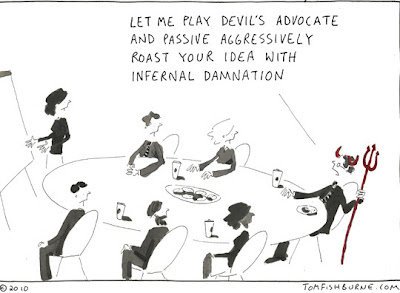
Eliminate devil’s advocacy (unless you’re the Pope). Disagreement without responsibility hinders your organization’s progress.
Teach your staff your job. Let them do it when you’re on vacation.
Take all your vacation days. No contact. Don’t ruin it by doubling your workload upon returning.
Make sure your full-time salary is less than 6x the full-time salary of anyone else.
A Version Aversion (or: Why It’s More Important That The Whole Thing Works And Not Just The Elements)

Saw a play recently. The story was appropriately troubling and deftly told. But great art is not about literary proficiency or good acting.
Often in any of the artistic ventures, we render our version of a piece, and are judged by some version of accolade. Our study becomes about acting excellence or mind-blowing special effect or the brilliant manipulation of color and light. And critics judge on those foundations. Even in a new work, we cling to “our version.”
Fans don’t care. Fans are, fittingly, binary. Either the art makes one transform or it doesn’t. When we seek outcomes that make it jarring to return to reality, we do well. If fans only enjoy the elements created to produce the art’s reality, then “our version of art” is to “great art” as “Matchbox Cars” are to “Lamborghinis.”
Stepping in Moral Quicksand: When a Horrible Person/Company Gives to Your Nonprofit

I was going to write about all the charities to which Donald Sterling donated.
I was going to ask if the standards of the organization should stand up against the horror of the donor.
After all, UCLA gave back $3 million of Sterling’s money.
Then I was going to ask about donations from companies that peddle “evil” – tobacco, liquor, oil, etc.
But then I thought about individual donors’ morals. Not just unethical oligarchs like Henry Ford, Rupert Murdoch, John D. MacArthur, or even Sterling. What about all the philanthropists whose fortunes were built on a million broken backs? Or a few? Or one? And I thought about my experiences with morally corrupt donors.
I’m sinking.
Help.
You Gotta Live in the House You Live in

Hypothetical: Strategically speaking, what would your charity do if money were not an issue at all?
The answer to this question is significant. Because if it begins with anything but “we’d do exactly what we’re doing now,” then it’s likely that either you or your mission have to go.
I live in a 1950s house. Typical low ceilings. Small, utilitarian rooms. If I had all the money in the world to renovate it, I’d enhance its 1950s nature, not build 4 additional stories to get a Puget Sound view and in doing so, ruin the house’s charm.
Same with charities, arts or otherwise. You created a mission for a reason…there was a need. A societal wrong to be righted. If you want to accomplish something other than your organization’s mission, go do it.
Just do it somewhere else.
Verbal Tics and Jargon Reduce Your Ability to Communicate Effectively. What’s Your Fingernails-on-the-Chalkboard Verbal Tic?
So the word I overuse most lists “accordingly,” “consequently,” “ergo,” “hence,” “therefore,” and “thus” among its synonyms. I’m among many who have this unfortunate tic.
So we’ve used it to reframe questions to fit our answers. We’ve used it as a replacement for “uh,” “um,” “y’know,” or “well.” We’ve used it to preface an opinion for the purpose of making it sound as though we represent universal consensus.
So honestly, we’ve stopped knowing why we use it at all. Or that we use it at all.
So I discovered the tic by listening to Harry Shearer’s brilliant radio program, Le Show.
So I have other communication peeves having to do with the words “literally” and “notoriety,” the phrase “the exact opposite,” and the valley-girl end-of-statement uptick, now prevalent among both genders. But “glass houses” and all that.
Jack and Jill: Why Smart Nonprofits Search for Interim Leadership
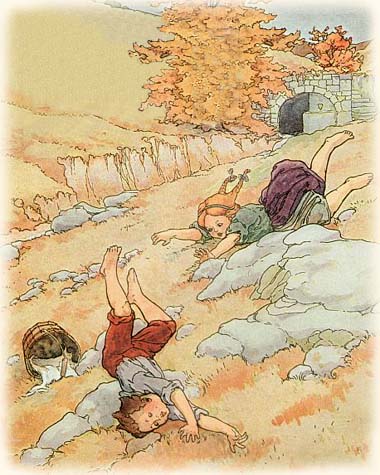
Executive Director Jack resigns.
Jack leads the committee to replace himself. The committee selects Jill.
Jill is not Jack.
Jill discovers too late that she been enlisted to follow Jack’s path rather than set her own.
After a year, not only is Jill unhappy, but trustees and employees resign.
After a second year, Jill resigns. Or is fired.
The reeling company hires Fred – who is neither Jack nor Jill.
Uneasy lies the head that breaks a crown.
Succession planning needn’t require permanence. It might be best to hire an interim leader from outside the organization (not a board member) while the permanent search is carefully executed.
Every organizational leader’s legacy ends the day the leader leaves. Which means it is never a good idea to have the outgoing director have a say on a permanent successor.
Personality, Talent, Intellect, Experience, Spirit, Passion, and the Ability to Inspire. Good Qualities for You but Intimidating as Hell to Insecure Leaders

I have a friend (not me) who is a sensational grant writer. She’s brilliant (Ivy League educated), inspirational (magnetic personality), talented (great references), and people genuinely like her.
She’s also ethical, sensible, positive, quite attractive, and a snappy dresser.
And without a job.
Lately, when she meets with prospective employers, they are impressed by her prowess, references, and samples. Sadly, they don’t hire her. It’s plausible that insecure bosses-to-be fear she is more impressive than they are and look elsewhere.
Look, if you’re in greater Seattle and need a hell of a grant writer for a full-time gig, contact me and I’ll forward your info to her. But if you’re unstable enough just to want someone inferior to you (even if your grants are being denied) because “anyone can write a grant,” then you deserve your results.
40 years in the Desert – Advice for Leaders Taking the Helm and Those Whose Helm is being Taken

Happy Passover. Story goes: Jews escaped slavery and spent 40 years finding “the Promised Land.”
A popular idea on why it took so long: the generation that escaped were slaves. The generation after that was prepared to lead the new world. People found leadership abilities only after shedding the slave mentality.
When a change in staff or board leadership occurs, it is incumbent upon the incumbent organizational leaders to adapt, not the other way around. You didn’t hire (or elect) a “new” former leader. You hired an exemplary individual with different (but complementary) values, aspirations, and ideas. Shed the mentality of an organization run by the previous leader. That culture vanished when that person left.
If you’re the new leader, remember that you were hired to lead on your terms. Your feet won’t fit in someone else’s footprints.
Charity-Nonprofit. Tomato-Tomahto? Potato-Potahto? Not so much.

Charity as defined by the OED. Helping those in need.
Nonprofit as defined by the OED. Having to do with the financial aspects of a company and specifically designated in definition 2 as being separate from a charity.
Nonprofit organization as defined by the United States. Makes possible some companies to be tax-exempt if they participate in specified exempt purposes: charitable, religious, educational, scientific, literary, testing for public safety, fostering national or international amateur sports competition, and preventing cruelty to children or animals.
Charity as defined by the United States. Key words: “the poor, distressed, or underprivileged,” “religion,” “education,” “science,” “public buildings, monuments, or works,” “the burdens of government,” “neighborhood tensions,” “prejudice and discrimination,” “human and civil rights,” and “community deterioration and juvenile delinquency.”
I’d rather run a charity than a nonprofit, wouldn’t you?
More importantly, do you?
Innovation: not just for production managers and marketing directors

I love production managers. The good ones tend to come from a background of experimentation. Using the improv-tested training mantra of “Yes And,” their work ethic promotes wildly thoughtful experimentation.
I love marketing directors, too. Good ones aim for reaction rather than beauty. No fan cares about “Addy” awards. They care about having a personally meaningful experience.
Innovation in arts charities need not be limited to the production manager or marketing director, the two lead staff members dedicated to translating the art to fans.
To innovate, all you need to do is innovate. Which requires…
Identifying the need…
Honor for the ideas of the team…
Synthesizing the data…
10% more time than is available…
500% more patience…
A vision of success…
And the acceptance that, as more than one production manager has famously said, “This could suck.”
Even Endowments Don’t Want You to Have an Endowment

Went to a foundation’s financial conference a few years back. Before the economy went south.
The COO of the foundation said (a direct quote), “If you’re not pulling 20% of your annual budget from your endowment roll-off, then you probably shouldn’t have an endowment.”
And now, the math:
Assuming the annual payment is 5%, your endowment would have to outnumber your annual budget by a ratio of 4-1.
Endowments are not reserve funds. They are not liquid. They have little to do with an organization’s stability. Often, the endowment campaign is successful, but the organization teeters on bankruptcy in vast oceans of red ink.
Endowments do not prove an organization’s worth, nor does it assure its future. Although, I suppose, it does offer a bankrupt organization the chance to pay off its bills before closing for good. So there’s that.
Seen on a sweatshirt while walking around Green Lake: “Change is good. You go first.”

Innovation is annoying. Instigation is even worse. I ought to know. I’ve been accused of both.
But when companies are stagnant (or failing), staying put is not an option.
Innovators and instigators can be difficult. Steve Jobs, Thomas Edison, and Henry Ford are/were not particularly “easy” people. Nor were César Chávez or Copernicus. Nor were many women who broke through glass ceilings.
Too often when things aren’t working, managers paralyze themselves by thinking without forensic analysis. For them, all they believe they need to do is to keep doing what they’re doing.
“We tried change,” they’ll tell you. “It didn’t work. All we have to do is work harder.”
Forensic analysis matters. The great leaders know that and use it to their competitive advantage. They may also consider change agency to be annoying – but also rewarding.
Like licking honey off a thorn – Art, why we do it, who it’s for, and why it has power

Painters sing.
Actors play.
Writers choreograph.
Singers paint.
Dancers conduct.
Choreographers sculpt.
Sculptors act.
Musicians paint.
Directors sing.
Conductors write.
And in doing so, no issue, thought, or attitude can be unseen, unfelt, or unheard. It is not for the singing, the painting, etc., that art is produced. The glory of art is in its scope of power. To inspire peace or revolution. To cause great comfort or great discomfort. To provide joy or desolation.
As a populist, I believe that visual and performing arts serve great groups of people. I fear that many in power judge art as dangerous. Their battle plan continues to manipulate those same great groups of people into despising it, to consider it as foreign. As the other.
And I fear that they’ve won that battle. But not the war. Not yet.
More words and phrases that ought to be outlawed from the lexicon

“If you build it, they will come.” – Originally written by WP Kinsella in his best-selling novel, Shoeless Joe, and popularized in FIELD OF DREAMS, these six words have rationalized arts capital campaigns across the US, many of the fruits of which have predictably become money pits.
(The original quote was “If you build it, he will come,” and referred to the protagonist’s father. They had a catch.)
“Art for art’s sake” – coined in the 19th century to justify Aestheticism, in which art was thought to exist for the sake of its beauty alone, and that it need serve no other purpose. Today used to justify programming for many arts organizations.
“Community” – here’s the OED definition. Used by nonprofits in a mercurial manner to keep from describing the very people they wish to positively affect.
“I Wanna!” The Fatal Game of Power About Nonprofit Arts. Ages infantile and up.
How to play:
Players select their tokens to start play. Each token designates their role in nonprofit art.
Marionette: Performing Artists/Designers
Blob of Clay: Writers/Composers/Visual Artists
Pawn: All technical/administrative/volunteer personnel (one token represents all)
Change Purse: Audience
Louis Vuitton Pocketbook: Donor/Funder
Fake Louis Vuitton Pocketbook: Development Director
Hammer: Trustee
Bent nail: Managing/Executive Director
Telescope looking up: Artistic Director/Curator
Microscope looking down: General Manager/CFO
Bloody leech: Critic/Journalist
Sorry: designated tokens for marketing/pr directors were deleted in the last budget cycle.
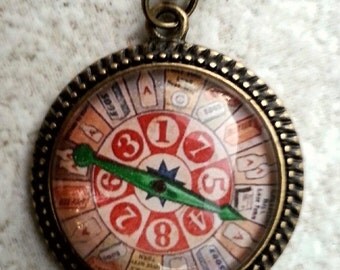
All players spin the Great Glass Wheel Of Art simultaneously in all directions and yell, “I Wanna!” The Wheel comes off its bearings; breaks into millions of pieces. Players move tokens anyplace in the room that feels most advantageous, regardless of the playing board or other players.
End of game:
Chaos. All players proclaim victory. None actually win.
U-Better, U-Better, UBIT

Watching arts nonprofits seek funding in unusual ways leads to same old/new discussions on Unrelated Business Income Tax.
Taking a group of donors for a London theatre tour (even if all the finances are handled by an independent agent)…UBIT, you betcha.
The percentage of time spent in London at a lecture about your company’s particular brand of theatre…OK.
Selling t-shirts with just the logo of your natural history museum…UBIT, you betcha.
Selling t-shirts with dinosaurs on them at your natural history museum…OK.
Leasing part of your building to a separate business…UBIT, you betcha.
Items sold at a gift shop with a separate public entrance…UBIT off more than you can chew.
Items sold at a gift shop only accessible to ticket-buyers…UBIT only items not related to the tax-exempt purpose of the organization.
UBIT. Not just another 4-letter acronym.
Nag, nag, nag. So, Mr. Big Shot, how do you make a perfect nonprofit arts organization?

There is no perfect nonprofit organization of any kind. All nonprofits are experiments in righting some crucial societal wrong.
For the arts, that wrong is ignorance. It is complacence. It is the invisibility of the big picture. The visual and performing arts bring us beauty, power, and intellect. The opposite of all those words, of course, is nothingness.
Art is never for art’s sake because it is condescending to anthropomorphize it.
When great nonprofit arts organizations look at their core ambitions and value, they view their work as an innovative tool toward the betterment of society.
Commercial arts organizations’ goals begin and end with profits. Mediocre arts nonprofits goals are measured by their art. Great arts organizations’ goals involve righting the crucial societal wrong.
Final note: Great nonprofits don’t consider self-survival a worthy mission. Mediocre ones do.
Legacy-building is not derived from a legacy building

The intention of legacy is a killer.
Many nonprofits in the arts have chosen to engage in massive fundraising efforts to build buildings. But buildings in and of themselves are not your duty.
A capital campaign is like raising money for launch pads. NASA’s mission is to “pioneer the future in space exploration, scientific discovery and aeronautics research.” Not “build the best launch pad.”
Your nonprofit’s mission may tangentially benefit from capital expenditures. But when EDs, ADs, or philanthropists intentionally attempt to leave a legacy by building venues, they put the organization at risk of irrelevance. Some call that the “Edifice Complex.”
The building may last, but the company may die from spent energy, mission drift, and rationalizing programming for the new space.
Your legacy with a nonprofit organization ends when you leave. As it should be.
Isn’t Great Art Enough?

Doesn’t the artwork of a Van Gogh or Diego Rivera exhibit at a nonprofit museum make one seek insight into the meaning of life?
Doesn’t the performance of a nonprofit dance company’s production of Copland/DeMille’s “Rodeo” or Ailey’s “Revelations” make one try to restore the American dream?
Doesn’t the experience of a nonprofit theater’s production of “A Raisin in the Sun,” “Romeo and Juliet,” or “Angels in America” make one try to become more tolerant?
Do nonprofit arts organizations need more than those responses to justify charitable funding?
While many nonprofit arts organizations choose “art for art’s sake,” populist sentiment seeks quantifiable results to validate contributions to any portion of the nonprofit sector (social service, education, etc.).
So: shouldn’t great art be enough? Absolutely. Art can be produced for its own sake when no donations are requested.
You’re faking it. You know you are. So why would you hire someone who knows less than you do?

Deep in your soul, you understand that you have no idea what you’re doing. You’ve been faking it for years.
You have years of experience and an important-sounding title. But you know the truth.
Now that it’s time to hire someone to report to you, who do you want?
“Someone young I can mold,” said an ED acquaintance recently. What he meant was, “Someone who won’t outshine me in front of my board.” Idiot.
“Someone who has fought the fight,” said a board member I know. “Someone who can offer great perspective and can innovate intelligently.” Wise.
We are imperfect. We have weaknesses. So when you accept that you don’t know everything, the best thing you can do is hire to those weaknesses.
When you do, you’ll be a leader. Until then, you really are a fake.
Nonprofit Arts Organizations – Are you aware that the other parts of the sector believe that you’re stealing money?

In most nonprofits, a donor gives and someone else benefits. Food banks solve hunger, which promotes family stability, which stimulates re-entry into society for the impoverished. Environmental nonprofits encourage clean air and water, which promotes health, which supports longer, happier lives for everyone. Many religious organizations sponsor high morals (“Do unto others…”), which provides a sense of community, which fosters a safety net.
In the arts, the donor and the recipient are often the same person. The donor gives to a company, the company produces a performance or exhibit, and the donor/recipient enjoys the event. The arts are seen by many as elitist and unworthy of support.
We in the arts have to recognize that there is an enmity-laden relationship between arts nonprofits and all the other charities.
And then we have to do something about it.
Nonprofit hiring… Consensus…check. Fairness…check. Zombie interviewers…GRAXAGHZ.

Employees are your biggest asset as an organization. Nonprofit employees hold greater importance. Relationship-building through positive, passionate human interaction are better portents to success than technological advances.
And yet, too often the hiring process – especially in communities seeking “consensus” or “fairness” – has devolved into “Interviews in Zombieland.”
“Consensus” is not unanimity. “Fairness” is irrelevant when you’re seeking great people.
The group interview is quickly disintegrating. Every person takes turns reading pre-designed, pre-printed questions in the dullest drones imaginable. Your staff turns into a cast of Zombies in a badly-written, badly-acted play, and everyone uses the same dull inflection to every candidate.
And then, invariably, zombie staff members complain about the candidates’ dullness.
Nonprofit leaders: is your hiring process as undead as your results? And are zombie interviews the best way to show off your organization?
The black ten goes on the red Jack, Jack

The worst thing you can say is “I’m too busy.”
There are reasons, remedies, and repercussions available here and here and here.
Therefore:
If someone you know calls, call them back. Don’t write. Call. Today.
If someone you know writes, write them back. Or call. Today.
If you have an appointment with someone, do not text them a “crazy busy” excuse in the hopes they’ll go away. Meet. You said you would. Passive aggressiveness is still aggression…and it’s repugnant.
Be fifteen minutes early. Honoring time is the ultimate respect.
Stop being afraid that people will catch you playing Solitaire. We know you’re playing Solitaire. Everyone’s playing Solitaire of a kind. We’re not actually speaking with other people, seeking ideas and help, or evolving curiosity.
If we only express things we already know, then how do we grow?
$14.50

On July 24, 2009, the national minimum wage was $7.25/hour.
A year has a capacity for 2,080 hours (40 hours x 52 weeks). 2,080 hours provides an annual gross income of $15,080 (if the employer pays for holidays, sick days, insurance, parking, etc.). Income tax lowers the figure down to $12,516.
The 2009 official poverty line for the US (family of four) was $22,050.
4½ years later, minimum wage is still $12,516/year.
If the minimum wage were doubled for businesses with 50+ employees, the gross annual minimum wage would be $30,160. After federal tax, those employees would take home $25,033. 2013’s official four-person-family poverty line is estimated to be $25,000.
Sounds about right. Unless the economy is built on maintaining a working poor. If that’s the case, we should reduce the minimum wage and build workhouses.

