The Psychology of Being Last and 4 Other Ways to Level the Board Meeting Room Table
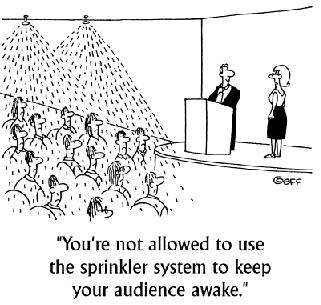 Board meetings are often reporting festivals. Endless polite reports reminiscent of “what I did last summer” essays from the first day of elementary school. It’s too bad.
Calculate the hourly consulting rate of the people in the room (for example, 15 board members x $100/hour = $1,500/hour). At $1,500/hour, do you want to talk about the past or the future?
Board members, inside the meeting room…
- Never do what the last person in the conversation advocates. It’s a trick manipulative people do.
- Consensus is not unanimity; votes needn’t be unanimous. After the decision is made, however, everyone needs to back it.
- No devil’s advocates; take responsibility for your disagreement.
- Read the ED’s report beforehand. EDs: issue your report at least a week before the meeting.
- Your ED is not responsible for writing and executing your strategic plan. You are.
“In This Scene, Could You Be a Little Funnier?” – A Perspective on Performance Reviews
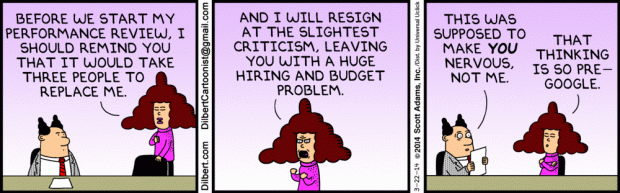
“Fire ’em the first time you think about it.” This was the mantra of the board chair of a company with which I was affiliated. I’ve always appreciated the portion that means that I should know when things are not working with a company or individual – from the perspective of employer or employee.
Which brings me to performance reviews. Gack. Many formal performance reviews within arts organizations waste time and energy and breed unnecessary anxiety. That’s not to say that you shouldn’t do them – but do them continually rather than once a year or when a contract demands it.
If your company has a horrible work environment, a performance review is about as helpful as a Band-Aid on a heart attack. Similarly, if the environment is open-minded, so should your inter-reactions. You’ll know if it’s working out.
Don’t Be a Company with a Mission; Be a Mission with a Company

I’ve been reading a number of articles discussing arts charity marketing as a whole-company tool, not a ticket-sales tool. Here’s one from TRG.
I was disappointed by Advancement Northwest’s Major Gifts Symposium keynote speakers’ idea of including donors within a charity’s mission.
I have been met with resistance from key artistic and production personnel who have been taught that “we do the art and everything else is a necessary evil.” (Actual quote.)
It’s just human nature for stakeholders to overvalue their contribution. Board members do it. Employees. Volunteers. Audience. Artists. Donors.
Here’s the thing: arts nonprofits that are created to solve a societal problem don’t have these issues. These issues fester when the company is created prior to creating (and rationalizing) a mission.
Create your company as an answer and horses and carts will sort themselves out.
There’s Not An App for That
There are an endless number of costly, effective CRM systems for the arts. One costs hundreds of thousands of dollars and it’s superb at what it does.
One might say, “It had better be.”
Before that expensive, expansive piece of software, there were others. Some great at some things, some at others.
Not one of these pieces of software ever raised a dime. People do that.
Not one of these pieces of software ever performed, exhibited, or created a compelling artistic experience. People do that.
Not one of these pieces of software ever governed, advocated, cajoled, or counseled. People do that.
Before CRMs that cost various ulnae, fibulae, and tibiae, there were inexpensive off-the-shelf database software solutions.
Before that, we did it all on paper.
Millions attended. Millions still do.
And the best relationships are still person-to-person.
Stop Kibbitzing Your Nonprofit Arts Marketers — They’re the Experts at What They Do (And You’re Probably Not)
Jerry Yoshitomi wrote a brilliant article last October. And in learning and unlearning of audience development skills, all too often marketing people are brutally disrespected by the other areas of the organization. I’ve heard marketing departments referred to as “a necessary evil” dozens of times.
Compare the following sentences:
“Anyone can market your arts organization.”
“Anyone can market your arts organization SUCCESSFULLY.”
“Anyone can act, paint, sing, dance, sculpt, direct, and play the tuba.”
“Anyone can act, paint, sing, dance, sculpt, direct, and play the tuba SUCCESSFULLY.”
Don’t be caught in ancient thinking. Just because all consumers react to marketing doesn’t make them good marketers. Treat marketers as you would treat other artists, because that’s what they are. They are the best interpreters of your product to the public. Don’t stand between them and your organization’s success.
Leadership by Forcing Audiences to Follow: “This is How We’ve Always Done It” Didn’t Work in 1776 and It’s Not Working Now

Overall, there are 28% fewer television viewers between 18 and 49 than there were 4 years ago. The average television viewer is now 50.
They’re streaming and DVRing. “Appointment Television” is becoming increasingly obsolete, apart from the Super Bowl…so far.
Broadcasters are sweating bullets and taking golden parachutes. It’s guerrilla consumer behavior and to them, it’s just not fair.
Just like the Colonial armies – they didn’t stand in neat, straight lines as the British did in the Revolutionary War. They broke the rules of battle. Not fair.
Just like younger people bolting from old-school arts organizations – those whose customs and rules work for the producer without working for the video streamer. Not fair.
Predictable, season-oriented, excellently-produced but inadequately result-oriented programming has become today’s version of Artistic Redcoats. Pretty, stubborn, old-fashioned, and easily destroyed by Artistic Neo-Colonials.
Guess who wins that battle?
In Charities, The Chicken Came First. There. Settled. (But Each Chicken has the Ability to Hatch a Whole Passel of Eggs.)

When communities are in trouble, specific needs arise. Charities embark on social experiments aimed at addressing issues not easily solved when profit is king.
In the arts, we tend to loudly cluck about indirect results. Economic impact. The “Anti-Gang.” Higher math scores…happy by-products, but not arts’ reason for being.
But do regions address their specific needs – or even their happy by-products – when dominated by single museums, ballets, operas, theaters, or symphonies? Doesn’t it really take hen-houses full of them to increase a region’s vibrancy?
To achieve a community’s cultural success, dominating arts charities might consider the counter-intuitive notion of creating their own competition, risking their own vibrancy for the community’s sake. It’s certainly better for the region to incubate dozens of arts charities rather than one, especially when those “chicks” do the same once they’re able.
I’m baaaaa-aaaaack — “He who’s down one day can be up the next, unless he really wants to stay in bed, that is…”

For 8 months, I’ve been temporarily working in Detroit, mixing Cervantes (above) with Kerouac (below). Detroit was fascinating.
Where to go next is the issue.
I’ve studied nonprofit arts cultures across the country and (so far) settled on regions surrounding Seattle, Portland, Chicago, and Washington, DC.
The house and TK are in Seattle. TG is in Detroit. I’ll give you a great deal on the house, but not the others.
Criterion #1: When a region’s arts community is comprised of a whole bunch of discrete mission-based organizations – rather than everybody doing everything – then that region’s organizations succeed. That’s for me.
Criterion #2: When a region’s arts community is comprised of a precious few large arts organizations, those organizations are doomed to irrelevance. Not for me.
But my mind wanders…
“What’s in store for me in the direction I don’t take?”
Art in a Plutocratic Oligarchy: Send Lawyers, Guns, and Money
In the USA, we made up the phrase “freedom of expression.”
Constitutionally, the first amendment states that Congress can’t pass laws that, among other things, designate a national religion or abridge the freedom of speech or the press.
Often, these rights are lumped together and expanded to include artistic expression.
And political contributions.
And porn.
But in an America where we have officially anthropomorphized businesses, can the arts be effective tools for positive change? Or simply a numbing agent against negative change?
Have retribution-fearing foundations and donors unwittingly turned nonprofit arts charities into a series of retribution-fearing crab buckets? With the exception of organizations that seek measurable impact using arts as a means (not an end), have we become participants in social malaise?
If so, send lawyers, guns, and money to get you out of this.
If Educational Attainment is the Most Valuable Predictor of Arts Attendance, Can the Arts Become a Magnet for a More Highly-Educated Populace?

39.4% of Americans have at least a 2-year college degree.
Of the 25 most populous metropolitan areas (not limited to the city limits), only 15 surpass that percentage by more than 1%.
They are (in order of percentage, high-low):
- DC
- Boston
- Oakland-San Francisco
- Minneapolis
- Seattle
- Denver
- New York
- Baltimore
- Pittsburgh
- San Diego
- Portland
- Chicago
- Atlanta
- Philadelphia
- St. Louis
Coincidentally, every one of these cities exceeds the mean in inter-city US migration (moving from one US city to another).
When you eliminate people who have attended school-based arts performances and exhibitions in which they have a significantly personal connection to the art (a child, a neighbor, etc.), fewer than 50% of Americans have paid to experience the arts.
Does that mean that we give up on the arts in other metropolitan areas? Or might the arts serve as an attractor for highly-educated migrants?
Marketing Arts Charities: In 2014, It’s about Me (Not You… Me)
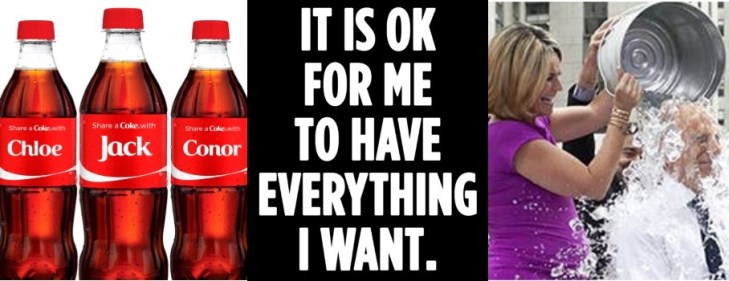
Attracting Millennials to the arts isn’t the easiest thing in the world. What worked with the Greatest Generation hasn’t worked with Boomers or Millennials.
This summer, Coca-Cola put names on the bottles (common first names for those born in the 80s and 90s). Then, a Coke turned into something about “me.”
Look what I’m drinking… it’s me!
We’ve also seen hundreds of bucket challenges to support ALS research, which is great. The product sold in the videos is “me.”
Look what I’m using to do good in the world… it’s me!
Marketing the transformative experience of the arts works best when it’s about “me.”
Look at that amazing artwork/ballet/opera/play/musical… it’s me!
If you can make the experience about the patron (not for the patron), you’ll have a fan for life.
Or at least until the next big thing.
Careers in the Arts: It’s Pretty Ugly Out There

Paul Begala said, “Politics is show business for ugly people.”
The converse, that show business is politics for pretty people, is equally true.
Pretty (young) people enter nonprofit arts leadership believing that they should land a high-paying managing director’s job within 3 years. Ginormous student debt is predicated on that prospect.
Ugly (old) people, therefore, had better vamoose, and decrease the surplus population, to paraphrase C-Dick.
Pretty people panic at red ink. They leave. No experience or belief in failure.
Ugly people see an opportunity. They know when to duck and when to charge.
Consider for your next important hire:
- When hiring for “fit,” by definition, you’re hiring to appease. Don’t expect much change.
- When hiring for “innovation,” you’re hiring to anticipate obstacles. And only someone who has experienced obstacles (and carried on) knows how to do that.
Arts Charity Strategy: When Substitutes and Competitors Blur, Does Your Organization Become Unfocused?

In 1979, Porter’s Five Forces Analysis tool was published by the Harvard Business Review. If you haven’t studied it, do so. But study it hard – it’s far more comprehensive and complex than “5 Tips to Get More Donors” or others in the current mini-list nonsense arena.
When arts charities view competitors (those that do what we do) and substitutes (those that do something that the customer will do instead of what we do) as one force, they lose mission focus, and once that happens, they begin the downward spiral.
To wit: if you run a theatre, your competition is “theatres.” If you make the mistake of thinking that “video games” is a competitor (rather than a substitute), the logical conclusion is that you need to provide “television” instead of “theatre.”
Be a theatre. That’s hard enough these days.
The Politics of Charity: Minding Your Speaking Your Mind

Some of us are more candid than we probably ought to be. We put ourselves out there. But remember this as you read this blog and other business columns: things change.
Each charity has a special mission (or at least should) that may relate to other charities in the universe, but not exactly. There is no right or wrong way to do it. And expressing a thought in a column – such as 137 Words – does not equate to either a Sermon on the Mount or a whisper from Jiminy Cricket about that charity. It is merely an expression based on the writer’s own vantage point.
So when Covey, Collins, Porter, or even Harrison proclaim a truth, it’s not backpedaling to say that the “truth” is a reaction to what’s happening right now. And that things change.
The Future of the Arts: It’s About the Impact Outside the Building
 I’ve been scouring mission statements. Some inspiring, some boring; some engaging, some self-indulgent. Indications of what the charity values? Absolutely.
Performing arts charities, more than any other, tend to value programming over impact:
“to sustain, encourage, and promote the performing arts and to educate the public with relation thereto” – Lincoln Center
“producing and presenting the greatest examples of music, dance, and theater; supporting artists in the creation of new work; and serving the nation as a leader in arts education” – Kennedy Center
In contrast, public broadcasting tends to value impact over programming:
“to create a more informed public – one challenged and invigorated by a deeper understanding and appreciation of events, ideas and cultures” – NPR
“to inform, to inspire, and to educate” – PBS
Do you see the difference? Do you want the difference?
Negatively Commenting on the Title of a Post (What You’re Reading Now) is Akin to PETA Boycotting “To Kill a Mockingbird” Because, You Know, They’re Killing a Mockingbird.
Recently, a foundation advocate negatively commented on the title of a 137 Words blog post. On the title, not the post.
As Ben Franklin once said, “We are all born ignorant, but one must work hard to remain stupid.”
Thank you for reading 137 Words and sharing it with your colleagues. We’re pretty amazed when 137 Words evokes derision, praise, or questions.
If you haven’t shared yet, please do – karma will be kind.
In 6 months, 137 Words has picked up about 6,000 readers. That exceeds all our expectations. We are truly grateful.
And to those like this advocate who only read the title and not the posting (what you’re reading now), I only wish bliss. Or, should I say, additional bliss.
Harsh? Maybe so. Because I am all too often a card-carrying member of the Right to Extreme Stupidity League.
Marketing the Arts, the Play-Doh® Fun Factory, and Marketman©
 “Have a response to ‘If it’s a hit, it’s the art. If it’s a bomb, it’s the marketing.’
It’ll keep you off death row.”
– Marketman©
Artistic events evolve. The elements may be eons old, but the results continue to change. With the squeeze of a contraption, like Play-Doh® in a Fun Factory, necessarily comes a different product. Different from the time before. Different from the next time.
This is a job for Marketman©, a copyrighted portion of this publication. Marketman© (not necessarily male) is your company’s Sea Gal/Jay Carney/Don Draper/Rob Petrie. Marketman© is charged with the task of launching a product to market, eliminating it, subsequently launching a new product.
Marketman© sells art, not tickets. There is no lasting inventory, like month-old sodas on the shelf, when the new product is introduced.
The 7 Most Important Things Not to Do About Not Doing the 52 Most Important Things

I write this blog and read many others. I find that people responding to nifty list posts (6 Strategic Ways to Get the Best Board of Directors) are looking for shorthand answers to longhand questions. I understand the appeal; work is complex and speed is valued over thoughtfulness. But the awkward and obvious question is:
“Are there only 6 ways to get the best board? Or are these just the first 6 you thought of?”
Same goes with negative posts (How NOT to Have a Sucky Board of Directors). I’ve been guilty of this, usually after a recent bad experience. Sorry about that, because the obvious and awkward question is:
“There are a kerjillion ways to have a sucky board. Can’t you help me get a good one?”
I’ll try to be a better poster. And here are 137 ways how…
Kibitzing is the Road to Hell for Charitable Organizations: “You know what you SHOULD do…”

Kibitzing. Webster’s definition: “watching other people and making unwanted comments about what they are doing.”
Good intentions (egad). Some people pay for the privilege via their donation or board service. My mother believes it’s her birthright.
For arts charities, kibitzing mainly involves comments, programs, and activities that are unsupported by research or any evidence of success.
Instead: come with solutions rather than problems. Shortfalls are as unintentional as bad art. No one intends red ink or a lousy play with bad acting. But rather than more bake sales, auctions, galas, or (egad) a “give-a-million-dollars-or-we’ll-go-bankrupt-on-Tuesday” campaign; rather than creating a program committee (because anyone can pick plays) or a marketing committee (because anyone can market the arts), work with your ED toward real, verified solutions.
The road to hell is paved with kibitzers. The road to bankruptcy, too.
Executive Directors: How Do You Control Your Self-Righteous, Burnout-Induced Rage Because, Well, Nobody Knows the Trouble You’ve Seen and Nobody Knows Your Sorrow?

I read an earnest article about burnout and its inevitability for certain nonprofits. According to the article, everyone running a charity should watch for certain signs. Included: “chronic underfunding” (always stressful in any operation), “documentation demands” (spending extra hours issuing reports for funders who do not pay for the extra time/staff necessary to prepare that report), and more.
What to do about it? I’ve tried intense sarcasm, shouting at the top of my lungs, turning crimson, and bellowing the occasional Charlie Brown “AAUGH!” Those seemed like good ideas at the time, but proved to be exactly the opposite. Funny that.
The article recommends that funders provide additional funds for a) reports and for b) executive directors to take sabbaticals.
Wow. Sounds so simple when you put it that way, doesn’t it?
Wait, there’s that sarcasm again. AAUGH.
The Creation of Art: Diamonds and Great Art Come from Tension and Pressure

Artists don’t work alone. They require collaborators.
A script isn’t a play. A score isn’t a symphony. A scene isn’t a painting. Choreography isn’t a dance. A libretto and score isn’t an opera.
And a vision isn’t an arts charity.
For any piece of art to be considered finished (and viable), a team is required. Playwrights, composers, choreographers, visual artists, and arts charities may be the ones who create artistic launching pads, but art, like space exploration, requires a slew of equal partners. Among those: directors, performers, designers, interpreters, tools and toolmakers, and audiences. All partners create tension. And that’s good.
No single artist deserves immunity from collaborative pressure. A piece of true art isn’t done until it’s done. Not before. Not after. The immutable pressure of the finish line makes the race exciting, meaningful, and artistic.
Nonprofit Strategy: Managing Change is Hard; Managing Stasis is Impossible

I had breakfast with a trustee for an educational organization in a wealthy community within the last five years.
He bemoaned the fact that an über-wealthy benefactor was annually bailing them out with huge sums of money, but the organization was still always crying for cash. And the company refused to upgrade its business practices.
“Why is she bailing them out?” I paraphrased.
“Because it’s her legacy to her kid,” he paraphrased. “And let’s face it, for vanity.”
“And if it folds?”
“She won’t let it.”
“Are they always in a cash crisis?”
“Yes – and not only that, it’s just not serving all that many children.”
“And they can’t change the way they do business?”
“She won’t let them.”
Can’t change. Can’t succeed. Can’t close.
Bad for the organization? Bad for the industry? Bad for the community?
For Arts Charities, Everything Powerful Stems from a Great Mission…Including a Great Mission Statement
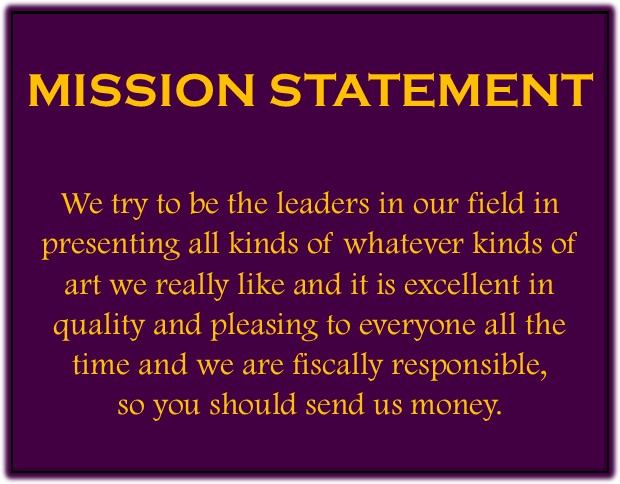
Many arts organizations craft mission statements that promote activities, art, and excellence. Unfortunately, those things are irrelevant.
“[Theater] presents engaging dramatic work that celebrates the intimate relationship among artist, audience and language.”
That’s not a mission statement. No surprise: that theater died.
A mission is the unspeakable acme of a societal obligation. A mission statement expresses that mission, the product of an organizational manifesto, as best it can.
“[Company’s] mission is to create theatre so strikingly original in form, content or both, that it instills in young people an enduring awe, love and respect for the medium, thus preserving imagination and wonder, those hallmarks of childhood which are the keys to the future.”
See the difference? This mission statement discusses the mission’s impact – “preserving imagination and wonder” – as a crucial need. That’s a supportable argument.
Disinterested Advocacy: When Issues Become Global, the Pool for Support Grows Exponentially

Women’s issues are not about women. Race issues are not about people of color.
And when Mars attacks Oklahoma, the issues will not be about Oklahoma.
I visited a domestic abuse nonprofit. They do great work, but are ghettoized by donors as a “women’s issue” charity. The executive director wondered how they might be able to globalize the cause (and increase revenues).
“Domestic abuse is a societal problem,” she complained. “And I worry that without some men providing disinterested advocacy, we’ll only attract women donors.”
But every time she interviewed qualified men for marketing or development positions (and they’d graduate to a final 10-on-1 group interview), the staff and board balked. “Just not a good fit,” they’d euphemize. And they’d recommend another qualified woman.
Is your charity’s issue exclusively yours? If not, how are you communicating that?
Hiring 103: Do Unto Others, for Pete’s Sake!

Oh, those shoddy, “industry standard” hiring practices. They’re still here.
To follow up on this, this, this, this and this,
1) Communicate quickly, at least twice.
- We got your resume.
- Thanks for your interest, but you are not being considered (within a week of close).
2) When you’ve interviewed someone, call them (no email) within a week.
- Thanks for your interest, but you are no longer being considered.
- We’re still interviewing people. I’ll call you on [date range].
3) When you’ve interviewed someone more than once and have hired someone else, call them (no email) immediately.
- Thanks for your interest, but we’ve chosen someone else.
4) Never…
- …send communications stating who you’ve hired (salt, meet wound)
- …let them know they were in the final cut (see above)
- …say you’ll be in touch and then disappear.
- …be rude.
- …assume job-seekers are psychics.
 137 Words