Your Next Charity Leader: “Cool, Aloof, Efficient” or “Passionate, Assertive, Innovative?”

I suppose it’s not a binary choice. But ultimately, they seem to fall in exclusive constellations of attributes.
Few leaders are in both camps. And, depending on the organization’s life-stage, you may need more from one camp than the other.
Pope Benedict vs. Steve Jobs. Neither is perfect, but each offers different personality sets at the helm of your charity.
I prefer to work with those who are in the latter camp. They are invariably afraid of little, impolitic, guileless, insistent, and noisy. But they most often find solutions, tell the truth, and can make things happen.
Not that I don’t like the former group, but I’ve found they hold their cards tight, condescend, rarely make a definitive statement, defer, passively-aggressively ignore, and require others to make things happen.
But they rarely threaten change. So there’s that.
Negatively Commenting on the Title of a Post (What You’re Reading Now) is Akin to PETA Boycotting “To Kill a Mockingbird” Because, You Know, They’re Killing a Mockingbird.
Recently, a foundation advocate negatively commented on the title of a 137 Words blog post. On the title, not the post.
As Ben Franklin once said, “We are all born ignorant, but one must work hard to remain stupid.”
Thank you for reading 137 Words and sharing it with your colleagues. We’re pretty amazed when 137 Words evokes derision, praise, or questions.
If you haven’t shared yet, please do – karma will be kind.
In 6 months, 137 Words has picked up about 6,000 readers. That exceeds all our expectations. We are truly grateful.
And to those like this advocate who only read the title and not the posting (what you’re reading now), I only wish bliss. Or, should I say, additional bliss.
Harsh? Maybe so. Because I am all too often a card-carrying member of the Right to Extreme Stupidity League.
Charity Missions: Are They Relevant, Or Are They Adorable?
Charitable mission statements tell us what the world looks like as the charity succeeds.
When the mission is rendered moot, the charity is superfluous.
Outside the USA, arts nonprofits are suffering due to reductions in government subsidy. In the USA, however, subsidies are almost non-existent, save for the NEA, which supports with pennies, paper clips, and Cheerios from underneath the Congressional Budget couch cushions.
So the US turns to capitalistic support. Survival of the fittest.
I don’t know. Perhaps the NEA now only exists to exist, like the NRA, PTA, PBS, Catholic Church, or the United Way.
Because in a country where the wealthiest 1% own more than the least-wealthiest 90% and where 95% of monetary gains since 2009 went to the wealthiest 1% of the population, could it be that charities are now just quaint relics of a populist past?
Arts Charity Leaders: The Economic Impact Argument Has Become a Losing Proposition…Move On

From ArtsFund, Seattle:
“Together the activity of nonprofit arts organizations [in our region]…generates close to $2 billion in the Central Puget Sound’s economy creating 32,520 jobs, $882 million in labor income and $83 million in taxes.”
From Viking Stadium (new NFL stadium), Minneapolis:
“Construction will support approximately 13,000 jobs…almost $300 million in wages…upon completion, 3,400 full and part-time jobs…the economic activity from a new stadium will generate over $26 million per year in tax revenue and over $145 million in direct spending by Vikings fans inside the State of Minnesota.”
From McDonald’s:
“McDonald’s provides tax revenue for local, state and national governments…$1.3 billion in United States national and state corporate taxes in 2011…McDonald’s spends hundreds of millions upgrading or building new locations.”
Let’s move on to quantifying our outcomes before we bury ourselves with more “economic impact” studies. It’s just not a winning argument for the arts.
The 7 Most Important Things Not to Do About Not Doing the 52 Most Important Things

I write this blog and read many others. I find that people responding to nifty list posts (6 Strategic Ways to Get the Best Board of Directors) are looking for shorthand answers to longhand questions. I understand the appeal; work is complex and speed is valued over thoughtfulness. But the awkward and obvious question is:
“Are there only 6 ways to get the best board? Or are these just the first 6 you thought of?”
Same goes with negative posts (How NOT to Have a Sucky Board of Directors). I’ve been guilty of this, usually after a recent bad experience. Sorry about that, because the obvious and awkward question is:
“There are a kerjillion ways to have a sucky board. Can’t you help me get a good one?”
I’ll try to be a better poster. And here are 137 ways how…
Kibitzing is the Road to Hell for Charitable Organizations: “You know what you SHOULD do…”

Kibitzing. Webster’s definition: “watching other people and making unwanted comments about what they are doing.”
Good intentions (egad). Some people pay for the privilege via their donation or board service. My mother believes it’s her birthright.
For arts charities, kibitzing mainly involves comments, programs, and activities that are unsupported by research or any evidence of success.
Instead: come with solutions rather than problems. Shortfalls are as unintentional as bad art. No one intends red ink or a lousy play with bad acting. But rather than more bake sales, auctions, galas, or (egad) a “give-a-million-dollars-or-we’ll-go-bankrupt-on-Tuesday” campaign; rather than creating a program committee (because anyone can pick plays) or a marketing committee (because anyone can market the arts), work with your ED toward real, verified solutions.
The road to hell is paved with kibitzers. The road to bankruptcy, too.
Successful Trusteeship, or “Isn’t Writing a Big Honking Check Enough?”

Good board members:
- aren’t ambassadors. Ambassadors wait for people to come to them. They’re zealots. They zealously get donations and zealously get new board members.
- don’t try to get. They work together and with staff and they get.
- personally donate among their three largest monetary donations that year. Not from their company…from them.
- are forensic analysts, (not governors). Remember, the bottom line is “Are we living our mission? Is the mission working?” They see to it that it does, regardless of the financials.
- insist that board meetings are too important to be reporting vehicles. Productive monthly board meetings can be like having twelve mini-retreats.
Think of it this way: if each board member’s consulting rate is $100/hour and your charity has 20 board members, do you want to spend $2,000/hour talking about the past or the future?
This Just In: Artists Value Money Just Like You Do

I just read an article in the Chicago Tribune about actors receiving no payment for some performances. I’m not sure why it was written, except as acknowledgment that, well, actors receive no payment for some performances. Even for hit shows.
But why? “We can either pay you guys and not do a show — or not pay you and do a show,” said one producer in the article.
Here’s the thing: there are lots of performers. The competition forces them to undervalue themselves.
But that doesn’t mean that it’s ethical not to pay them. At least minimum wage. For rehearsal and performance time.
If that producer decides not to make money on a project, that’s his prerogative. But no pay to performers is abusive, unless he’s offering 40 acres and a mule after the run of the show.
Nonprofit Strategy: Managing Change is Hard; Managing Stasis is Impossible

I had breakfast with a trustee for an educational organization in a wealthy community within the last five years.
He bemoaned the fact that an über-wealthy benefactor was annually bailing them out with huge sums of money, but the organization was still always crying for cash. And the company refused to upgrade its business practices.
“Why is she bailing them out?” I paraphrased.
“Because it’s her legacy to her kid,” he paraphrased. “And let’s face it, for vanity.”
“And if it folds?”
“She won’t let it.”
“Are they always in a cash crisis?”
“Yes – and not only that, it’s just not serving all that many children.”
“And they can’t change the way they do business?”
“She won’t let them.”
Can’t change. Can’t succeed. Can’t close.
Bad for the organization? Bad for the industry? Bad for the community?
Nonprofit Management Counter-Intuition 2 — “Throwing Out the Baby with the Bathwater” Might Be a Better Risk than Listening to the Sirens

There is a Siren-like fatal lure to “almost there” for some charity leaders.
Let’s say that despite success in other programs, a few of the more ambitious risk-reward programs are flailing. The Sirens entice you to put more time, more effort, more personnel, and more money into the flailing programs.
When you explain to them that by moving time, personal, and financial resources away from the programs that are working into the programs that are not, the company risks the success of the working programs, the Sirens entice you to do it anyway.
Sirens are evil.
Why not take this opportunity to refresh your organization’s ambitions, goals, and programs? The smart move might be to throw all the programs out (at least on paper) and build a new list of activities that support the mission from scratch.
Rethinking the Group Job Interview – Consensus? Abdication? Or Focus Group?
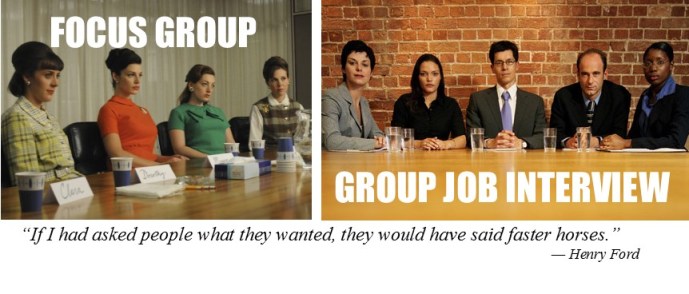
I’ve tortured people in the group interview process. I thought I was offering consensus. Buy-in. Group drive.
I was wrong.
Wrong. Wrong. Wrong.
Oh, so wrong.
To everyone I’ve ever put through that, on either side of the table, I apologize. I’ll never do it again. Promise.
There are four decisions: autocratic (I say), consultative (I say with your input), democratic (we vote, losers weep), consensus (we vote and everyone backs the decision).
As practiced, the group interview might have evolved into a method for managers to abdicate responsibility in the name of consensus. While consensus is ideal, the group-think process can too often be dominated by a crank in the corner with issues, motives, and insecurities. And, possibly, an unknown agenda.
Group-think promises consensus but can preclude innovation.
And why would you ever choose to preclude innovation?
Disinterested Advocacy: When Issues Become Global, the Pool for Support Grows Exponentially

Women’s issues are not about women. Race issues are not about people of color.
And when Mars attacks Oklahoma, the issues will not be about Oklahoma.
I visited a domestic abuse nonprofit. They do great work, but are ghettoized by donors as a “women’s issue” charity. The executive director wondered how they might be able to globalize the cause (and increase revenues).
“Domestic abuse is a societal problem,” she complained. “And I worry that without some men providing disinterested advocacy, we’ll only attract women donors.”
But every time she interviewed qualified men for marketing or development positions (and they’d graduate to a final 10-on-1 group interview), the staff and board balked. “Just not a good fit,” they’d euphemize. And they’d recommend another qualified woman.
Is your charity’s issue exclusively yours? If not, how are you communicating that?
I died this morning.

I was an energetic, charismatic, visionary leader.
I worked at least 60 hours a week.
The office is by turns chaotic and paralyzed.
Some are crying.
Some are ecstatic.
Outside the charity, most don’t care.
Not their problem.
Trustees are panicking. Staff members are traumatized.
Some are taking charge, Alexander Haig-style.
Others are forming committees to decide what to decide.
Still others are composing resignations.
Reporter on line 1.
I knew every board and staff member.
And their families.
I knew every major donor.
I knew local foundation leaders.
Benefactors on line 2.
Beneficiaries on line 3.
I knew financials.
I knew history.
I had passwords.
Vendors on line 4.
I knew where everything was.
I shared that information.
But that was 5 years ago.
To employees who are no longer here.
Too bad there wasn’t a written succession policy.
Not my problem.
Hiring 102: Breaking the Code on Ageism (We’re on to You.)

You don’t have to be Alan Turing to break the HR “can’t-ask-how-old-you-are” code:
“How is your energy level?” = “Are you a geezer?”
…Correct response: “I run 26 marathons daily.”
“What were you doing before 2001?” = “What were you doing before I turned 10?”
…Correct response: “I’m 35 years old with 30 years’ experience.”
“When did you graduate college?” = “I’m checking my arithmetic to determine your age.”
…Correct response: “When I was 22.”
“How flexible are you?” = “Is your mind as ossified as a petrified fossil?”
…Correct response: “I’m currently holding the phone with my pinkie toe while simultaneously writing Iraq’s new constitution.”
Seriously, though, hiring managers: according to the US Bureau of Labor Statistics, workers 45–64 stayed twice as long as those 25–34 — so those under 40 are a much higher risk of leaving you high and dry.
So stop it.
Dream Job…and My Title Would Be Chief Dream Merchant

What I want:
An arts charity that makes my community better.
Value to the community:
Safety. Knowledge. Personal Power. Issue solutions.
Artistic Tools:
Provocation. Entertainment. Populism. Progressiveness. Mischief.
Other Tools:
Educational residencies in both art and topic.
Partners:
Every other charity, educational institution, or NGO with similar values.
Differentiation:
50-50 split on revenues with partners. Partners open their mailing lists to help themselves financially through ticket sales.
Quantifiable outcomes:
The measured outcomes of the partners. Quantity of classes, students, and schools participating.
Non-quantifiable outcomes:
Populist results defeat the arts’ elitist reputation. The needs of the charities are filled.
Initial budget:
Enough so that all artists receive at least $15/hour (in 2014 dollars) and no full-time hourly rate is more than 4x anyone else’s.
Impact:
Arts moves people to action. Thorny issues seen can never be unseen. Life is better.
Sustainability is Neither Reaching for Relevance nor Selling Out. It’s More Important than That.

The art of sustainability in arts charities is akin to performing a balance beam routine on a Ginsu knife. You can sacrifice mission for dollars or dollars for mission, but even if you maintain a perfect balance, there will still be substantial blood on both sides.
We talk way too much about relevance in the arts. The tag in the back of the shirt is relevant for a description of content and washing instructions, but the design of the shirt can reveal personal characteristics of the wearer. Let’s aim higher. How about “integral”?
Integral arts charities are those that are so entwined with other charities that they become essential to the health of the community. “Integral” obviates this useless discussion of relevance and moves us to the more useful question:
How do the arts make communities thrive?
Nonprofit Management Counter-Intuition: Every Now and Then, You Have to Fire Yourself
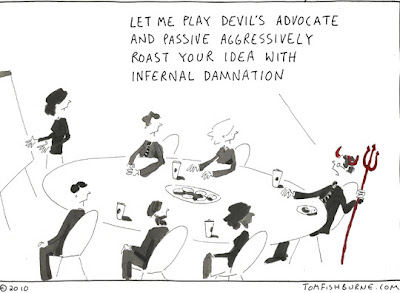 Every now and then, fire yourself. Then interview yourself for your job. Would you get it? What attributes would best suit you for it? (Do you even want it?)
Don’t schedule a meeting for one entire week each quarter. Stop being “too busy.” Find your value as a resource (rather than as a boss).
Take down all the cubicle and office doors. Then, every morning, say hello to each human you see before you walk into your door-free office.
Eliminate devil’s advocacy (unless you’re the Pope). Disagreement without responsibility hinders your organization’s progress.
Teach your staff your job. Let them do it when you’re on vacation.
Take all your vacation days. No contact. Don’t ruin it by doubling your workload upon returning.
Make sure your full-time salary is less than 6x the full-time salary of anyone else.
Stepping in Moral Quicksand: When a Horrible Person/Company Gives to Your Nonprofit

I was going to write about all the charities to which Donald Sterling donated.
I was going to ask if the standards of the organization should stand up against the horror of the donor.
After all, UCLA gave back $3 million of Sterling’s money.
Then I was going to ask about donations from companies that peddle “evil” – tobacco, liquor, oil, etc.
But then I thought about individual donors’ morals. Not just unethical oligarchs like Henry Ford, Rupert Murdoch, John D. MacArthur, or even Sterling. What about all the philanthropists whose fortunes were built on a million broken backs? Or a few? Or one? And I thought about my experiences with morally corrupt donors.
I’m sinking.
Help.
You Gotta Live in the House You Live in

Hypothetical: Strategically speaking, what would your charity do if money were not an issue at all?
The answer to this question is significant. Because if it begins with anything but “we’d do exactly what we’re doing now,” then it’s likely that either you or your mission have to go.
I live in a 1950s house. Typical low ceilings. Small, utilitarian rooms. If I had all the money in the world to renovate it, I’d enhance its 1950s nature, not build 4 additional stories to get a Puget Sound view and in doing so, ruin the house’s charm.
Same with charities, arts or otherwise. You created a mission for a reason…there was a need. A societal wrong to be righted. If you want to accomplish something other than your organization’s mission, go do it.
Just do it somewhere else.
Jack and Jill: Why Smart Nonprofits Search for Interim Leadership

Executive Director Jack resigns.
Jack leads the committee to replace himself. The committee selects Jill.
Jill is not Jack.
Jill discovers too late that she been enlisted to follow Jack’s path rather than set her own.
After a year, not only is Jill unhappy, but trustees and employees resign.
After a second year, Jill resigns. Or is fired.
The reeling company hires Fred – who is neither Jack nor Jill.
Uneasy lies the head that breaks a crown.
Succession planning needn’t require permanence. It might be best to hire an interim leader from outside the organization (not a board member) while the permanent search is carefully executed.
Every organizational leader’s legacy ends the day the leader leaves. Which means it is never a good idea to have the outgoing director have a say on a permanent successor.
Personality, Talent, Intellect, Experience, Spirit, Passion, and the Ability to Inspire. Good Qualities for You but Intimidating as Hell to Insecure Leaders

I have a friend (not me) who is a sensational grant writer. She’s brilliant (Ivy League educated), inspirational (magnetic personality), talented (great references), and people genuinely like her.
She’s also ethical, sensible, positive, quite attractive, and a snappy dresser.
And without a job.
Lately, when she meets with prospective employers, they are impressed by her prowess, references, and samples. Sadly, they don’t hire her. It’s plausible that insecure bosses-to-be fear she is more impressive than they are and look elsewhere.
Look, if you’re in greater Seattle and need a hell of a grant writer for a full-time gig, contact me and I’ll forward your info to her. But if you’re unstable enough just to want someone inferior to you (even if your grants are being denied) because “anyone can write a grant,” then you deserve your results.
Innovation: not just for production managers and marketing directors

I love production managers. The good ones tend to come from a background of experimentation. Using the improv-tested training mantra of “Yes And,” their work ethic promotes wildly thoughtful experimentation.
I love marketing directors, too. Good ones aim for reaction rather than beauty. No fan cares about “Addy” awards. They care about having a personally meaningful experience.
Innovation in arts charities need not be limited to the production manager or marketing director, the two lead staff members dedicated to translating the art to fans.
To innovate, all you need to do is innovate. Which requires…
Identifying the need…
Honor for the ideas of the team…
Synthesizing the data…
10% more time than is available…
500% more patience…
A vision of success…
And the acceptance that, as more than one production manager has famously said, “This could suck.”
Even Endowments Don’t Want You to Have an Endowment

Went to a foundation’s financial conference a few years back. Before the economy went south.
The COO of the foundation said (a direct quote), “If you’re not pulling 20% of your annual budget from your endowment roll-off, then you probably shouldn’t have an endowment.”
And now, the math:
Assuming the annual payment is 5%, your endowment would have to outnumber your annual budget by a ratio of 4-1.
Endowments are not reserve funds. They are not liquid. They have little to do with an organization’s stability. Often, the endowment campaign is successful, but the organization teeters on bankruptcy in vast oceans of red ink.
Endowments do not prove an organization’s worth, nor does it assure its future. Although, I suppose, it does offer a bankrupt organization the chance to pay off its bills before closing for good. So there’s that.
Seen on a sweatshirt while walking around Green Lake: “Change is good. You go first.”

Innovation is annoying. Instigation is even worse. I ought to know. I’ve been accused of both.
But when companies are stagnant (or failing), staying put is not an option.
Innovators and instigators can be difficult. Steve Jobs, Thomas Edison, and Henry Ford are/were not particularly “easy” people. Nor were César Chávez or Copernicus. Nor were many women who broke through glass ceilings.
Too often when things aren’t working, managers paralyze themselves by thinking without forensic analysis. For them, all they believe they need to do is to keep doing what they’re doing.
“We tried change,” they’ll tell you. “It didn’t work. All we have to do is work harder.”
Forensic analysis matters. The great leaders know that and use it to their competitive advantage. They may also consider change agency to be annoying – but also rewarding.
“I Wanna!” The Fatal Game of Power About Nonprofit Arts. Ages infantile and up.
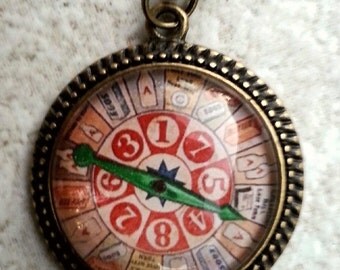
How to play:
Players select their tokens to start play. Each token designates their role in nonprofit art.
Marionette: Performing Artists/Designers
Blob of Clay: Writers/Composers/Visual Artists
Pawn: All technical/administrative/volunteer personnel (one token represents all)
Change Purse: Audience
Louis Vuitton Pocketbook: Donor/Funder
Fake Louis Vuitton Pocketbook: Development Director
Hammer: Trustee
Bent nail: Managing/Executive Director
Telescope looking up: Artistic Director/Curator
Microscope looking down: General Manager/CFO
Bloody leech: Critic/Journalist
Sorry: designated tokens for marketing/pr directors were deleted in the last budget cycle.
All players spin the Great Glass Wheel Of Art simultaneously in all directions and yell, “I Wanna!” The Wheel comes off its bearings; breaks into millions of pieces. Players move tokens anyplace in the room that feels most advantageous, regardless of the playing board or other players.
End of game:
Chaos. All players proclaim victory. None actually win.
 137 Words